Russia and Belarus have released footage they say shows nuclear munitions being moved to field storage points in Belarus during joint exercises, in a further display of nuclear signalling close to NATO’s eastern flank. The claim has not been independently verified.
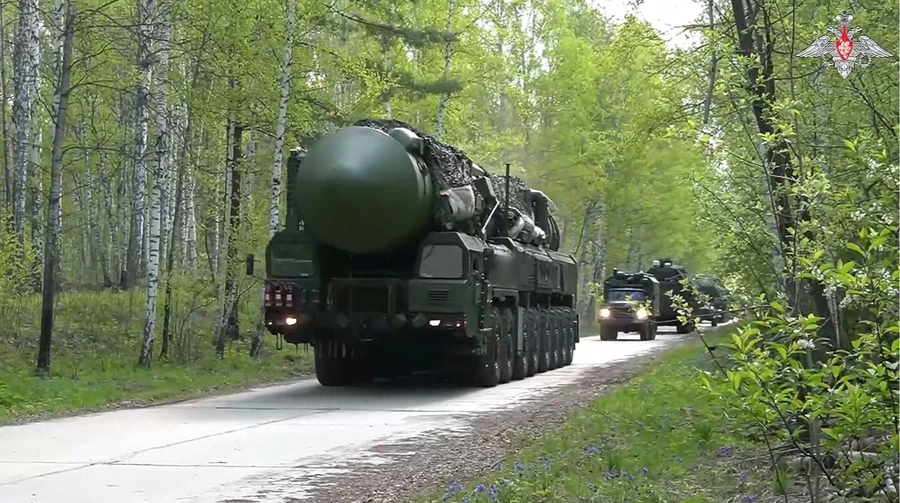
Russia has said that nuclear munitions were delivered to field storage sites in Belarus as part of joint nuclear drills involving Russian and Belarusian forces. Belarusian defence ministry described the footage as showing the “delivery of nuclear munitions” to field storage points in the position area of a missile unit in Belarus, while Russian reporting said an Iskander-M system had been deployed with “special munitions”.
The latest footage, released through Russian and Belarusian official channels, showed military vehicles moving through forested terrain and missile-loading activity. It does not, on its own, independently prove that live nuclear warheads were transported. Exercises of this type may involve training warheads, mock-up equipment or containers designed to simulate operational procedures.
The Belarusian phase forms part of a wider Russian nuclear exercise taking place from 19 to 21 May. The drills involve Russia’s Strategic Missile Forces, the Northern and Pacific Fleets, long-range aviation and missile units operating in Russia and Belarus. The exercise included around 64,000 personnel, more than 200 missile launchers, 140 aircraft, 73 ships and 13 submarines.
Moscow Tests Nuclear Command Readiness in Major Land, Sea and Air Exercise
Belarus announced on 18 May that it had begun training involving Russian nuclear weapons. Minsk said the drills were intended to improve the readiness of personnel and did not threaten regional security. However, the exercise comes against the background of Russia’s deployment of tactical nuclear weapons to Belarus and repeated nuclear messaging by Moscow since the start of its full-scale war against Ukraine.
The Iskander-M system is central to the Belarusian element of the exercise. It is a mobile short-range ballistic missile system capable of carrying either conventional or nuclear warheads. Russia has used Iskander systems in its war against Ukraine, while their deployment in Belarus and Kaliningrad places parts of NATO territory within range. Russian forces also practised bringing units to the highest level of readiness for the use of nuclear weapons, including the movement of warheads to mobile launch systems, according to reporting on the wider exercise.
The military significance lies less in the public video itself than in the procedure it is meant to show. Tactical nuclear weapons are normally stored in specialised, heavily protected facilities, with warheads, delivery systems and other components held separately. Their movement to field storage points, even under exercise conditions, suggests the rehearsal of steps closer to operational deployment than routine storage.
That does not mean Russia is preparing imminent nuclear use. Large-scale nuclear drills are part of military readiness cycles, and publicised exercises can be designed as political signals as much as operational activity. In this case, the signalling purpose is clear. Moscow is demonstrating that Belarusian territory is integrated into its nuclear planning environment and that nuclear-capable systems can be moved, prepared and displayed close to NATO’s eastern border.
The exercise also comes amid heightened tension around the Baltic region. Russia has accused Baltic states of enabling Ukrainian drone operations, a claim NATO countries have rejected. Baltic governments, in turn, have raised concerns about Russian pressure, airspace incidents and hybrid activity. In that context, nuclear exercises in Belarus reinforce Russia’s broader deterrence messaging towards European capitals.
For Belarus, the drills underline the extent of its military dependence on Moscow. Although President Vladimir Putin has said Russia retains control over nuclear weapons deployed in Belarus, Minsk has increasingly presented itself as part of Russia’s nuclear posture. Belarusian President Alexander Lukashenko has previously said his country hosts Russian nuclear weapons and has supported preparations for further Russian nuclear-capable systems on Belarusian territory, including the Oreshnik missile system.
The immediate risk is therefore not only military, but political. By publicising the movement of nuclear-associated equipment, Russia is seeking to ensure that NATO governments consider escalation scenarios when making decisions on support for Ukraine. The message is aimed at Ukraine, at NATO’s eastern members, and at Western governments weighing further military assistance to Kyiv.
For public reporting, the uncertainty should remain central. Russian and Belarusian authorities say nuclear munitions were moved to field storage sites in Belarus during the exercise. The available footage does not independently verify the nature of the munitions. What can be stated with confidence is that Russia is again using nuclear exercises and Belarusian territory to project readiness, pressure European decision-making and reinforce the role of nuclear signalling in its confrontation with the West.