The federal government’s decision to invest €10 billion in a sweeping new civil-defence strategy marks more than a technical update to ageing infrastructure. It reflects a profound psychological shift in Europe’s largest economy: the return of territorial insecurity to the centre of public policy.
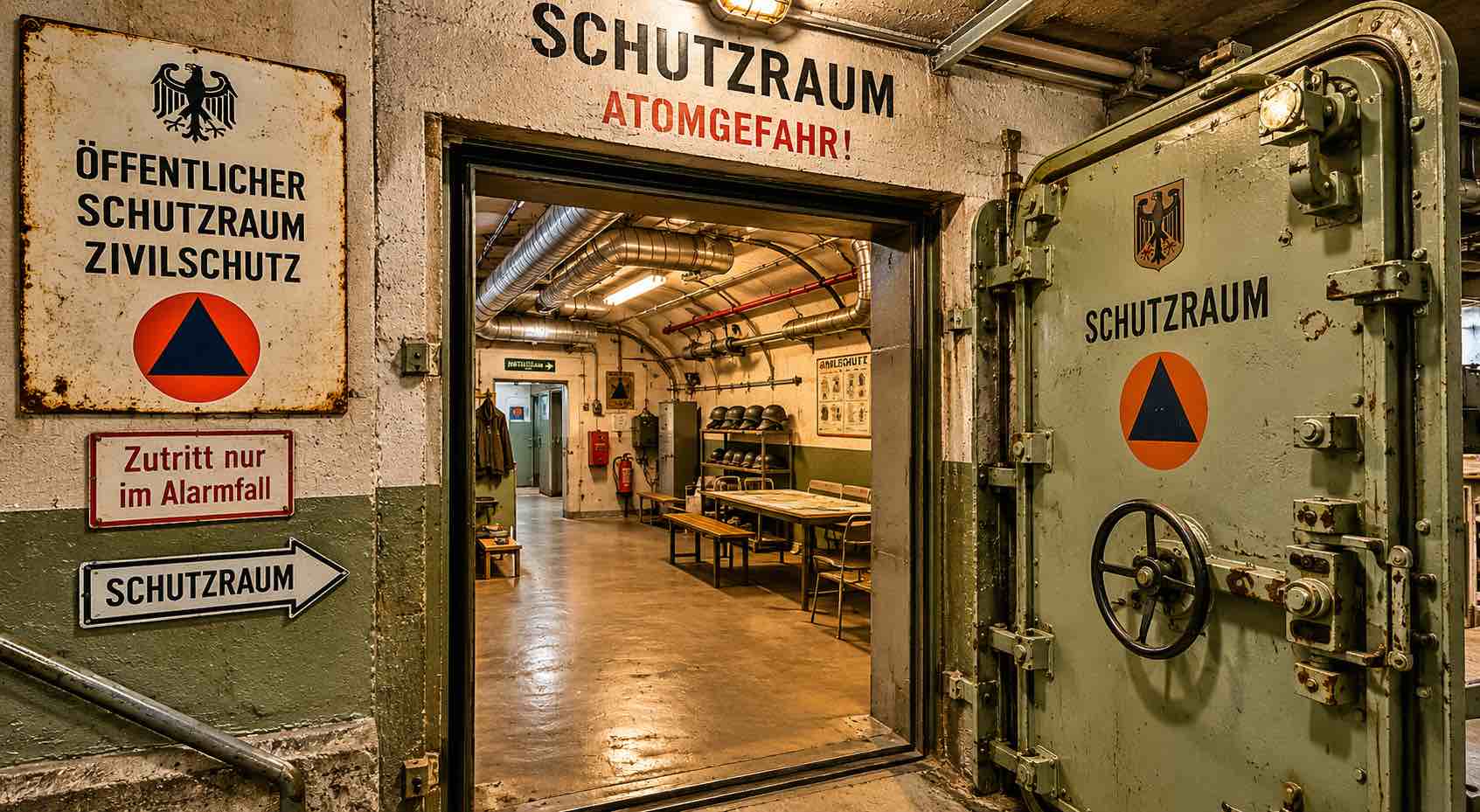
For decades after reunification, Germany treated civil defence as an embarrassing relic of Cold War paranoia. Vast underground bunkers built to withstand nuclear attack were mothballed, neglected or converted into museums. The assumption underpinning the post-1990 German state was simple enough: large-scale war in Europe had become unthinkable.
Russia’s invasion of Ukraine shattered that illusion.
The government approved a new Civil Defence Plan this week that abandons the old model of purpose-built atomic shelters in favour of something more pragmatic — and arguably more realistic. Underground car parks, metro stations, tunnels and public basements will now form the backbone of Germany’s emergency protection network.
The symbolism matters. Germany is not preparing for a Hollywood-style nuclear apocalypse. It is preparing for disruption: missile strikes, cyber attacks, infrastructure sabotage and the kind of prolonged societal strain visible daily in Ukraine.
Interior Minister Alexander Dobrindt was unusually blunt in dismissing the old Cold War approach, describing it as a concept from the 1980s “which has never worked”. His point was less historical criticism than strategic realism. Modern threats arrive faster, strike civilian infrastructure directly and demand rapid decentralised responses rather than heavily fortified command centres.
The figures alone reveal how ill-prepared Germany had become. According to government data, the country currently possesses just 579 operational shelters with space for roughly 480,000 people — scarcely enough for 1 per cent of the population. Many have not been used since the Cold War.
In another era such numbers might have seemed academic. Today they are politically combustible.
Across Europe, governments are rediscovering the awkward truth that national resilience cannot be improvised once a crisis begins. Finland, long regarded by southern European policymakers as excessively security-minded, suddenly looks prescient rather than paranoid. Helsinki maintains more than 50,000 shelters, many integrated seamlessly into everyday urban life as sports centres, car parks and community facilities.
German officials appear to have taken careful note.
The new strategy borrows heavily from Ukrainian wartime experience. Defence Minister Boris Pistorius highlighted the importance of rapid-warning systems and public accessibility, pointing to apps used in Ukraine that alert civilians to incoming attacks and direct them towards shelter. Germany intends to upgrade its national alert network alongside purchases of more than 1,000 specialist vehicles and protective equipment.
The broader political significance, however, lies in what this says about Germany’s changing role in Europe.
For much of the post-war era, Berlin defined security primarily through economics. Trade integration, fiscal discipline and industrial interdependence were viewed as guarantors of peace. Military hard power remained politically uncomfortable, constrained by historical memory and public scepticism.
That consensus is dissolving.
Since 2022 Germany has embarked upon the most significant defence reorientation in its modern history. Military spending has risen sharply, constitutional debt restrictions have been loosened for security purposes, and policymakers increasingly speak the language of deterrence rather than merely diplomacy.
Civil defence is becoming part of that transformation.
The logic extends beyond Russia alone. European governments increasingly fear hybrid warfare: cyber disruption, attacks on energy grids, sabotage of telecommunications infrastructure and coordinated disinformation campaigns designed to create panic and institutional paralysis. Traditional military spending addresses only part of that challenge.
Resilient societies matter as much as resilient armies.
There is also a deeper cultural adjustment underway. The post-Cold War European model encouraged governments to minimise visible discussions of conflict preparedness for fear of alarming voters. Today the opposite is happening. Public resilience is being normalised as a civic responsibility.
In Germany, that shift carries particular weight because the country spent decades dismantling many of the institutional habits associated with national emergency planning. Even the enormous West German government bunker near Bonn — once designed to preserve constitutional government during nuclear war — was largely abandoned after reunification and later transformed into a museum piece.
Now, some of the assumptions that led to its closure no longer look entirely secure.
Critics will inevitably question the cost. Germany’s economy remains fragile, industrial growth is weak and political pressure over public spending continues to intensify. Yet Berlin appears to have concluded that resilience spending is no longer optional insurance but part of the core architecture of statehood.
That conclusion is spreading across Europe.
The uncomfortable reality exposed by Ukraine is that advanced societies remain vulnerable in surprisingly analogue ways. Electricity grids fail. Transport networks collapse. Civilians require shelter. Governments need functioning communications systems under pressure.
For years such concerns were treated as the obsessions of defence planners and Cold War nostalgists. They have now re-entered mainstream politics.
Germany’s shelter plan therefore represents something larger than infrastructure policy. It is evidence that Europe’s economic powerhouse is mentally adapting to a harsher age — one in which peace can no longer be assumed, only managed.
And perhaps the most striking feature of all is how quickly the political vocabulary has changed. Only a few years ago, discussion of bomb shelters in Germany would have sounded faintly absurd.
Today it sounds prudent.