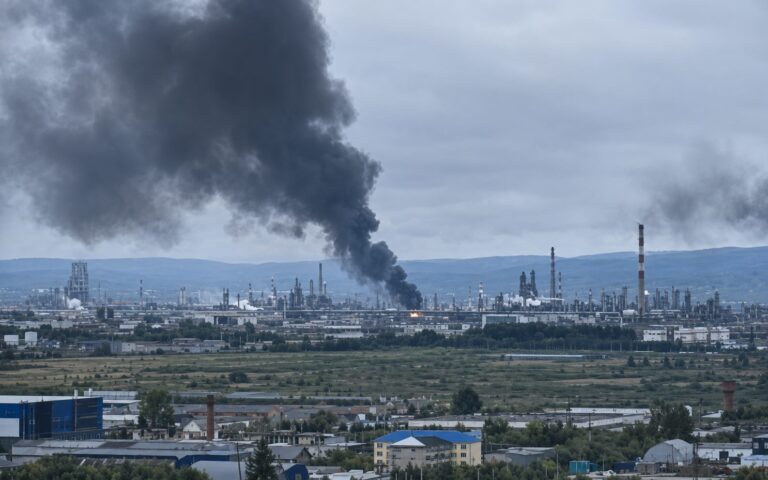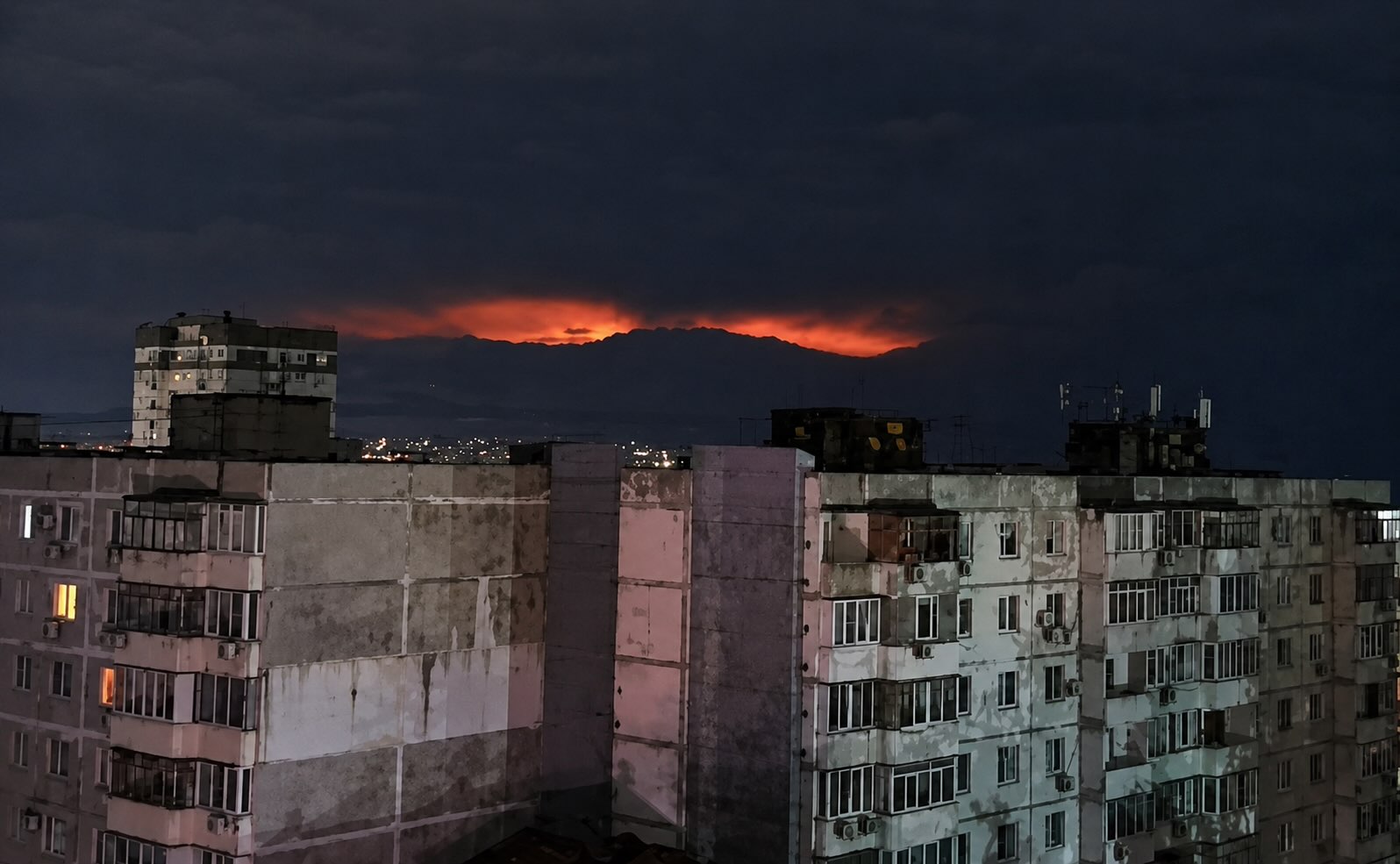
A fire at oil infrastructure in Novorossiysk on Saturday, May 23, has placed renewed focus on Ukraine’s expanding long-range campaign against Russia’s energy system, particularly the facilities that support crude exports through the Black Sea. Russian regional authorities said falling drone debris triggered a fire at an oil terminal in the port city, while several technical and administrative buildings also caught fire. The incident was reported by Reuters, which cited officials in Russia’s southern Krasnodar region.
The strike is significant because Novorossiysk is among Russia’s most important oil export outlets on the Black Sea. The affected infrastructure forms part of a broader storage, pumping and loading network serving exports through the port, including facilities in the Grushovaya area and the Sheskharis terminal. Such storage sites function as buffer points, holding crude or oil products before they are transferred onward for tanker loading. However, the full extent of the fire, the damage to individual tanks, and any operational disruption have not yet been independently confirmed.
Open-source reporting pointed to the Grushovaya Balka oil depot as one likely site affected by the attack, while smoke was also reported near the Sheskharis oil loading terminal. Meduza, citing Russian regional authorities and OSINT analysis by Astra, reported that the fire began at Grushovaya Balka and that smoke was seen rising from the Sheskharis area, around 12 kilometres away.
Russia’s Defence Ministry said its air defences intercepted 348 Ukrainian drones overnight across several regions, Crimea, and the Black and Azov Sea areas. That figure, if accurate, would point to one of the larger Ukrainian drone waves of recent months. Russian interception claims cannot be independently verified, but the reported damage in Novorossiysk suggests that at least some drones or debris reached sensitive energy infrastructure. The scale of the overnight attack was also reported by Russian regional media, citing official statements.
The incident follows a series of Ukrainian attacks on Russian refineries and oil facilities in May. Reuters reported this week that Ukrainian drone strikes had forced several major refineries in central Russia to halt or reduce production, affecting facilities that account for a substantial share of Russia’s petrol and diesel output. Separately, Ukraine said it had struck the Syzran refinery in the Samara region, more than 800 kilometres from the Ukrainian border.
President Volodymyr Zelenskyy has described such strikes as “long-range sanctions” against Russia’s oil sector. The phrase reflects Kyiv’s argument that energy infrastructure linked to Russia’s war economy is a legitimate target because oil revenues and fuel supplies support Moscow’s military campaign. After Ukraine struck targets associated with the Yaroslavl oil refinery, Zelenskyy said the facility was about 700 kilometres from Ukrainian territory.
For Russia, Novorossiysk carries particular importance because it connects production, storage, pipeline flows and tanker loading. Disruption at a refinery can reduce fuel output; disruption at an export terminal can affect revenue flows more directly. A previous attack on the Sheskharis terminal in April led to the suspension of crude loading, underlining the vulnerability of the Black Sea export chain.
Ukraine’s Drone Campaign Puts Renewed Pressure on Russia’s Oil Infrastructure
The practical effect of Saturday’s fire will depend on the extent of damage to tanks, loading systems, pumping equipment and associated infrastructure. Initial reports do not establish whether the attack caused a temporary fire, a partial operational disruption, or more serious damage to the export system. Repeated strikes against storage, pipeline and terminal infrastructure could gradually degrade Russia’s ability to ship oil through the Black Sea, but that assessment remains dependent on further confirmation from satellite imagery, shipping data and official or industry reporting.
The attack also highlights a broader defensive problem for Moscow. Russia must protect refineries, depots, ports, pipelines, military airfields and command facilities across a large territory. Ukraine’s use of relatively low-cost long-range drones forces Russian air defences to cover multiple possible targets, while Kyiv can vary the timing and direction of attacks. Even when drones are intercepted, falling debris can still cause fires at industrial sites.
The economic impact should not be overstated without detailed damage assessments. Russia remains a major oil producer and has repeatedly restored damaged energy infrastructure after previous strikes. However, repeated attacks can impose cumulative costs: repairs, production stoppages, insurance complications, logistical rerouting and greater pressure on domestic fuel supplies during periods of high demand.
Saturday’s incident therefore appears less as an isolated strike than as part of a sustained campaign. By targeting the infrastructure that stores, processes and exports Russian oil, Ukraine is seeking to raise the cost of Moscow’s war while reducing the reliability of one of its main revenue systems.