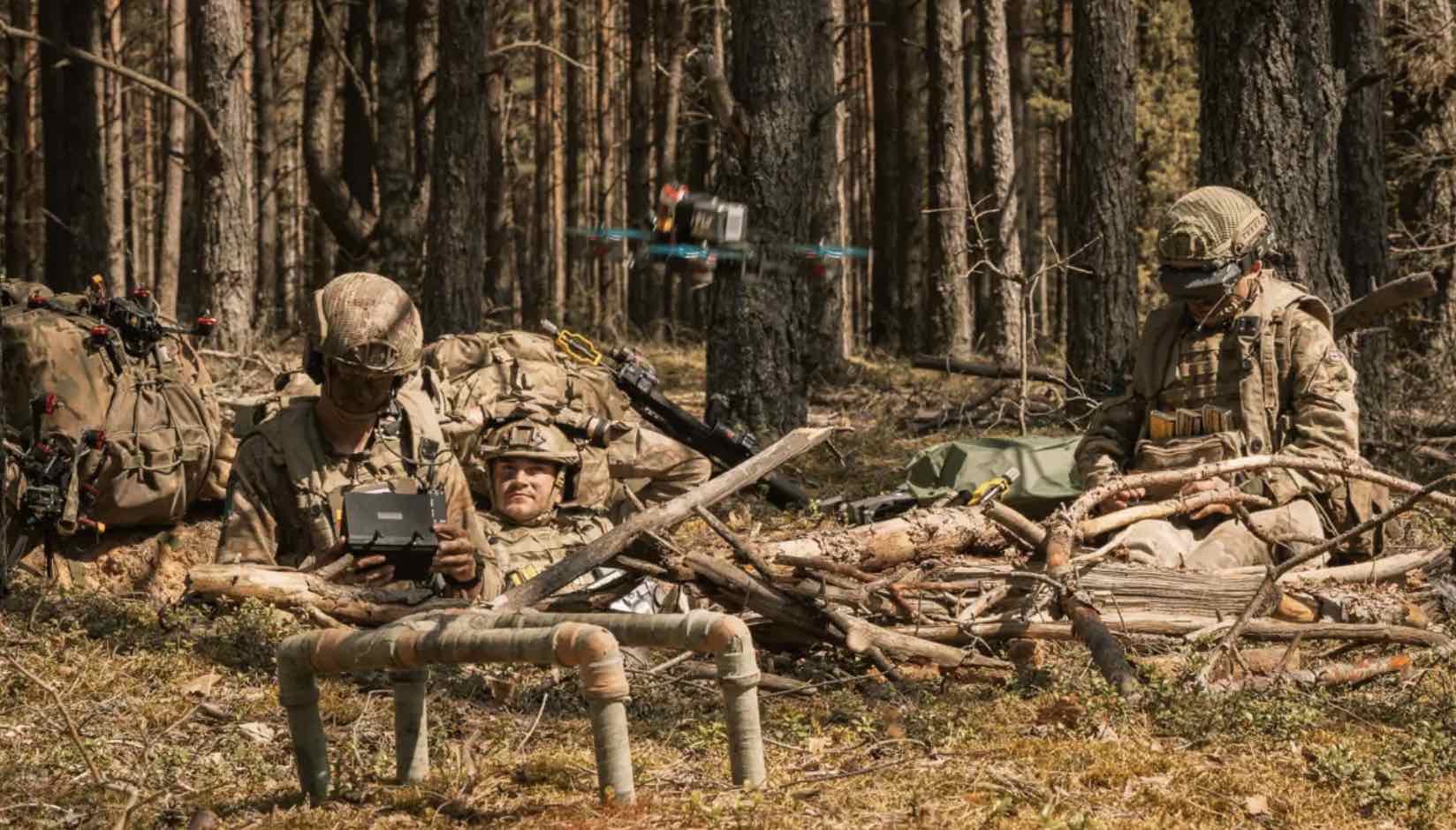
That reality was on stark display this week as British paratroopers tested a new generation of counter-drone tactics and equipment designed to confront what soldiers now describe as a constant aerial menace.
The exercises, carried out by troops from Britain’s airborne forces, reflected a profound shift in military thinking. For decades, elite infantry units trained to evade artillery, machine-gun fire and armoured assaults. Today, they must also prepare for cheap commercial drones capable of spotting troop positions, directing artillery fire or delivering explosives with chilling precision.
The Ministry of Defence said paratroopers had been experimenting with methods ranging from drone detection to physical interception and electronic disruption. What was once regarded as specialist work for air-defence units is rapidly becoming part of the ordinary infantryman’s battlefield skillset.
The war in Ukraine has accelerated that transformation. Military officials across NATO have watched as drones costing a few hundred pounds have destroyed tanks worth millions. Soldiers on both sides now live under near-constant surveillance from quadcopters hovering overhead, while first-person-view attack drones have rewritten the economics of battlefield lethality.
British commanders appear determined not to be caught unprepared.
Recent trials involving 16 Air Assault Brigade have focused heavily on adapting airborne troops for this new environment. British soldiers have already been equipped with advanced computerised rifle sights capable of tracking and engaging drones in flight, technology once considered futuristic but now viewed as urgently necessary.
The new emphasis is not simply about shooting drones down. It is about surviving in a battlespace where concealment has become vastly more difficult and reaction times far shorter.
Senior defence figures privately admit that the lessons emerging from Ukraine have unsettled NATO militaries. Traditional assumptions about manoeuvre warfare are being challenged by swarms of inexpensive unmanned systems capable of overwhelming even sophisticated defences.
That anxiety is increasingly visible in Britain’s defence posture.
In recent months the British Army has accelerated multiple drone and counter-drone programmes. Project NYX, one of the Ministry of Defence’s flagship initiatives, aims to develop autonomous “loyal wingman” drones that will operate alongside Apache attack helicopters. Elsewhere, British forces have tested drone swarms capable of coordinating attacks autonomously in large-scale exercises modelled on potential conflict with Russia.
The shift reflects a broader recognition that future conflicts may be dominated not by vast armoured formations, but by networks of sensors, autonomous systems and electronic warfare.
For Britain’s paratroopers, however, the implications are intensely personal.
Airborne infantry traditionally rely on speed, surprise and aggressive manoeuvre. Yet drones threaten to strip away exactly those advantages. A concealed unit can now be exposed within minutes by a small commercial quadcopter flying overhead. Once detected, artillery or loitering munitions can arrive with devastating speed.
The British Army’s response is increasingly layered. Troops are being trained not merely to hide from drones but to hunt them. Electronic warfare systems designed to jam signals or seize control of hostile drones are being integrated alongside kinetic solutions capable of physically destroying aerial threats.
Military officials also recognise that drone warfare is evolving at extraordinary speed. Swarming technologies, artificial intelligence and autonomous targeting systems are developing far faster than conventional procurement cycles can comfortably handle.
The concern in Whitehall is not theoretical. British bases in Cyprus have already faced drone threats during recent Middle Eastern tensions, underscoring how rapidly these technologies are proliferating beyond conventional battlefields.
What makes the threat particularly alarming is its accessibility. Many of the drones now causing havoc in conflict zones are adapted from commercially available platforms. They are cheap, plentiful and increasingly difficult to counter economically. A missile worth hundreds of thousands of pounds may be required to destroy a drone costing a few hundred.
That imbalance is forcing armies across the West to rethink military doctrine at speed.
For Britain’s airborne troops, the message is brutally clear: the skies can no longer be assumed safe, even at low altitude. The battlefield overhead has become crowded, contested and lethal.
The age of the drone infantry war has arrived. Britain’s paratroopers are learning that survival may depend as much on looking upward as looking ahead.