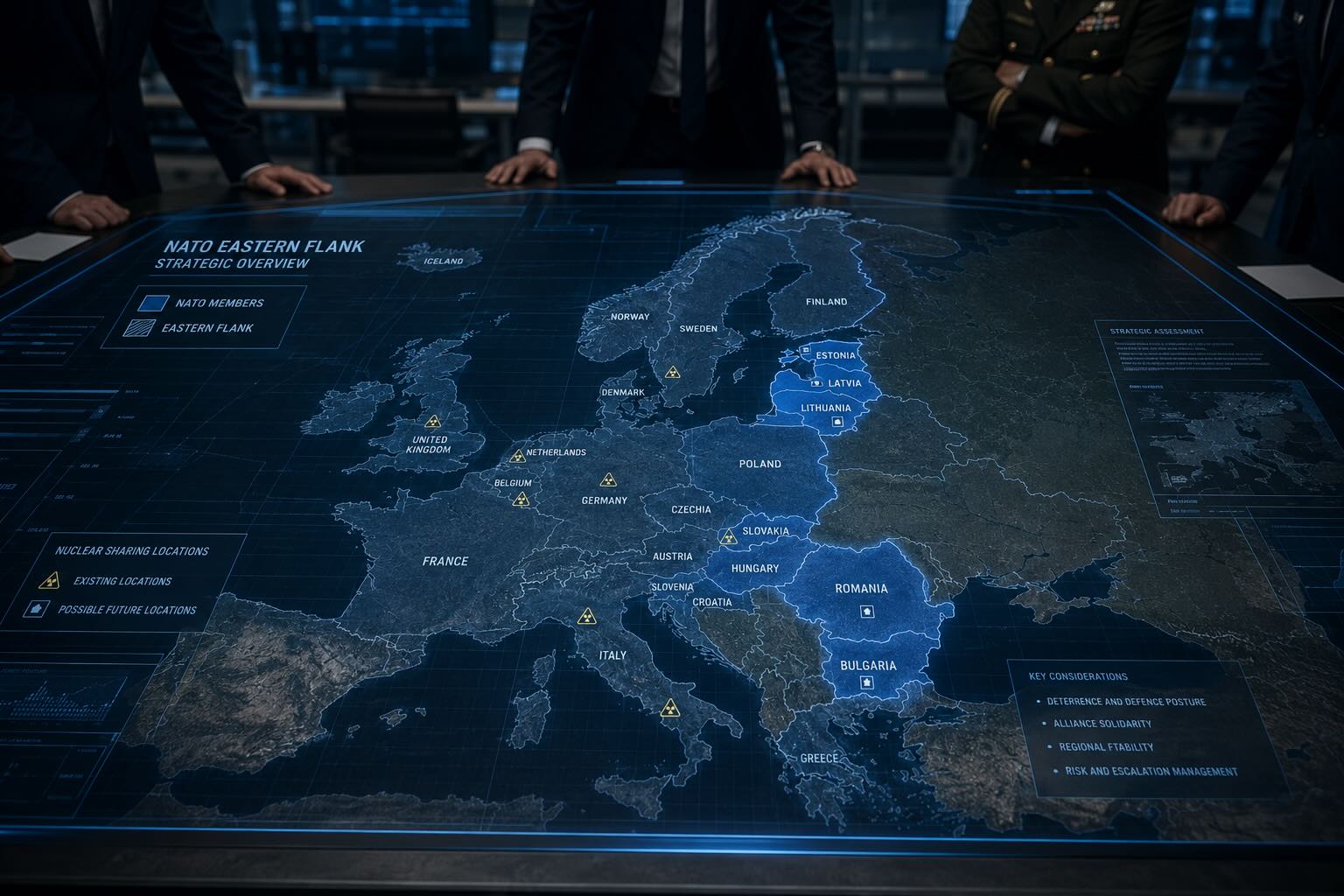
According to a Reuters report citing the Financial Times, US officials have signalled openness to deployments beyond the existing six European countries that host nuclear-capable aircraft. The discussions are said to include possible arrangements involving dual-capable aircraft, which can be used for conventional or nuclear missions.
Reuters said it could not immediately verify the report, and that the White House, the US Department of Defense and NATO had not responded to requests for comment. That caveat is important. No formal decision has been announced, and any expansion of nuclear-sharing arrangements would require extensive political, legal, military and domestic consideration by potential host countries.
Even so, the fact that such discussions are being reported is significant. It suggests that NATO’s nuclear posture is no longer being treated as a settled Cold War inheritance, but as a live question linked to Russia’s war against Ukraine, eastern-flank security concerns and uncertainty over the future balance between American and European defence responsibilities.
NATO’s existing nuclear-sharing arrangements are designed to distribute the political responsibility and operational burden of deterrence across the alliance. According to NATO’s own explanation of nuclear deterrence, the alliance’s nuclear posture rests on the strategic forces of the United States, the United Kingdom and France, as well as US nuclear weapons deployed in Europe and supporting capabilities provided by allies.
The United States remains the central actor. NATO describes US strategic forces as the supreme guarantee of alliance security, while British and French nuclear forces contribute to overall deterrence. Under nuclear-sharing arrangements, European allies provide aircraft, infrastructure and participation in planning, while the weapons remain under US custody and control unless a decision were taken at the highest political level.
The discussion of possible expansion comes at a time when several eastern-flank allies have pressed for stronger reassurance. Poland has previously expressed interest in joining NATO’s nuclear-sharing framework, arguing that Russia’s deployment of nuclear weapons in Belarus and its wider military posture have altered the regional security environment. The Baltic states, while geographically exposed, would face additional practical and political constraints in any nuclear-hosting scenario.
The issue is not only military. Any move to station nuclear weapons further east would be read in Moscow, Brussels and Washington as a strategic signal. Supporters would argue that it strengthens deterrence by making clear that NATO’s eastern members are covered by the same visible nuclear guarantees as western allies. Critics would warn that it could increase escalation risks and provide Russia with a pretext for additional deployments or rhetoric.
The reported talks also highlight a broader shift in transatlantic defence. Washington has repeatedly pressed European allies to take on more conventional defence responsibility. That pressure has intensified as the United States balances European security commitments with demands in the Indo-Pacific and the Middle East. In that context, an expanded nuclear posture could be interpreted as a way of maintaining the most sensitive part of the American security guarantee while expecting Europe to carry a larger share of the conventional burden.
This distinction matters. Nuclear weapons are not a substitute for air defence, ammunition stocks, armoured formations, logistics, drones, cyber resilience or deployable forces. They are intended to deter existential threats, not to solve Europe’s day-to-day capability shortfalls. If the US nuclear umbrella remains in place but conventional US forces in Europe are reduced, European allies would still face the practical task of rebuilding military capacity after years of underinvestment.
France has also sought to place its own nuclear deterrent within a wider European debate. In May, Norway said it would join French-led discussions on nuclear deterrence, while stressing that no nuclear weapons would be stationed on Norwegian soil in peacetime. According to Reuters, the move reflected a wider European reassessment of deterrence at a time of concern over Russia and uncertainty about long-term US commitments.
For NATO, the immediate challenge is to prevent reassurance from becoming fragmentation. The alliance must maintain a common nuclear policy while accommodating different national threat perceptions. Allies closest to Russia are likely to favour stronger visible guarantees. Others may fear that new deployments would carry domestic political costs or weaken arms-control arguments.
The reported US discussions should therefore be understood as part of a larger deterrence debate rather than a narrow basing issue. Europe is asking whether the current mix of US nuclear protection, British and French deterrents, NATO conventional forces and national military capabilities remains adequate for the security environment created by Russia’s war.
No decision has yet been confirmed. But the debate itself shows how far European security has moved from the assumptions that shaped the post-Cold War period. Nuclear deterrence is again becoming a practical policy question for NATO, not simply a strategic doctrine kept in reserve.