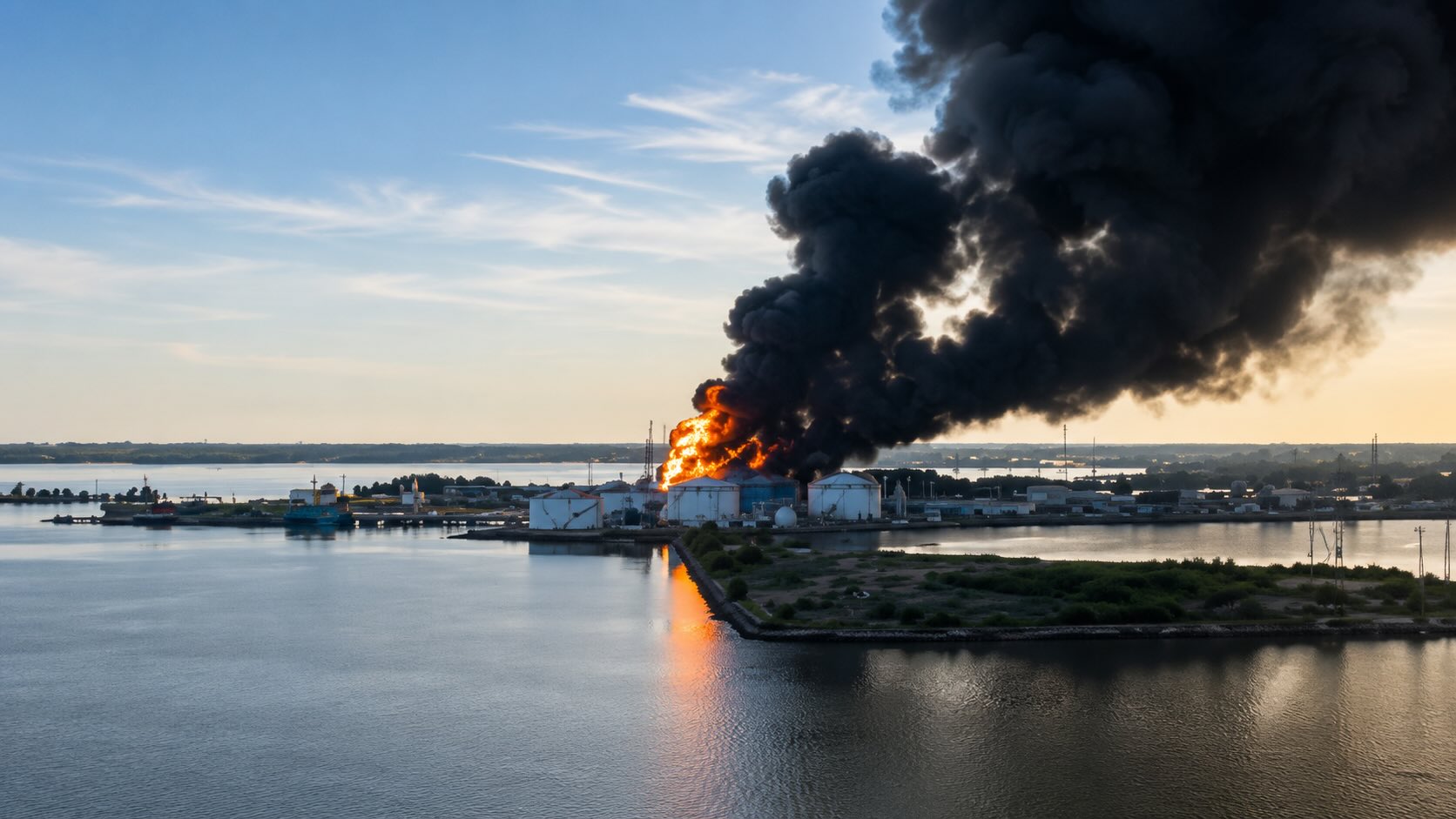
President Volodymyr Zelenskyy said Ukrainian forces had struck the terminal, around 1,100 kilometres from Ukraine’s border, as well as targets at Kronstadt and a weapons-production facility in Russia’s Tambov region.
The reported attack is significant not only because of the distance involved, but because of the type and location of the targets. St Petersburg is Russia’s second city and a major political and economic centre. Kronstadt, on Kotlin Island in the Gulf of Finland, has long been associated with Russia’s Baltic Fleet. Tambov lies much further south-east, indicating that the overnight operation covered multiple regions and target categories.
Russian authorities also reported drone activity around the Leningrad region as the St Petersburg International Economic Forum opened. According to a separate Reuters report, regional officials said air defences had intercepted drones, while operations at Pulkovo Airport were temporarily disrupted. Russian officials reported damage to infrastructure, though the full scale of the damage has not been independently verified.
Ukraine has increasingly used long-range drones to strike Russian energy, logistics and military-industrial targets far from the front line. The purpose is both military and economic: to degrade infrastructure that supports Russia’s war effort and to impose costs inside Russian territory. Kyiv has repeatedly described such attacks as part of its effort to reduce Moscow’s capacity to sustain the war.
Energy infrastructure has become a central target set. In recent months, Ukrainian strikes have hit or been reported against refineries, oil terminals, depots and pipelines across Russia. Reuters has documented a series of attacks on Russian energy sites, including facilities in Yaroslavl, Saratov, Novorossiysk, Primorsk and other locations. The pattern suggests a sustained campaign rather than isolated retaliatory action.
The St Petersburg Oil Terminal strike fits into that broader approach. Oil and petroleum logistics remain central to Russia’s export revenue, domestic fuel supply and military transport system. Even when individual strikes do not cause long-term shutdowns, repeated attacks can force Russia to disperse air defences, repair damaged infrastructure, reroute supplies and absorb higher security costs.
The geographic reach is also important. A strike near St Petersburg, more than 1,000 kilometres from Ukraine, demonstrates that Russia’s rear areas are no longer protected by distance alone. Moscow has invested heavily in layered air defence, but Ukraine’s ability to send drones deep into Russian territory has created a persistent problem for Russian planners. Defending every refinery, depot, port, airfield and industrial site across such a large territory is difficult, especially when the front line and occupied territories also require protection.
The timing adds another dimension. The reported attacks came as the St Petersburg International Economic Forum was opening, an event used by the Kremlin to project economic resilience and international engagement despite Western sanctions and the continuing war. Ukraine’s strike, if assessed primarily through military effect, targeted energy and military-related infrastructure. Politically, however, it also underlined the vulnerability of a city closely associated with President Vladimir Putin.
There is no evidence that Ukraine has shifted away from its stated emphasis on military and war-supporting infrastructure. Zelenskyy said the strikes targeted facilities connected to Russia’s war machine. Russia, for its part, has characterised Ukrainian drone attacks as terrorism, while continuing large-scale missile and drone strikes against Ukrainian cities and infrastructure. On 2 June Russian attacks had killed civilians in Ukraine and hit several regions.
Russia’s Mass Strike on Ukraine Renews Questions Over NATO Border Air Defence
For European security planners, the St Petersburg strike carries three implications. First, Ukraine’s long-range strike capacity is becoming more operationally mature. It can now threaten targets at strategic depth, not only border-region assets. Secondly, Russia’s energy infrastructure remains exposed despite air-defence coverage. Thirdly, the war’s economic geography is widening, with oil facilities, ports and industrial plants increasingly part of the operational map.
The campaign also raises questions for Europe’s sanctions and energy-security policy. Ukrainian strikes and Western sanctions are separate instruments, but both aim to constrain the resources available to the Russian state. If physical disruption to energy infrastructure increases, Moscow may face additional pressure alongside price caps, export restrictions and financial sanctions. At the same time, any significant disruption in Russian fuel or oil logistics can affect markets, shipping patterns and insurance calculations.
Russia has used missiles and drones to attack Ukrainian cities from safe distance throughout the war. Ukraine’s expanding strike reach is now forcing Moscow to manage risk across a much larger area of its own territory. The St Petersburg operation does not change the war by itself. It does, however, show that the geography of vulnerability is continuing to move deeper into Russia.