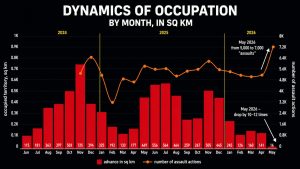
According to DeepState, Russian forces carried out more than 7,000 assault actions in May, an increase of 37.5 per cent compared with April. Yet the same monitoring data indicated that Russia captured only around 14 square kilometres of Ukrainian territory over the month. For a campaign still formally directed towards the seizure of the remaining Ukrainian-held parts of Donetsk and Luhansk regions, the ratio is significant.
The pattern suggests that Russia is not reducing pressure. It is increasing it. The question is whether that pressure is still converting into operational progress. The May figures suggest that it is doing so with sharply declining efficiency.
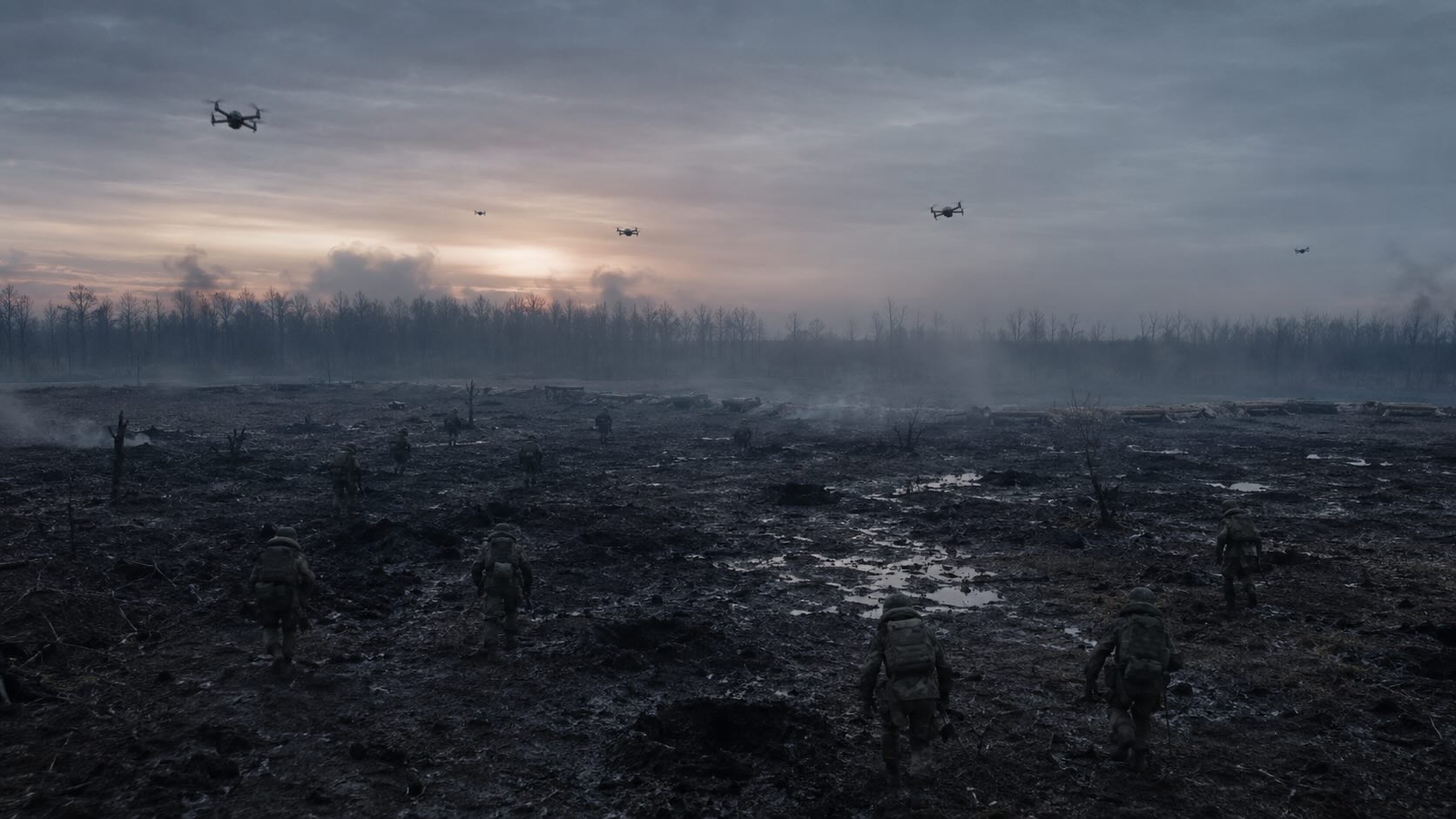
The Russian military has relied throughout the war on attritional assaults, often using small infantry groups to probe Ukrainian positions, draw fire, identify weak points, or force Ukrainian units to spend ammunition and drone assets. This method has allowed Moscow to maintain constant pressure even where mechanised manoeuvre has become difficult. It has also imposed a high casualty burden on Russian formations.
What appears to have changed in May is the return on that expenditure. A higher number of assault actions did not produce a corresponding increase in captured ground. On the contrary, the territorial result fell to one of the lowest levels recorded in recent months. This does not mean the front is static everywhere. It does mean that Russia’s current method is becoming more expensive in relation to the gains achieved.
There are several possible explanations. Ukrainian drone coverage has improved across much of the front, making it harder for Russian assault groups to cross open ground. Small Russian infantry teams, sometimes reduced to pairs or individual soldiers, are more easily detected and engaged before reaching Ukrainian positions. Minefields, artillery, first-person-view drones, loitering munitions and rapid surveillance loops have increased the lethality of exposed movement.
The result is a battlefield in which Russia can still generate attacks, but cannot easily convert them into breakthroughs. This distinction matters. A military can maintain activity for political purposes while failing to change the operational situation. In Moscow’s case, the pressure to demonstrate progress remains high, particularly if the Kremlin continues to present the capture of the Donbas as a central war aim.
That creates a manpower problem. If assault intensity rises while territorial gains fall, Russian commanders require more men for diminishing returns. Contract recruitment has helped Russia avoid a second declared mobilisation since 2022, but it has not removed the structural demand for infantry replacements. The more Moscow relies on repeated assaults, the more the question of mobilisation returns.
A new mobilisation would carry political and practical costs. It would probably fall more heavily on social groups that the Kremlin has so far tried not to antagonise directly. It would also not produce immediate battlefield results. Men called up in the autumn would need to be processed, equipped, assigned and trained. Even with abbreviated training cycles, they would be unlikely to alter the situation before the end of the year.
For that reason, mobilisation would be less a solution to Russia’s immediate operational problem than an attempt to sustain the war into its next phase. It would indicate that Moscow still believes it can overcome Ukrainian resistance through mass, even as battlefield evidence points to falling efficiency.
Ukraine’s challenge is different. Its defensive success depends not only on holding positions, but on maintaining the systems that make Russian assaults costly: drones, sensors, electronic warfare, artillery ammunition, air defence and decentralised weapons production. This explains why Russia is increasingly focused on Ukrainian defence industry targets.
President Volodymyr Zelenskyy has said that Russian military, political and propaganda structures are identifying Ukrainian companies involved in missile technology as future targets. That assessment is consistent with the wider pattern of the war. As Ukraine develops longer-range strike systems and works with partners on anti-ballistic capabilities, Russia has an incentive to disrupt production, intimidate specialists and strike industrial sites.
Ukraine has tried to reduce this vulnerability by dispersing production. Unlike large centralised facilities, decentralised networks are harder to disable with a single strike. If one site is damaged, output can be shifted or compensated elsewhere. This model does not remove the threat, but it complicates Russia’s targeting problem.
The May data therefore points to two connected trends. On the ground, Russia is committing more assault effort for less territorial gain. Away from the front, Moscow is trying to target the Ukrainian capabilities that help produce that result. The war is becoming a contest not only of territory, but of production systems, manpower reserves and the ability to absorb losses.
For Russia, the arithmetic is becoming less favourable. More attacks are not yet producing more progress. For Ukraine, the task is to preserve the conditions that have made that equation possible.