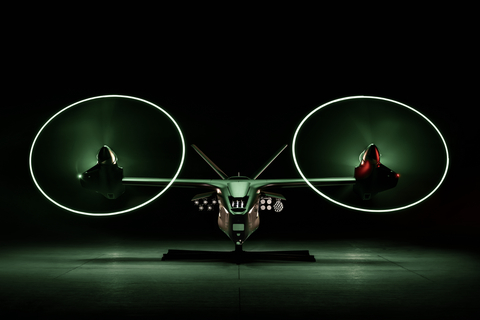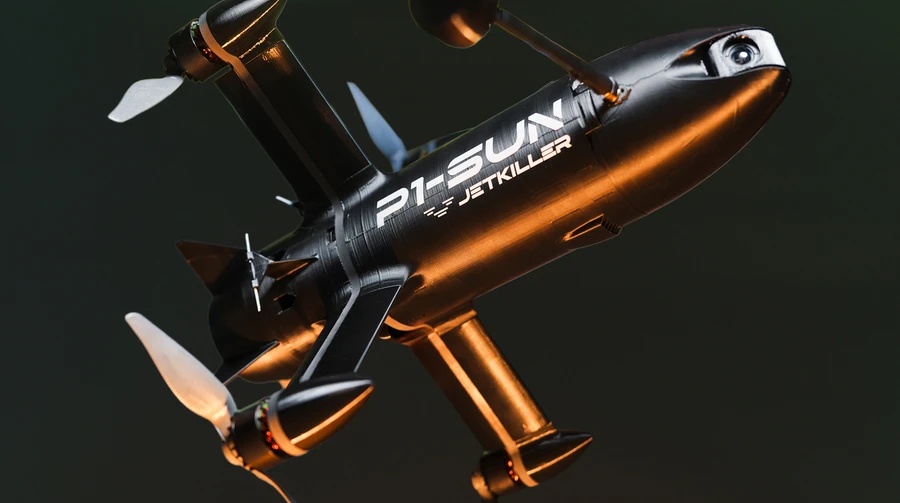
Ukrainian drone manufacturer SkyFall has displayed a faster P1-SUN Jetkiller interceptor at Farnborough as Russia deploys more jet-powered Shahed attack drones. The development, reported by Reuters, is more than another product reveal. It exposes an acceleration contest inside Ukraine’s air-defence system: low-cost interceptors must become faster, while missiles remain too expensive for routine use against mass drone attacks.
SkyFall says the Jetkiller version can reach 370km/h, compared with 310km/h for its earlier P1-SUN interceptor. Reuters reported that the company said it had already tested the system in combat and planned mass production from August, although those battlefield claims could not be independently verified. The same report noted that General Cherry is working on a faster version of its Bullet interceptor, aiming beyond 400km/h and potentially towards 500km/h.
The reason is straightforward. Russia’s Shahed family, known in Russian service as Geran, is no longer a single slow propeller-driven threat. Ukrainian officials and specialists have reported growing use of jet-powered versions able to approach far higher speeds than earlier loitering munitions. If a defender’s interceptor is only marginally faster than the target, the engagement window shrinks, especially at night, under electronic warfare and against manoeuvring or route-changing drones.
Defence Matters has previously covered how SkyFall explains Ukraine’s wartime drone innovation. The Farnborough reveal advances that story because the problem has changed. Ukraine is not merely scaling interceptor drones; it is redesigning them for a faster target set.
The economics are central. Western missiles can defeat drones, but at a cost that can be strategically self-defeating. A Shahed may cost tens of thousands of dollars, while a surface-to-air missile can cost many times more. An interceptor drone priced in the low thousands, or even under $10,000 for a faster jet-powered version, changes the defensive arithmetic if it can be produced and used reliably.
Speed, however, is not the only metric. Faster interceptors may need different propulsion, higher-quality components, stronger batteries or small turbojets, better cameras, improved autonomy and more robust guidance. Each improvement raises cost and production complexity. The danger is that the cheap interceptor becomes expensive enough to lose its advantage without becoming as reliable as a missile.
Ukraine’s operational challenge is also human. Many interceptor drones still require trained operators, even when computer vision assists with target tracking. If Russia launches hundreds of drones in one night, the bottleneck may be crews, command-and-control links and target assignment rather than airframes alone. Fully autonomous interception would reduce that burden, but it raises reliability, identification and safety questions.
The European implication is important. Ukraine is acting as both battlefield user and rapid developer. European suppliers and governments are watching because NATO forces face the same saturation problem, but with less recent combat experience. A future European air-defence layer will probably need missiles, guns, electronic warfare, lasers and autonomous interceptors working together rather than one dominant solution.
Jet-powered Shaheds therefore create a new gap. They are still cheaper than high-end missiles, but fast enough to challenge the first generation of low-cost interceptors. If Russia can increase their share in strike packages, Ukraine may have to spend more per kill or accept lower interception rates. That is exactly the kind of pressure Moscow wants.
SkyFall’s Jetkiller should therefore be judged by three tests: whether it can catch faster Shaheds in real operational conditions; whether Ukraine can buy and deploy it in sufficient numbers; and whether production can scale without dependence on components vulnerable to supply disruption. Until those tests are met, the system is a promising answer to a problem still growing.
The drone war is moving quickly. Ukraine’s first counter-Shahed interceptor generation proved that cheap unmanned air defence could work. Russia’s faster Shaheds now ask whether that model can keep pace. Farnborough has shown the next phase of the contest: not only drones against drones, but industrial speed against operational speed.
That also changes how allies should measure assistance. Donating air-defence missiles remains essential, but the marginal euro may sometimes have a greater effect if it buys domestic tooling, motors, thermal cameras, secure radios and testing ranges for the interceptor sector. Ukraine’s advantage has been the ability to compress development cycles under fire. The danger is that procurement bureaucracy, export controls or fragmented donor projects slow the very companies that are adapting quickest. Jet-powered Shaheds are therefore not only a battlefield problem. They are a test of whether Ukraine and its partners can build an industrial response at drone speed.