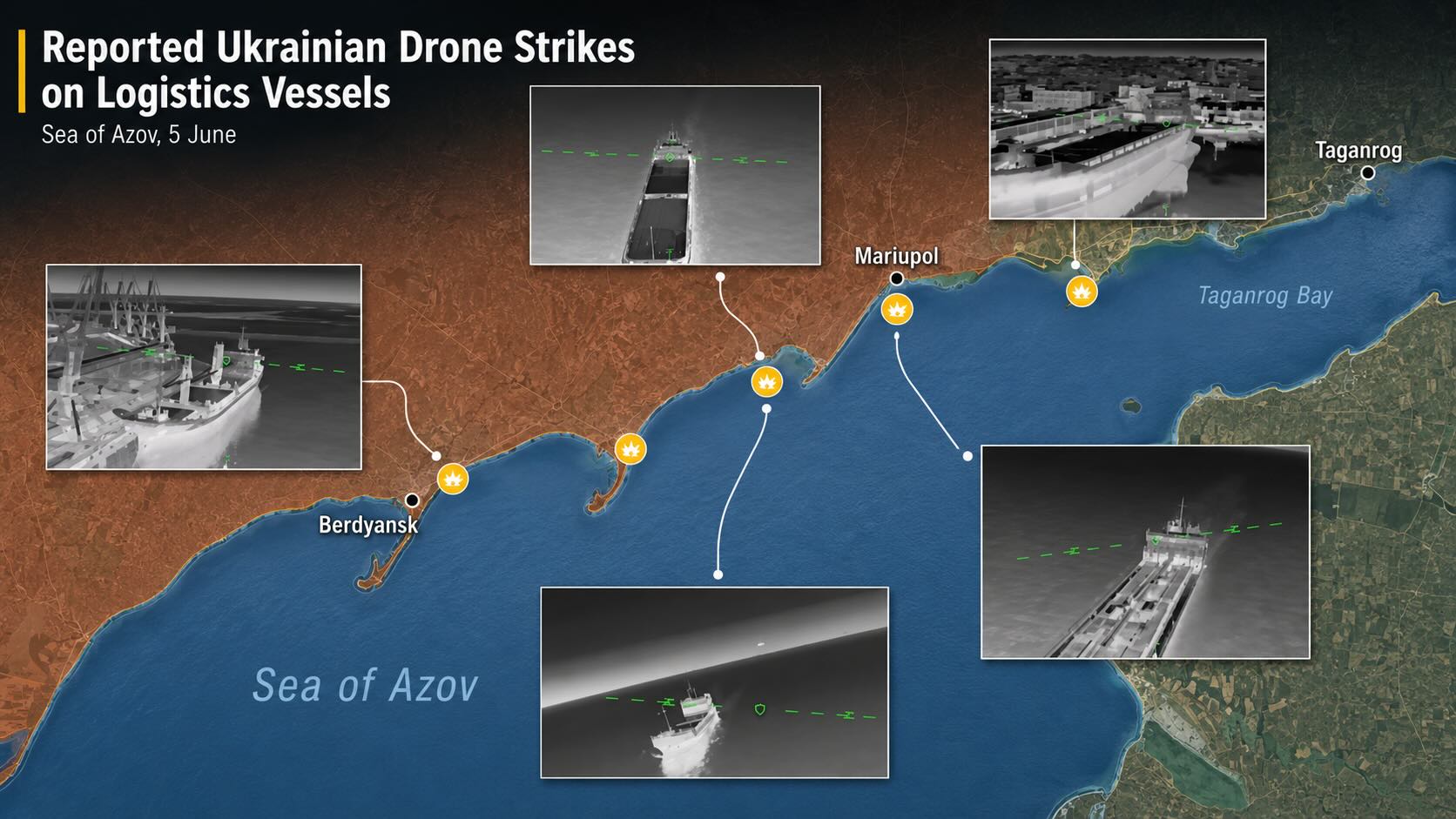
According to Robert Brovdi, commander of Ukraine’s Unmanned Systems Forces and widely known by the call sign “Madyar”, the targets included dry cargo vessels and a tanker operating in or near the ports of Mariupol and Berdyansk, as well as in coastal waters off Russian-occupied Ukrainian territory. Ukrainian reports said the overnight operation targeted five vessels in ports and coastal waters used by Russian forces.
Brovdi said the vessels were being used for the transport of military cargo, fuel and grain taken from occupied areas of Ukraine. He also alleged that some ships had obscured their names or disabled radar systems in an attempt to conceal their activities. These claims could not be independently verified in full, but they are consistent with Ukraine’s broader accusation that Russia has used occupied ports on the Sea of Azov to support both military logistics and the export of agricultural goods taken from seized Ukrainian territory.
The operation is notable because of its scale. Ukraine has previously struck individual vessels and port facilities in the Azov region, including Berdyansk and Mariupol, but the reported targeting of five ships in one night suggests a more systematic attempt to disrupt maritime logistics. In recent days, Ukrainian drone forces have also targeted port infrastructure and shipping assets, including a dry cargo vessel in occupied Berdyansk, as Kyiv increases pressure on Russian supply routes behind the southern front.
The Sea of Azov has strategic importance for Russia’s military presence in occupied southern Ukraine. Mariupol and Berdyansk are both situated on the northern coast of the sea and have been under Russian occupation since 2022. Russia has sought to use the area as a rear logistics zone for its forces in Donetsk, Zaporizhzhia and other parts of the southern front.
Ukraine’s latest reported strikes suggest that Kyiv is no longer focusing only on fixed port infrastructure, but is also attempting to make maritime movement itself more dangerous and less predictable. This could increase pressure on Russia’s supply network, particularly if the attacks are repeated and if civilian crews, insurers or operators become reluctant to sail into ports used by Russian forces.
Azerbaijan’s Foreign Ministry said five Azerbaijani citizens were killed and three others injured in attacks on two cargo vessels in the Sea of Azov. According to the ministry, 25 Azerbaijani nationals were on board, although the ships were not Azerbaijani-owned. The incident reportedly occurred in Taganrog Bay. The reported deaths of five Azerbaijani citizens add a further diplomatic and legal dimension to the intensifying drone war at sea.
Further details published in Azerbaijan identified the vessels as Natra and Zircon. According to those reports, both ships were hit several times, with one remaining afloat but requiring towing and the other burning after the crew abandoned ship in lifeboats. These details, if confirmed, would suggest that the strikes caused serious operational damage even where vessels were not immediately sunk.
The deaths underline the risks associated with the use of commercial or ostensibly civilian vessels in an active war zone, particularly where cargo, ownership structures, flag registration and operational purpose may be difficult to determine. The Sea of Azov is a confined maritime space, with limited routes between Russian ports, occupied Ukrainian ports and coastal waters under Russian control. That makes movements easier to monitor and potentially easier to target.
Brovdi’s reference to heavy warheads also points to Ukraine’s growing use of larger, remotely operated strike drones capable of attacking ships, port cranes, fuel storage and other logistics assets. Ukrainian drone warfare has expanded rapidly since 2022, moving from tactical battlefield use to long-range attacks on oil facilities, air bases, naval assets and supply routes inside Russia and occupied territory. Recent operations have included strikes on Russian military assets in Crimea and the Sea of Azov, reflecting Kyiv’s effort to stretch Russian air defence and logistics systems across several theatres.
For Moscow, the practical problem is whether it can protect commercial-style shipping in the Azov region without diverting air defence, electronic warfare or naval resources from other fronts. The ports of Mariupol and Berdyansk have already been exposed to attack. Ships operating from Taganrog, Temryuk or other Azov facilities may now face a similar threat if they are assessed by Ukraine as supporting the Russian war effort.
The wider context is Ukraine’s attempt to reduce Russia’s ability to sustain operations in the south. Road and rail links remain central to Russian logistics, but maritime routes have offered an additional means of moving bulk cargo, fuel and military supplies. Ukraine has also been targeting overland routes, including the R-280 “Novorossiya” supply highway, which connects Russian territory with occupied southern Ukraine and Crimea.
If Ukraine can impose recurring losses at sea, Russia may be forced to rely more heavily on overland routes already under drone and missile pressure. That would narrow Moscow’s logistical options and could complicate the supply of fuel, ammunition and equipment to forces deployed along the southern front.
The reported attack therefore represents more than a single overnight strike. It suggests that Ukraine is extending its campaign against Russian logistics into another domain, combining pressure on roads, railways, fuel infrastructure and now maritime transport. Whether this becomes a sustained blockade-style campaign will depend on Kyiv’s ability to repeat such operations and on Russia’s capacity to adapt.