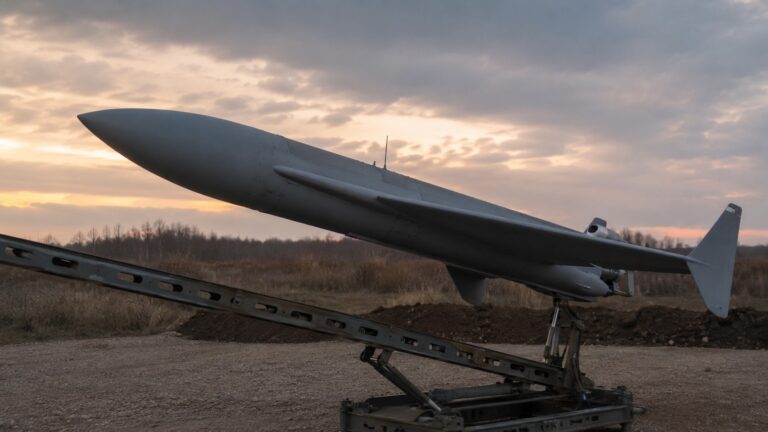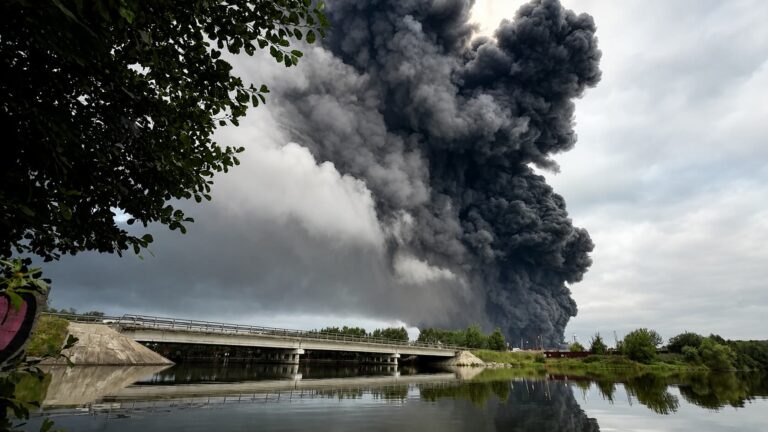
The latest reported attack took place on June 30, when drones again targeted the Dubna Space Communications Centre in the Moscow region. According to reports citing local footage and Russian regional statements, the facility was struck for the second time in just over a week, with videos from the area showing a column of dark smoke rising from the site.
The Dubna centre is one of Russia’s key ground-based satellite communications facilities. It forms part of the infrastructure used to control satellite relays and maintain communications links across Russia’s wider military and state communications network. A previous Ukrainian strike on the same facility on June 22 was later followed by satellite-image analysis indicating damage to buildings and equipment at the site.
The repeated targeting of Dubna, together with the reported strike on the Vladimir Space Communications Centre, points to a campaign aimed at degrading command links, satellite relay capacity and the ground infrastructure needed for Russia’s emerging low-Earth-orbit communications projects.
Subsequent Ukrainian military reporting gave more detail on what was claimed to have been hit. According to an assessment released after the strike, Ukraine damaged a modular hardware unit of a 32-metre MARK-IV antenna used for satellite communications, as well as a nearby technical building. The same account said the main production and administrative facility, which houses elements of the ground control segment and the main control centre of the satellite communications network, had also been affected.
The significance of Dubna lies in its function. It is not simply a civilian broadcasting facility. Ukrainian military sources describe it as part of a system used for military communications, satellite relay control and troop coordination. For an army fighting across a long front, such systems help transmit data, support command links and maintain communications where terrestrial networks are exposed, degraded or unavailable.
The strikes also come amid wider Ukrainian attacks on Russian space communications infrastructure. The source transcript refers to further reported strikes against the Vladimir Space Communications Centre and frames the attacks as part of an effort to disrupt Russia’s command, control and battlefield connectivity.
This interpretation fits the military logic of the campaign. Modern forces depend on resilient communications to coordinate units, transmit targeting information, control drones and move data between command posts and forward formations. Space-based communications are particularly valuable because they can bypass damaged ground networks and provide links across dispersed operating areas.
The timing is also important because Russia is working to develop its own low-Earth-orbit satellite internet system through Bureau 1440, the company behind the Rassvet communications constellation. In March 2026, Russia launched the first group of 16 Rassvet satellites, a project widely presented as a domestic answer to Starlink.
The comparison with Starlink should be treated carefully. SpaceX operates thousands of satellites, while the Russian system is still in its early deployment phase. Bureau 1440’s first operational batch consisted of 16 satellites, and later reporting indicated that one of them had already been lost. Even so, a small constellation can have military value if concentrated over a defined area for limited periods.
For Russian forces, a functioning Rassvet network could eventually support drone operations, mobile command posts and units operating in areas where conventional communications are vulnerable. The transcript specifically links the project to the potential control of Russian drones over longer distances, including systems that could otherwise depend on imported or unauthorised satellite terminals.
That matters because Russia’s use of Starlink terminals has been a recurring issue during the war. After measures were introduced to block unauthorised Russian access, Moscow had a clear incentive to develop alternatives. Rassvet remains far smaller than Starlink, but it points to a longer-term Russian attempt to reduce dependence on foreign satellite communications.
This is why ground infrastructure is central. Low-Earth-orbit satellite networks need ground stations, gateway links and integration with terrestrial backbone systems. Satellites must pass traffic to ground-based nodes, and those nodes require power, protected communication channels, antennas, software systems and trained personnel. Damage to even a limited number of ground sites can therefore have an effect beyond the physical structures hit by drones.
For Ukraine, the operational logic is direct. Repeated attacks on satellite communications centres can force interruptions, disrupt repair cycles, impose security procedures and complicate the work of specialist personnel. Even limited damage may have wider consequences if it affects antennas, switching equipment, control rooms, power systems or cable infrastructure.
For Russia, the problem is redundancy. Its space communications network includes several centres, and some functions can be shifted between facilities. But redundancy does not remove the cost of repeated attacks. If Dubna and Vladimir are both under pressure, Russia must either accept degraded performance, divert resources into protection and repair, or redistribute workloads across other nodes.
The strikes also fit Ukraine’s broader pattern of targeting infrastructure that supports Russia’s war effort beyond the immediate front line. Oil refineries, fuel depots, ammunition sites, airfields and now satellite communications facilities are part of the same operational picture: weakening the systems that allow Russia to sustain military pressure inside Ukraine.
There is still uncertainty over the full scale of damage at Dubna and any subsequent strikes. Satellite imagery, Ukrainian military statements and Russian official accounts will need to be assessed against each other. But the target set itself is notable. Ukraine is no longer striking only weapons, fuel and logistics. It is also targeting the information architecture that allows Russia to fight a networked war.