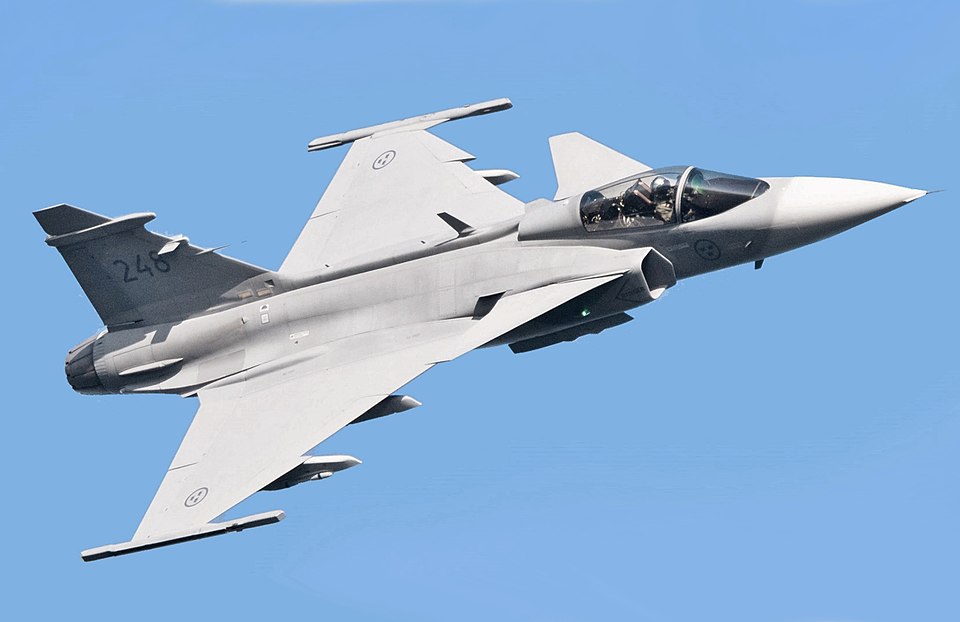
Saab has signed a SEK 24.6 billion contract with Sweden’s Defence Materiel Administration, FMV, for 16 Gripen E fighters intended for Ukraine, converting months of political intent into a funded procurement programme.
The company announcement submitted on 30 June says the order will be booked in the third quarter of 2026 and includes aircraft, equipment and associated support. Deliveries to FMV are scheduled for 2029 and 2030.
The contract is a major step for Ukraine’s post-war and long-war air-force planning. It is also a reminder that combat aviation cannot be expanded at the speed of a political announcement. The aircraft will not address the immediate pressure from Russian missiles, drones and tactical aviation. They represent a bet on Ukraine’s ability to build a sustainable Western-equipped force over several years.
Previous announcements established a broad Swedish-Ukrainian ambition involving both newer Gripen E aircraft and older C/D models. Defence Matters reported in May that Sweden was preparing a Gripen transfer while discussing a longer-term sale. The new contract supplies the missing industrial detail: a firm order, an initial quantity, a price and a delivery window.
That matters for Saab and its suppliers. Fighter production requires long-lead components, engines, sensors, electronic-warfare equipment, software, weapons integration and trained labour. A signed order allows the company and FMV to plan capacity in a way that a letter of intent cannot.
It also gives Ukraine a clearer basis for infrastructure and personnel decisions. Pilots and ground crews must be trained; maintenance, spares and weapons stocks must be established; secure mission-planning and data systems must be integrated. Those tasks begin well before the first aircraft arrives.
The Gripen’s attraction lies partly in the assumptions behind its design. Sweden built the aircraft to operate from dispersed locations, including road bases, with relatively small support teams and short turnaround times. Those features are relevant to an air force whose established bases are under persistent missile and drone threat.
Defence Matters has examined why the Gripen’s austere operating model is unusually relevant to Ukraine. The aircraft is not invulnerable, and dispersed operations still require fuel, munitions, communications, mobile maintenance and defended logistics. But the design reduces dependence on a small number of elaborate airbases.
Gripen E also offers a modern radar, electronic-warfare suite and compatibility with Western weapons. Its value will depend on the configuration Sweden approves, the munitions supplied and the quality of the wider command-and-control network into which it is introduced.
The delivery schedule is strategically important because it exposes Europe’s production constraint. Ukraine needs combat power now, but new fighters take years to build. Reporting on the contract also noted a difference between the 16 aircraft ordered and earlier political references to 20 new Gripens, as well as plans involving older C/D aircraft.
That makes the programme two-track. Existing aircraft, training and weapons can support nearer-term requirements; newly built Gripen E fighters create a more durable fleet later. The two tracks must be managed together if Ukraine is to avoid operating a collection of small, expensive and difficult-to-sustain fleets.
Ukraine is already integrating F-16s and other Western aviation capabilities. Adding Gripen increases tactical options but also adds another maintenance, training and supply chain. Common weapons and interoperable systems can reduce the burden, but they cannot erase it.
For Sweden, the order reinforces Gripen as an active European production line at a moment when air forces are reassessing force size, dispersal and attrition. For Ukraine, it provides an aircraft developed for precisely the kind of contested operating environment Russia has created.
The contract should not be mistaken for imminent battlefield delivery. Its significance is that a wartime requirement has become an industrial commitment extending to the end of the decade.
That is both its strength and its warning. European governments can promise sophisticated platforms quickly; factories, trained workers and certification schedules move more slowly. Ukraine’s Gripen programme will measure whether Europe can compress that gap while preserving safety, supportability and combat relevance.