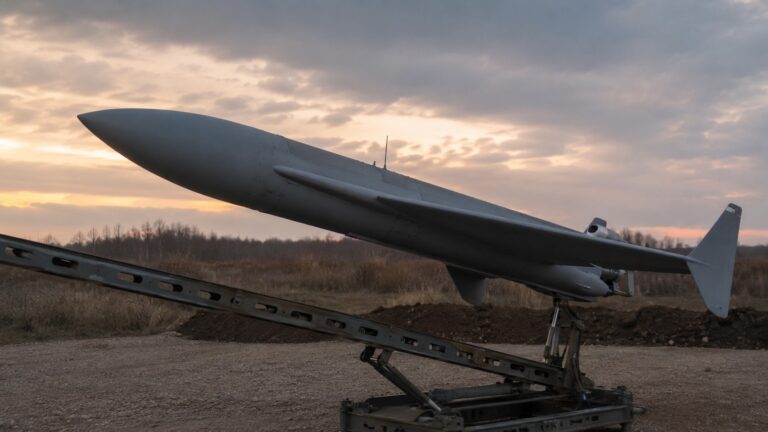
Ukraine says it has struck the Ufa refining complex for the second time in a week and hit a defence-industry facility in Russia’s Penza region, pairing a deep energy target with a plant linked to missile, aviation and space components.
President Volodymyr Zelenskyy confirmed the operations, describing Ufa as one of Russia’s largest lubricant-producing centres. Russian authorities reported widespread drone interceptions but did not confirm the Ukrainian account of damage. Independent evidence was insufficient at the time of writing to establish the full operational effect.
The significance lies less in footage of an explosion than in the combination of distance, repetition and target selection. Ufa is about 1,300 kilometres from the front. Reaching it twice means Russia cannot assume that one interception effort or repair cycle removes the threat.
Defence Matters covered an earlier strike on the Ufa refining cluster in April. The latest operation is not fresh simply because the same city was hit again. Its value is the demonstration that Ukraine can return to a deep target after Russia has had time to adjust defences and repairs.
A one-off attack may force a temporary shutdown. Repeated attacks require permanent allocation of air defence, electronic warfare, firefighting and repair personnel. Operators may limit throughput or keep equipment offline because another strike is expected.
Long range therefore has an effect even when warheads cause limited physical damage. It enlarges the territory Russia must defend and creates uncertainty across industrial planning.
Ufa’s refining complex is particularly important because it processes fuel and produces lubricants required by transport, industry and military equipment. Russia has a large refining network and can shift some production, so claims of systemic collapse would be premature. The cumulative burden across many sites is more relevant than any single fire.
Ukraine also reported striking the Research Institute of Physical Measurements in Penza. Ukrainian accounts describe it as a producer of instrumentation and components used in missiles, aircraft and space systems.
That target points to a complementary objective. Refinery attacks pressure energy and logistics; strikes on specialised manufacturers can disrupt components that are harder to replace through excess capacity elsewhere.
The operational impact depends on what was damaged. A warehouse, power connection or general building has a different consequence from specialised production equipment, testing facilities or clean rooms. Without verified imagery and production data, the effect should not be overstated.
The choice nevertheless signals an intelligence-led campaign. Identifying a less visible component producer requires mapping supply chains rather than selecting only prominent factories.
Russia cannot protect every refinery, plant, airfield and logistics hub with the same density of air defence. Systems placed around Ufa or Penza are unavailable elsewhere. Mobile electronic-warfare units and short-range guns can improve local protection, but the geography is vast.
Ukraine benefits if Russia disperses expensive defences across the interior. It also benefits if Moscow concentrates protection around politically important cities and leaves industrial sites more exposed.
Russia’s reported interception of 179 drones across numerous regions illustrates the scale of the defensive task. Interception figures cannot be independently verified and do not reveal how many decoys were used or whether debris caused damage.
Long-range drones are not strategic merely because they fly far. Their value comes from the effects they impose: reduced output, delayed components, higher protection costs, disrupted transport or political pressure.
Defence Matters has tracked how Ukraine’s campaign is pressuring Russia’s refining network. Ufa and Penza add an important operational feature: Ukraine is combining repeated attacks on energy nodes with strikes on specialised defence production.
The next evidence to watch is not the number of drones launched. It is whether Ufa’s throughput falls, whether the Penza institute suspends work and whether Russia moves additional defences eastward.
Ukraine’s reach is now forcing those decisions far beyond the front. Repetition is what turns that reach from a demonstration into pressure.