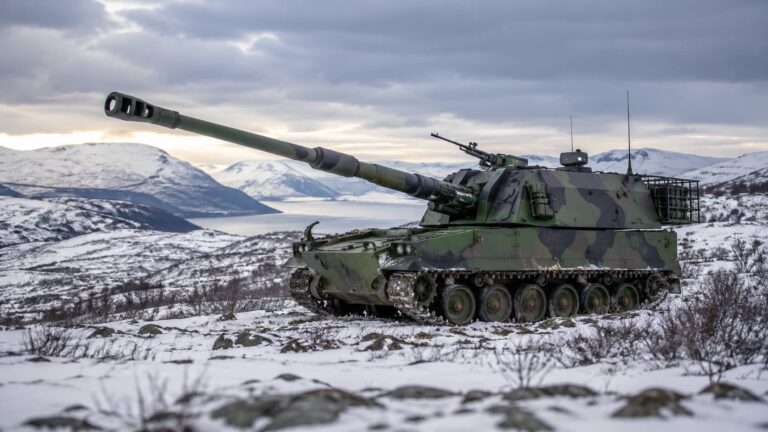
Five NATO members are projected to spend more than 3.5 per cent of gross domestic product on core defence in 2026, placing eastern-flank states well ahead of several larger western allies as NATO begins implementing its new investment commitment.
Alliance estimates reported from the Ankara summit put Lithuania at 5.33 per cent, Estonia at 5.1 per cent, Latvia at 4.92 per cent, Poland at 4.68 per cent and Greece at 3.65 per cent.
The comparison is more revealing than the alliance-wide headline. NATO’s new framework calls for 3.5 per cent of GDP on core military requirements and another 1.5 per cent on defence- and security-related investment, producing the politically prominent five-per-cent total.
Four of the five highest core spenders sit on NATO’s eastern flank. Their budgets reflect proximity to Russia, concern about the durability of US support and the practical cost of expanding forces, air defence, ammunition stocks and infrastructure.
Poland has built one of Europe’s largest land-force modernisation programmes. The Baltic states face smaller economies but an acute need for territorial defence, allied reinforcement and resilient logistics. Greece’s position reflects a different threat environment and a long-standing pattern of comparatively high defence expenditure.
NATO’s official explanation of the five-per-cent commitment stresses that allies must fund agreed capability requirements rather than pursue a number for its own sake. That distinction matters because identical GDP shares can buy very different levels of readiness.
The United States is estimated at 3.17 per cent on core defence. Germany is projected at 2.69 per cent, the United Kingdom at 2.56 per cent and France at 2.22 per cent. Belgium is at 2 per cent, while Italy and Portugal are near 2.1 per cent.
Those countries possess much larger industrial bases and, in some cases, nuclear forces or global commitments. Their lower percentages do not mean they contribute nothing of value. They do show, however, how far budgets must move if the 3.5 per cent core benchmark is to become an alliance norm.
Defence Matters has reported that Europe has replaced many planned US contributions but still lacks specialised capabilities. Spending increases must address those gaps: integrated air defence, long-range fires, intelligence, strategic lift, stockpiles and command capacity.
Rapid budget growth can outrun procurement institutions and industrial capacity. Governments may announce orders that manufacturers cannot deliver for years, or buy incompatible fleets because available equipment takes priority over common standards.
Personnel are another constraint. New brigades, ships and air-defence batteries need trained crews, housing, maintenance staff and exercises. Raising expenditure without expanding the human and logistical system can create impressive acquisition totals but limited usable force.
The 1.5 per cent security-related category will also require scrutiny. Resilient roads, ports, cyber systems and civil preparedness can strengthen defence. A broad definition, however, could allow governments to relabel existing spending without increasing military output.
The early figures establish a hierarchy of urgency inside NATO. Frontline allies can argue that they are carrying extraordinary fiscal costs because the threat is immediate, while wealthier western members have more room to increase investment.
The strongest response is not a competition over percentages but a clearer division of labour tied to regional plans. High-spending eastern states need reinforcement, ammunition and enabling capabilities that larger allies are well placed to provide.
The five countries above 3.5 per cent have demonstrated political intent. NATO’s harder task is ensuring that every additional euro produces forces able to deploy, communicate, fight and be sustained together.