Damascus will recover civilian infrastructure while Moscow keeps a restructured military presence, replacing the broad basing model established under Bashar al-Assad with a narrower joint arrangement.
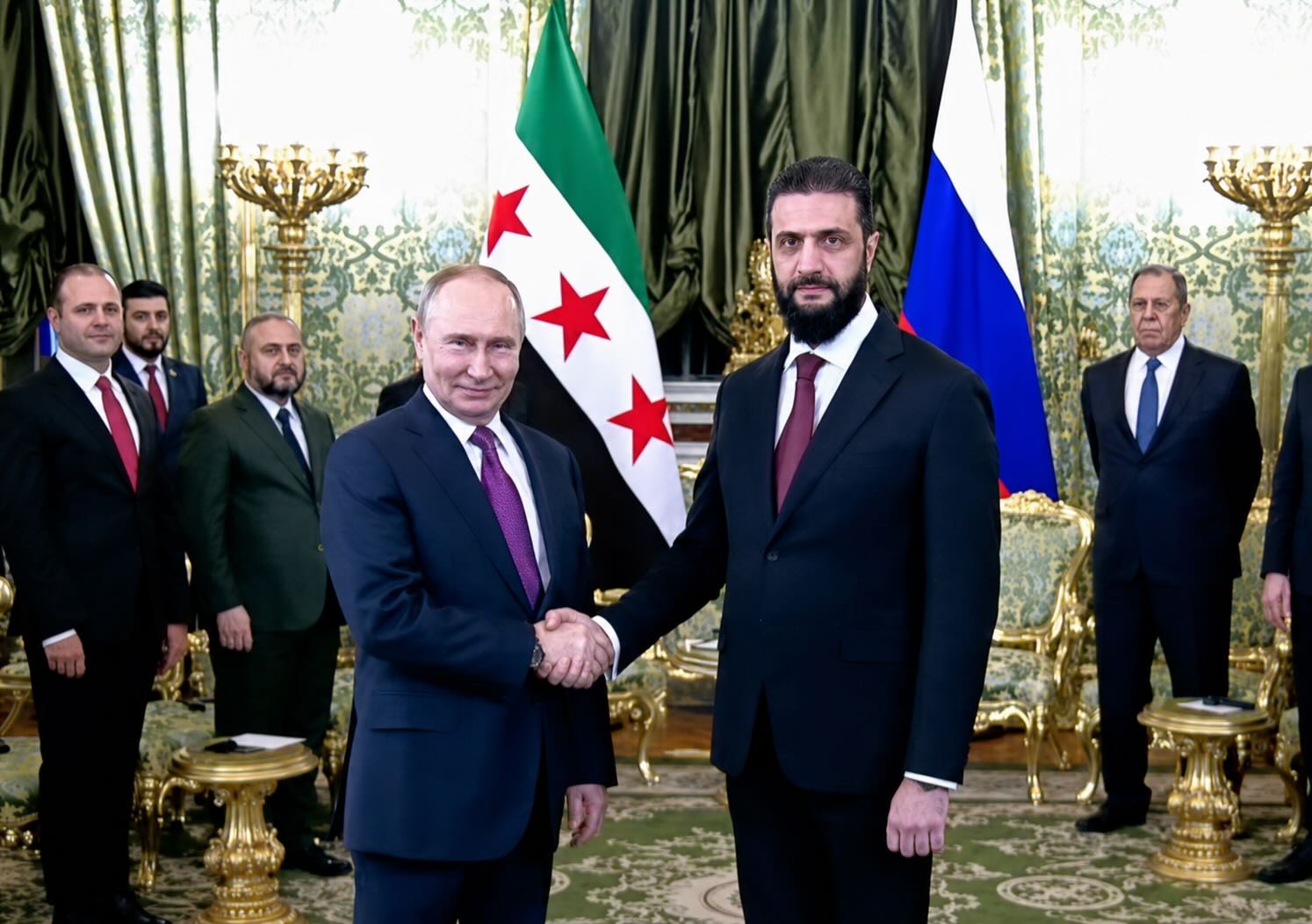
Syria and Russia have agreed new terms for Moscow’s military presence at Tartous and Hmeimim, ending 18 months of uncertainty over two facilities that have underpinned Russian operations in the Mediterranean and Middle East.
Under a memorandum announced by Syria’s Foreign Ministry on 9 August, Damascus will resume management of civilian facilities at Hmeimim airport and the commercial fourth berth at Tartous. The military parts of the two sites will be recast as joint Syrian-Russian training and qualification centres.
The transition is to be completed within three months, according to the Syrian account. The full memorandum has not been published, leaving important questions about personnel, command, access, weapons, duration and legal jurisdiction unanswered.
The agreement should not be described as a Russian withdrawal. Moscow has lost the unrestricted basing model it enjoyed under Bashar al-Assad, but it has retained a military foothold on Syria’s Mediterranean coast under a new Syrian government that once fought Russian-backed forces.
Hmeimim became the centre of Russia’s air campaign in Syria after Moscow intervened militarily in 2015. Tartous provided naval maintenance, resupply and access to the eastern Mediterranean, supporting Russian deployments beyond Syria and giving Moscow a facility outside the former Soviet Union.
Those arrangements were negotiated with an Assad government heavily dependent on Russian military support. His removal in December 2024 transformed their political foundation. Syria’s new authorities inherited agreements made by a deposed regime and had strong reasons to seek control over strategically valuable land, air and port infrastructure.
The new formula is therefore a compromise. Damascus can say it has restored sovereignty over civilian assets and changed the legal and operational character of the military sites. Moscow avoids eviction and preserves access that would be expensive and politically difficult to replace elsewhere in the region.
The Syrian presidency’s account of earlier talks said in July that negotiations over the bases were continuing. The announcement now moves the issue from open-ended bargaining to an agreed framework, although the published Syrian description cannot substitute for the memorandum itself.
Joint training centres can support more activity than their name suggests. Depending on the unpublished terms, they could accommodate Russian instructors, technicians, aircraft, ships, logistics personnel and equipment while placing formal control and public presentation on a bilateral basis.
The decisive measures will be practical. Analysts will watch the number and type of Russian aircraft at Hmeimim, naval calls at Tartous, replenishment traffic, air-defence deployments and whether Russian forces retain autonomous operational areas.
If Russian aircraft can still stage through Hmeimim and naval vessels can receive support at Tartous, Moscow will retain a useful regional network even with reduced freedom. If activity is limited to scheduled training under Syrian approval, the agreement will represent a much more substantial contraction.
The new structure may also offer Damascus leverage. Joint management can give Syrian authorities greater visibility over Russian movements and the ability to connect future access with investment, reconstruction, debt, arms support or diplomatic concessions.
The return of civilian facilities is not a symbolic detail. Hmeimim shares infrastructure with Latakia’s airport, while Tartous is a major commercial gateway. Bringing those assets into the civilian administration could support trade and investment and remove obstacles created by separate Russian control.
In July, Russian and Syrian officials discussed using part of Tartous as a commercial logistics hub for Russian goods. A Syrian-managed berth could still host such commerce, but on terms more directly connected to Damascus and its state investment institutions.
Commercial integration will depend on sanctions, financing, security and the condition of the infrastructure. Russia may want a logistics route into the Middle East, while Syria needs revenue and reconstruction. Neither interest automatically resolves the compliance risks faced by shipping companies, banks and insurers.
The agreement captures Russia’s reduced position after Assad. Moscow once operated from the two sites as the decisive outside power protecting the Syrian government. It will now remain by consent of leaders whose forces were attacked by Russian aircraft during the civil war.
That reversal is strategically damaging even if the physical presence continues. Russia has had to negotiate down from long-term privileges to shared centres and accept the return of civilian infrastructure to Syrian management.
Yet retaining any durable access is also an achievement. The eastern Mediterranean offers few comparable options. Tartous supports naval reach towards the Suez Canal and North Africa, while Hmeimim can connect Russian territory with deployments and relationships farther south.
Syria, for its part, is avoiding an abrupt break with a nuclear-armed UN Security Council member that can supply equipment, energy and diplomatic support. The arrangement fits a wider effort by Damascus to diversify relationships without becoming fully dependent on a single outside patron.
The next three months should show whether the memorandum produces a genuine transfer of authority. Syria will need to identify which facilities it controls, how joint decisions are made and what rules govern Russian personnel.
The duration of the arrangement is also important. Previous Russian agreements envisaged long time horizons. A short, reviewable memorandum would give Damascus continuing leverage; a lengthy commitment could preserve much of Moscow’s strategic certainty under different language.
The original Reuters report and the Associated Press account both establish the Syrian announcement, but neither provides the complete text.
For now, the clearest conclusion is that Russia has neither kept its old Syrian basing system nor lost its Mediterranean position altogether. Damascus has imposed a new sovereign framework, while Moscow has secured a narrower route to remain.