Yet behind the spectacle lies something more consequential than ceremony: a demonstration of how institutions preserve their identity while adapting to the demands of a modern military.
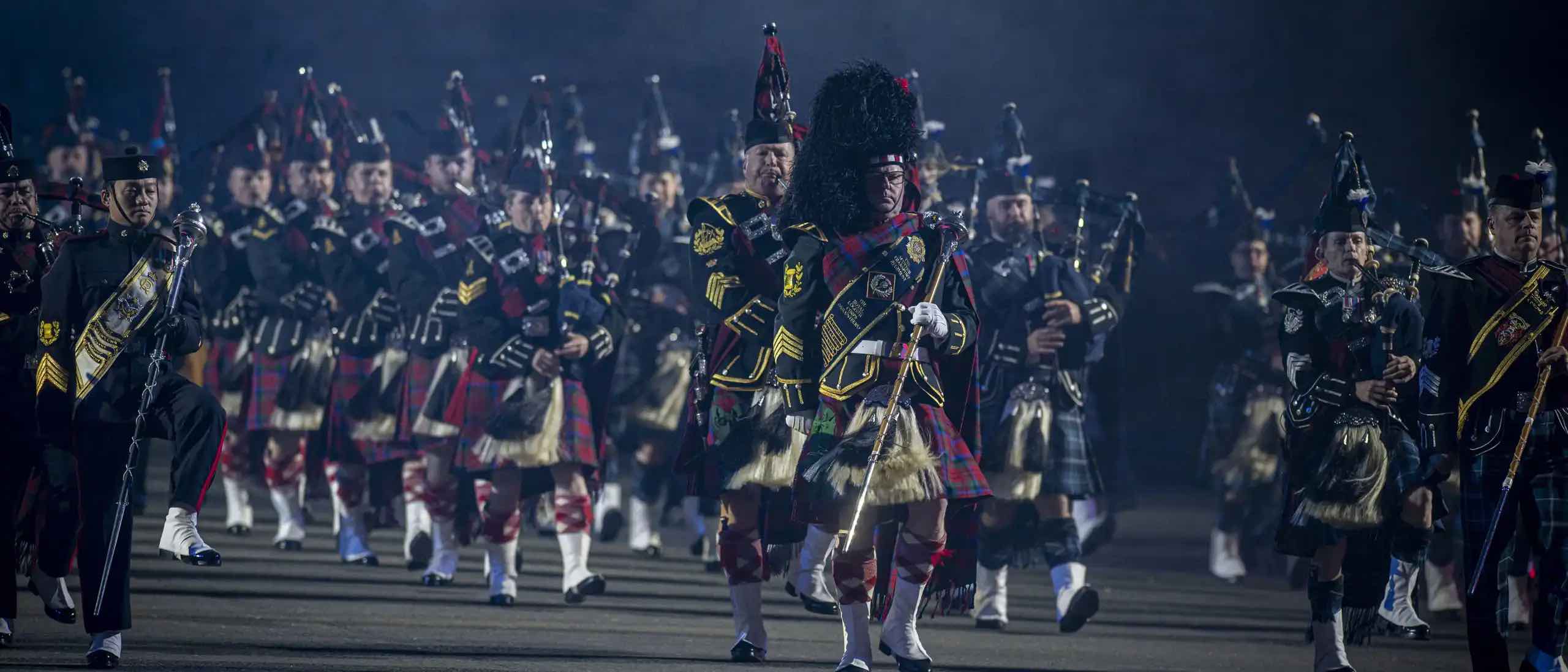
This month, British Army pipers and drummers are taking their place at the Royal Edinburgh Military Tattoo, whose 2026 theme, “A Call to Gather”, is particularly apt. Although the Royal Air Force is the lead service this year, Army musicians remain central to the Tattoo’s massed pipes and drums, bringing together personnel from units across Britain.
The event runs from August 7th to 29th and will feature 26 live performances on the Edinburgh Castle Esplanade. Audiences of about 8,500 are expected each night, while millions more will watch internationally. The performers will share the stage with military and ceremonial groups from countries including Germany, New Zealand, Qatar and the United States.
That international dimension matters. Military music is sometimes dismissed as pageantry, a picturesque remnant of an earlier age when regimental identity was expressed through uniforms, standards and bands. But such an assessment misses its institutional value.
For the British Army, the musicians appearing in Edinburgh are soldiers first and musicians second. They retain demanding primary military roles and, like their colleagues elsewhere in the Army, are required to maintain the discipline, resilience and teamwork expected of service personnel. Their musical responsibilities are an additional commitment rather than an alternative to soldiering.
That distinction gives the Tattoo its unusual power.
A performance of this scale requires more than musical ability. Pipers and drummers drawn from different regiments and corps must rapidly become a single, coherent formation. They arrive with different experiences, responsibilities and musical backgrounds, yet must achieve a level of collective precision in a comparatively short rehearsal period.
The process is an example of an increasingly valuable commodity in military organisations: the ability to make individuals from different backgrounds operate as one team.
The Army’s specialist training reinforces that principle. Personnel can undertake a 22-week course at the Army School of Bagpipe Music and Highland Drumming, developing skills that have been maintained across generations. Some graduates go on to highly visible ceremonial positions, including appointments such as Piper to the Sovereign.
The economic language of investment and return may seem inappropriate when discussing bagpipes and drums. Yet there is a broader lesson here about institutional capital.
Britain’s armed forces are being asked to modernise rapidly. Technology, drones, cyber capabilities, precision weapons and new approaches to warfare are reshaping the battlefield. At the same time, an effective military still depends on less tangible assets: morale, cohesion, identity, discipline and public confidence.
Tradition can contribute to all five.
The Edinburgh Tattoo provides one of the Army’s most visible opportunities to demonstrate those qualities to an audience extending well beyond Britain. In an era when public institutions frequently struggle to communicate their purpose, the armed forces have an unusually powerful advantage: their culture can be experienced rather than simply explained.
The sight and sound of soldiers marching down the Esplanade communicates discipline without requiring a policy paper. The presence of international military bands demonstrates relationships between allies without the need for a communiqué. And the participation of soldiers from across the Army illustrates, in a remarkably accessible way, the idea of service as a collective endeavour.
The Tattoo also offers a reminder that Britain’s military heritage is not necessarily in conflict with modernisation. A technologically sophisticated Army does not have to abandon the traditions that helped create its sense of identity.
Indeed, the opposite may be true.
As governments across Europe rethink defence in response to a deteriorating security environment, armed forces will need to attract and retain people capable of operating sophisticated systems while remaining effective members of cohesive teams. That requires investment not only in equipment but also in the institutional culture surrounding it.
The pipers and drummers gathering in Edinburgh represent a small but striking part of that equation.
For three weeks, the castle will once again become an international stage. The performance will be spectacular, as it should be. But beneath the pageantry is a serious message: an institution capable of preserving its traditions while preparing its people for an uncertain future is demonstrating a form of resilience that modern militaries cannot afford to overlook.
The pipes may belong to another age. The discipline required to play them together does not.
The Sound of War: British Troops Gain Instant Fire Detection Capability