

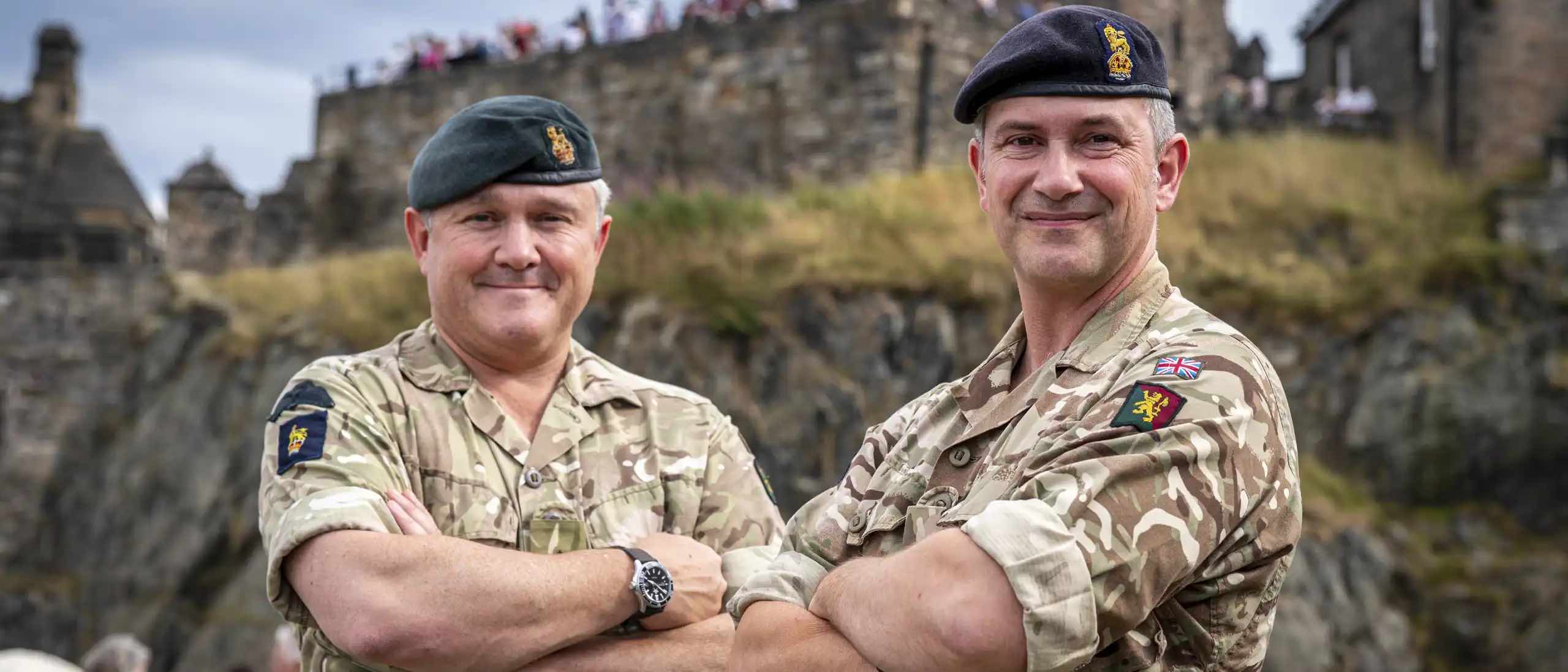
Brigadier Dave Calder takes charge of 51st Infantry Brigade and Headquarters Scotland, bringing operational experience and a strong local connection to a role that extends well beyond traditional military duties.
The arrival of Brigadier Dave Calder OBE as the British Army’s new commander in Scotland is a relatively routine change of military command. Yet the responsibilities attached to the post underline something increasingly important about modern defence: an army’s value is measured not only by its ability to fight overseas, but also by its capacity to support the country at home.
Calder formally assumed command of 51st Infantry Brigade and Headquarters Scotland on August 17th, succeeding Brigadier Jody Davies MBE, who had held the position since 2023. Based in Edinburgh, the brigade occupies a distinctive position within Britain’s military architecture, combining conventional military responsibilities with a substantial role in domestic resilience, security and engagement with Scotland’s institutions.
For Calder, the appointment has an unusually personal dimension. A Royal Engineer who joined the Army in 2003 after training as a mechanical engineer, he has served in a succession of demanding operational and senior staff appointments. His deployments have included Estonia, Afghanistan, Iraq and Belize, while his career has also taken him to the Permanent Joint Headquarters and the Ministry of Defence’s crisis-management machinery.
That combination of engineering expertise, operational experience and crisis management is well suited to an appointment whose importance lies partly in what happens outside the battlefield.
The 51st Brigade is a Joint Military Command. When required, it can direct personnel from the Army, Royal Navy and Royal Air Force, providing an integrated military response when circumstances demand it. Its responsibilities encompass UK resilience and security operations, ceremonial duties and the British Army’s engagement across Scotland. It also provides an important connection between the Army, the Scottish Government, the wider Scottish public and the Office of the Secretary of State for Scotland.
Such arrangements reflect a broader change in the way European militaries are thinking about national security. The distinction between domestic resilience and conventional defence has become increasingly blurred. Cyber incidents, disruption to critical infrastructure, extreme weather, emergencies and other national crises can all require capabilities that sit within the armed forces.
Scotland is particularly significant in this regard. Its geography, infrastructure and strategic position give it an importance extending well beyond its population. The country hosts major military facilities and provides access to the North Atlantic and northern approaches, areas whose strategic significance has grown as European governments have reassessed their security environment.
The brigade therefore represents an important bridge between military preparedness and wider national resilience. Its effectiveness depends not simply on soldiers, equipment and command structures, but on close cooperation with civilian authorities and other emergency and security organisations.
Davies’ tenure illustrates the value of that approach. In reflecting on his time in command, he highlighted cooperation with the Scottish Government, the Royal Navy, the Royal Air Force and Police Scotland in defending the homeland. He now moves to the UK’s Cyber and Specialist Operations Command, taking with him experience that reflects the growing importance of cooperation across military and civilian domains.
For Calder, the challenge will be to build on that foundation while maintaining the Army’s visibility and relevance across Scotland.
His own description of the appointment is revealing. He has called it an “immense privilege” to serve in his own community and emphasised the brigade’s contribution to making Scotland “safe, secure, and prosperous”.
There is a useful modesty in that formulation. Military power is ultimately intended to create the conditions in which societies can prosper. In Scotland, that means a force capable of responding when necessary while remaining closely connected to the communities it serves.
The change of command is therefore more than a ceremonial handover. It is a reminder that Britain’s defence posture increasingly depends upon institutions capable of operating across boundaries: between services, between military and civilian authorities, and between domestic resilience and international security.
Calder arrives with substantial experience of precisely that kind of environment. His next three years in Scotland will provide an opportunity to strengthen those relationships while ensuring that 51st Brigade remains ready for whatever demands may emerge.
In an era in which security challenges rarely respect organisational boundaries, that may prove to be one of the Army’s most valuable missions.


Trump’s VA Gamble: Less Bureaucracy, More Service