Norway has formally established a new artillery battalion at Porsangmoen in Finnmark, adding a heavy-fire component to the brigade responsible for the country’s northernmost territory and its 198-kilometre border with Russia.
Defence Minister Tore O. Sandvik attended the ceremony at Porsangmoen on 20 August. The Norwegian government’s official programme described the event explicitly as marking the establishment of a new artillery battalion.
The distinction matters. Norway announced plans for an artillery formation in Finnmark as part of its long-term defence build-up several years ago. The latest step creates the organisational structure through which the capability will be fielded, although its equipment, personnel and supporting elements will continue to arrive progressively.
For the Finnmark Brigade, artillery substantially changes the range of combat functions that can be conducted within the formation rather than relying on support assigned from elsewhere.
Until recently, Norwegian forces in Finnmark were heavily oriented towards surveillance, reconnaissance, border security and maintaining a military presence in the High North.
The Finnmark Brigade was itself established in August 2025 from the former Finnmark Land Defence. Its existing major formations include Porsanger Battalion, the Garrison of Sør-Varanger border force and Finnmark Home Guard District.
The addition of artillery gives the brigade an organic ability to provide indirect fire in support of manoeuvring ground forces. Together with combat air defence, communications, intelligence and other support units planned for the formation, it moves Finnmark closer to functioning as an independent combined-arms brigade.
Norway’s defence plan calls for Finnmark to receive an artillery battalion, combat air defence, a light infantry battalion, an engineer company, an intelligence, surveillance, target acquisition and reconnaissance unit, and strengthened command elements.
Brigadier John Olav Fuglem, commander of the Finnmark Brigade, said the expansion represented “a completely different level of firepower” for the force.
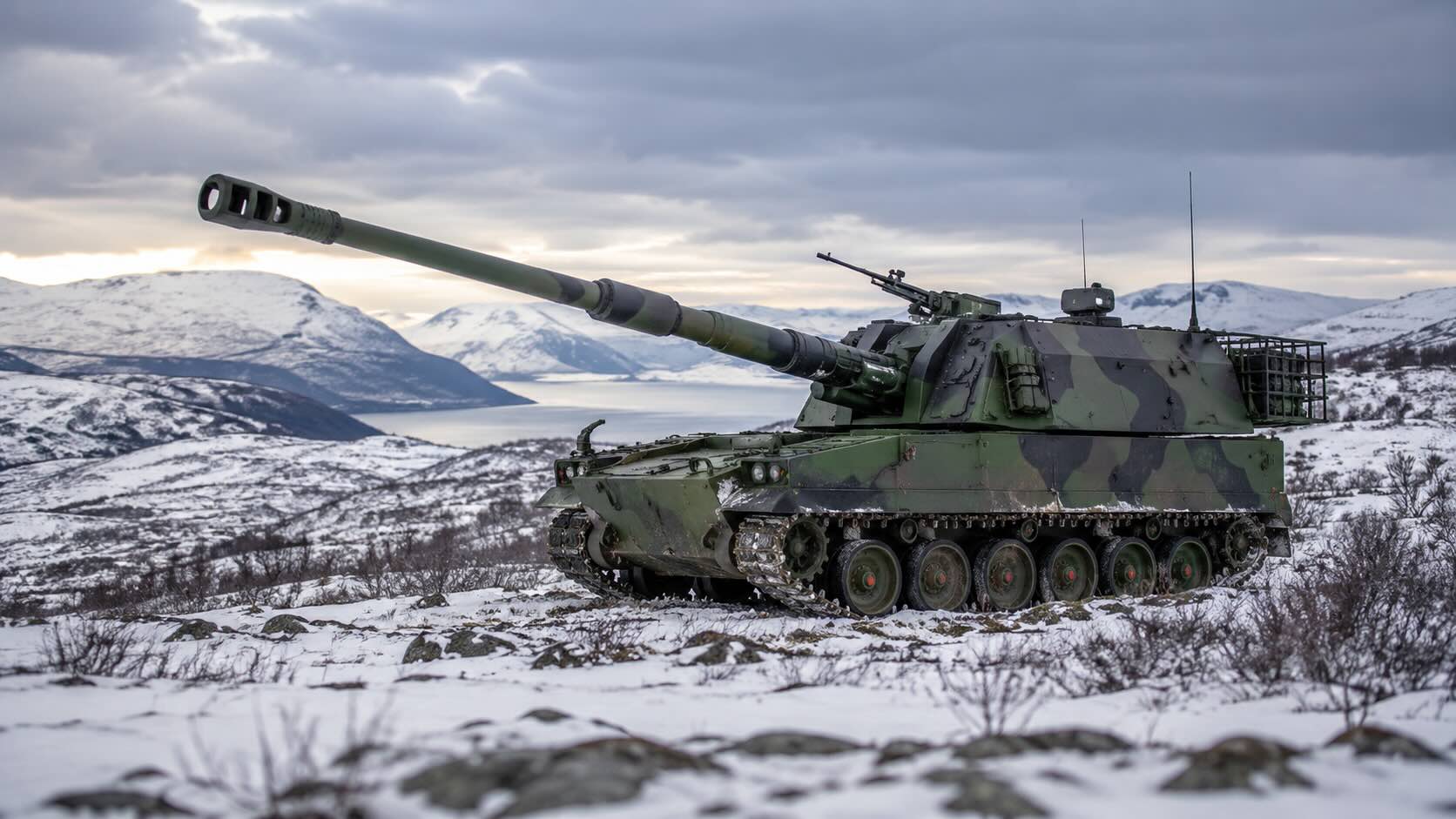
The new artillery capability is intended to allow Norwegian troops to engage land targets at ranges of more than 40 kilometres and to contribute to the coordination of fires involving Norwegian and allied aircraft and ships.
The battalion is expected to be equipped with South Korean-designed K9 self-propelled howitzers, already operated by the Norwegian Army.
In 2025, Oslo approved the acquisition of 24 additional 155mm artillery systems for Finnmark. The systems are of the same type used by Brigade North and are capable of firing conventional artillery ammunition beyond 40 kilometres, depending on the ammunition employed.
The acquisition programme has a cost ceiling of approximately NOK 11.1 billion after expansion of the existing artillery project.
However, Thursday’s establishment of the battalion should not be read as meaning that all 24 guns, their crews, ammunition stocks, logistics vehicles and supporting systems are already available at Porsangmoen.
Creating the formation is one stage of a wider process of generating combat capability. Equipment delivery must be accompanied by recruitment, training, ammunition stocks, maintenance capacity, command systems and repeated collective exercises before the battalion reaches its intended operational strength.
Oslo is also bringing forward the wider timetable for the Finnmark Brigade.
Under the government’s updated implementation of the long-term defence plan, the brigade and its subordinate units are now due to be completed towards 2033, two years earlier than previously envisaged.
The acceleration is part of a broader expansion of Norway’s Army. The long-term structure envisages three land combat brigades: the existing Brigade North, the developing Finnmark Brigade and a reservist-based Brigade South.
Norway is simultaneously increasing stocks of ammunition and spare parts, acquiring additional armoured vehicles, expanding air defence and introducing land-based long-range precision fires. The latter system is scheduled to begin entering service from 2027, with introduction into the force from 2028.
Porsangmoen, headquarters of the Finnmark Brigade, lies about 180 kilometres from the Russian border in a straight line. Across that frontier is Russia’s Murmansk region, which contains much of the infrastructure associated with the Northern Fleet and Russia’s strategic submarine forces.
The artillery battalion therefore forms part of a wider shift in Norway’s northern military posture. The purpose is no longer principally to maintain presence and observe activity along the frontier, but to build a formation able to conduct sustained combined-arms operations and integrate with NATO forces arriving in the High North.
For NATO, the establishment of the battalion is consequently more consequential than another defence-spending announcement. It represents a new combat unit being constructed on the ground — and another step towards giving Norway’s northern brigade the firepower, protection and supporting capabilities required to fight as a brigade.