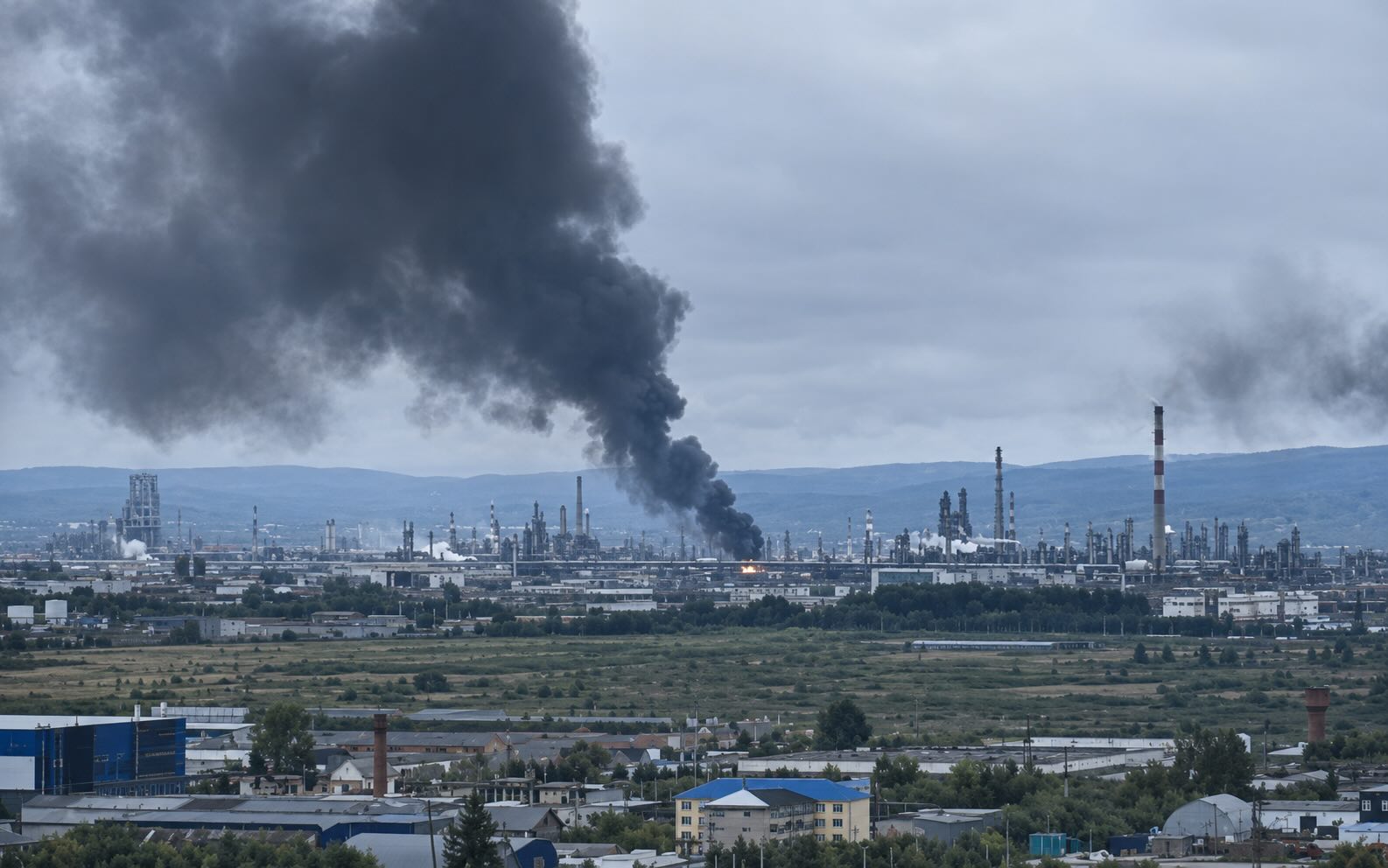
Ukraine carried out another long-range strike against the Lukoil-Permnefteorgsintez refinery in Perm early on Friday, 21 August, extending a campaign that has repeatedly targeted the same oil-processing complex deep inside Russian territory.
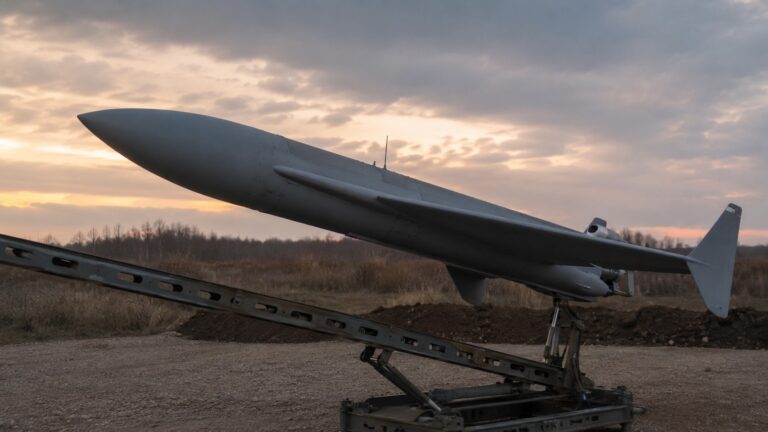
President Volodymyr Zelenskyy said Ukrainian deep-strike weapons had hit the Perm refinery, more than 1,600 kilometres from the border, as well as the Marynivka military airfield in Russia’s Volgograd region. The statement followed reports of explosions and smoke over the Perm industrial zone.
Perm Krai governor Dmitry Makhonin said that Russian forces had shot down 16 drones over the region. One man suffered a shrapnel wound and was reported to be in a satisfactory condition. Makhonin also confirmed damage at an industrial facility, although he did not publicly identify it. There were no reported casualties at the affected industrial site.
The source material reviewed by DefenceMatters identified both the Lukoil-Permnefteorgsintez refinery and the nearby LPDS Perm oil-pumping station as targets. Video circulating from the area showed fires and columns of smoke over the industrial zone.
The Perm facility is an important component of Russia’s refining network. According to Lukoil’s own description of the refinery, crude arrives through the Surgut–Polotsk and Kholmogory–Klin pipeline systems, while finished petroleum products leave by rail, road, river transport and the Perm–Andreevka–Ufa product pipeline.
Lukoil states that the refinery’s capacity was increased to 12.6 million tonnes a year in 2008. Its processing complex includes hydrocracking, catalytic cracking and coking units, while subsequent modernisation included upgrades to diesel-fuel treatment facilities.
This makes Perm more than a local fuel-production site. It sits at the intersection of crude supply, refining and onward distribution, meaning disruption can affect several stages of the petroleum chain simultaneously.
Friday’s attack is also notable because the complex has been targeted repeatedly. The supplied material describes earlier strikes against both the refinery and LPDS Perm, including damage to storage tanks and primary refining equipment.
The operational logic of repeated attacks differs from that of an isolated strike. Once damaged installations have been repaired and returned to service, another successful attack can force the operator to repeat the cycle of shutdown, inspection, replacement of equipment and recommissioning.
For Ukraine, this creates the possibility of imposing continuing repair and air-defence costs without having to destroy an entire refinery in one attack.
The strike comes while the Russian government is taking increasingly direct measures to protect domestic fuel availability.
On 30 July, the government introduced a new temporary prohibition on exports of petrol, diesel, marine fuel and gas oils. The restrictions took effect on 1 August, with the government explicitly stating that the measures were intended to maintain stability on the domestic fuel market.
Russia’s Energy Ministry has also acknowledged the effect of Ukrainian attacks. In June, it said increased aerial attacks on fuel and energy facilities were causing temporary supply difficulties in several southern regions.
By late July, the ministry said it was working with regional authorities and oil companies on measures to increase the volume of petroleum products available on the domestic market. Moscow has also created additional financial incentives for imports: the government extended an import-support mechanism to diesel fuel in July to encourage foreign supplies if required.
The combination is unusual for a state that remains one of the world’s largest crude-oil producers. The problem is not necessarily access to crude itself, but the ability to convert that crude into sufficient quantities of usable fuels and distribute them to where they are required.
The military implications are primarily logistical.
Diesel is required throughout Russia’s transport and industrial system, including heavy road transport and military logistics. Refineries also form part of a wider supply structure supporting aviation, storage facilities, railway distribution and military formations.
Russian authorities can prioritise fuel deliveries to the armed forces or major urban areas. Such prioritisation, however, redistributes shortages rather than creating additional refinery capacity.
The strategic effect of Ukraine’s refinery campaign therefore depends on the cumulative level of disruption: how many installations are unavailable at the same time, how rapidly Russia can repair them, and whether replacement fuel can be transported efficiently through the country’s extensive distribution network.
Perm illustrates another element of the campaign. Distance is becoming a less reliable form of protection for Russian industrial infrastructure. A refinery more than 1,500 kilometres from Ukraine has now been reached repeatedly, forcing Moscow to consider air defence not only around the front, border regions and major cities, but around energy and industrial sites across a much larger area.
For Russia, the question is increasingly not whether an individual refinery can be repaired, but whether damaged capacity can be restored faster than Ukraine can strike it again.