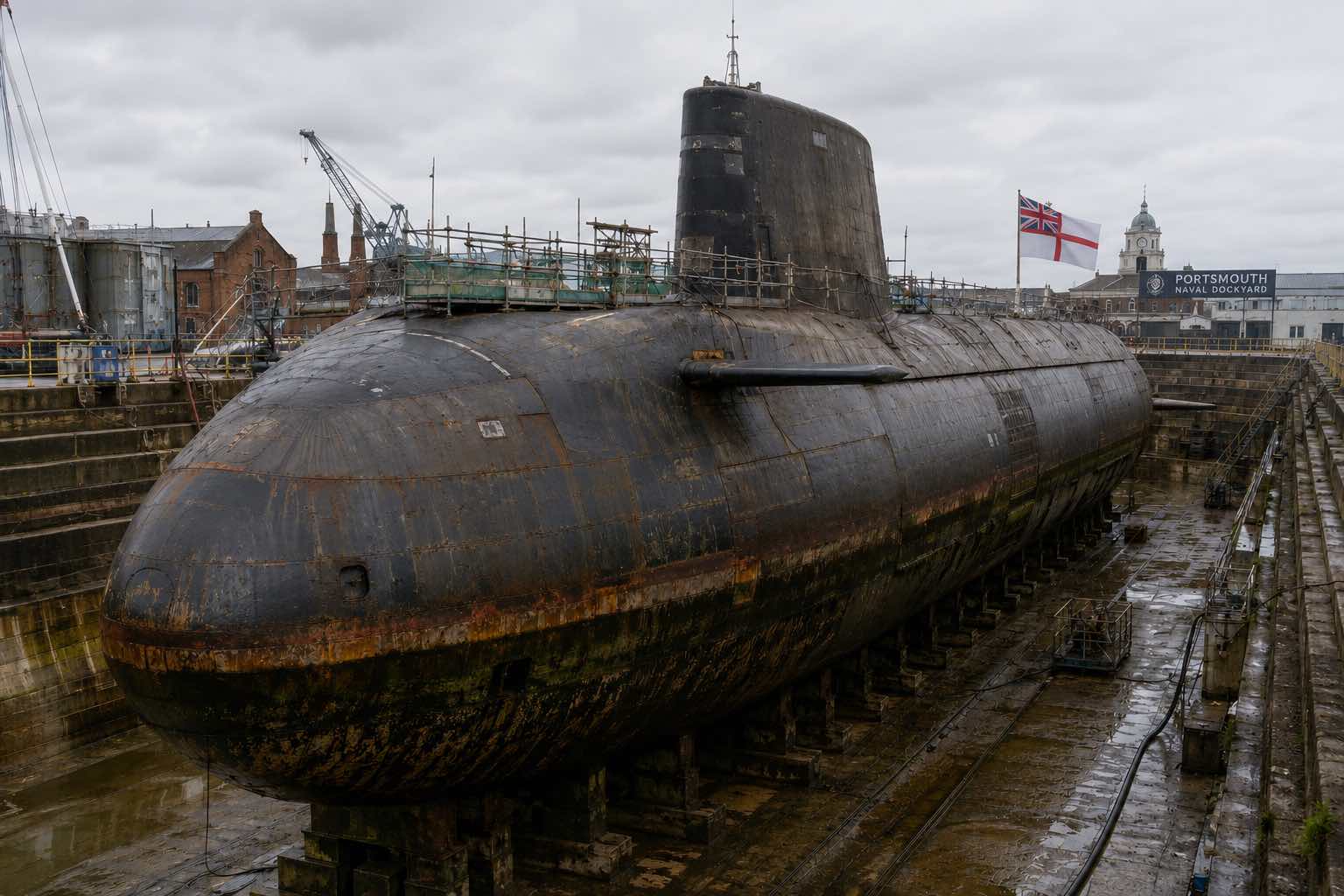
Another national capability degraded. Another strategic warning ignored. Another reminder that a country which once commanded the world’s oceans now struggles to keep a handful of nuclear-powered submarines operational.
The immediate temptation is to place the blame squarely on Sir Keir Starmer’s Labour government. Certainly, Labour cannot escape responsibility. Having inherited a deteriorating defence position, ministers have thus far shown little indication that they grasp either the urgency or the scale of the challenge. Britain faces the most dangerous security environment since the Cold War, yet defence spending remains constrained by Treasury caution and political calculation.
But to pretend this crisis began in July 2024 would be intellectually dishonest.
The roots of Britain’s military decline run much deeper. They stretch back through a succession of Conservative governments that spent years talking about “Global Britain” while systematically hollowing out the hard power required to support it.
For nearly a decade after Brexit, successive Conservative administrations appeared more interested in selling assets, trimming budgets and pursuing short-term political victories than ensuring Britain retained credible military capabilities. Ministers delivered grand speeches about sovereignty while allowing the industrial foundations of national defence to erode. Shipyards shrank. Maintenance backlogs grew. Skilled workers disappeared. Procurement programmes drifted years behind schedule.
The result is visible today.
The Royal Navy’s attack submarine force is not suffering from a sudden technical mishap. It is suffering from decades of underinvestment in dockyard infrastructure, maintenance facilities and workforce capacity. The inability to keep vessels available for operations reflects structural failures that accumulated year after year while governments of both colours congratulated themselves on supposedly balanced budgets.
This matters because attack submarines are not prestige projects. They are among the most important assets Britain possesses. They protect the nuclear deterrent. They gather intelligence. They track hostile submarines. They safeguard vital undersea infrastructure. They project power thousands of miles from home.
At precisely the moment when Russian submarine activity around Europe has become a growing concern, Britain finds itself confronting questions about whether its own fleet can respond effectively. Senior naval leaders have warned of increasing Russian underwater activity around critical infrastructure, including communications cables and energy networks that underpin the British economy.
Yet Westminster behaves as though these realities exist in a separate universe from fiscal policy.
The absurdity becomes even more glaring when viewed against Britain’s international commitments. London remains a central pillar of NATO. It is a leading member of AUKUS. It routinely lectures European allies about the importance of collective security.
But credibility in defence is not measured by speeches. It is measured by available ships, aircraft, submarines and trained personnel.
Recent parliamentary warnings surrounding AUKUS have highlighted concerns over Britain’s submarine capacity and industrial resilience. If the United Kingdom struggles to maintain its existing fleet, questions inevitably arise about its ability to deliver future commitments.
The uncomfortable truth is that Britain has spent years pretending it can enjoy the geopolitical influence of a major power while funding the armed forces of a middle-ranking one.
Labour now faces an unenviable choice. It can continue the familiar British tradition of announcing ambitious defence reviews while quietly delaying the expenditure required to implement them. Or it can acknowledge reality.
Reality is expensive.
Rebuilding naval infrastructure will cost billions. Expanding maintenance capacity will cost billions. Recruiting and retaining skilled engineers will cost billions. Modernising shipyards will cost billions. There is no shortcut and no accounting trick capable of avoiding that fact.
The greater danger is that ministers continue to behave as though time remains on Britain’s side.
It does not.
Across Europe, governments are increasing defence expenditure because they recognise that the strategic environment has changed fundamentally. Russia’s aggression has transformed assumptions about European security. Military preparedness is no longer a theoretical exercise. It is a prerequisite for deterrence.
Britain should be leading that effort. Instead, it finds itself explaining why key elements of its military capability are unavailable.
The Conservatives deserve severe criticism for allowing this position to develop. Their rhetoric about national sovereignty increasingly looks hollow when measured against the condition of the armed forces they left behind.
Yet Labour deserves equal criticism if it treats the problem as somebody else’s fault. Governments inherit crises; they are judged on whether they solve them.
Britain’s defence decline was years in the making. It was enabled by political complacency, strategic drift and chronic underinvestment from successive administrations.
The question now is brutally simple.
Will the current government reverse that decline, or merely manage it? Or neither…?