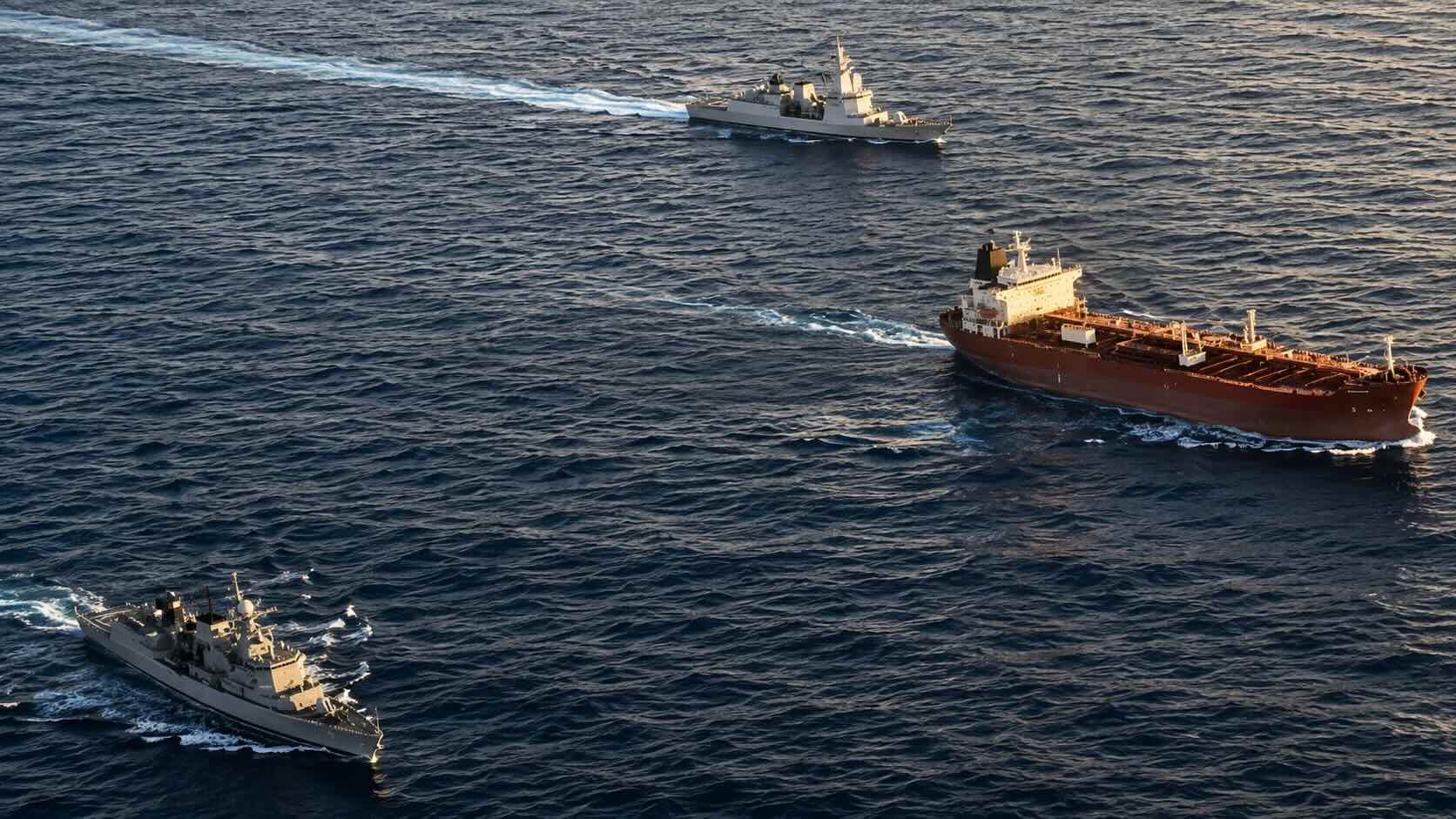
The boarding of the EU-sanctioned tanker Toa Payoh west of Pantelleria was a small operation with a large implication: Europe’s sanctions regime is moving from the legal page to the sea lane, but its enforcement powers remain uneven once a ship has been stopped.
An Italian-led EUNAVFOR MED IRINI team boarded the vessel on 2 August after its master initially failed to co-operate, according to an Italian defence ministry statement and Reuters reporting. The episode matters less as a single maritime incident than as a test of whether the EU can convert sanctions designations into practical pressure on vessels linked to opaque oil movements.
The caution is essential. This was a boarding, not a seizure. That distinction is not semantic. It marks the line between an EU mission’s ability to inspect a sanctioned ship and the more difficult question of who has the authority, evidence and political will to detain it, confiscate cargo, open proceedings or force a port call.
European sanctions increasingly depend on maritime enforcement. Brussels can list vessels, prohibit services, target owners and restrict access to ports or insurance. But the ocean does not enforce regulations. That requires naval assets, boarding teams, national prosecutors, port-state powers and evidence that will survive legal scrutiny.
The Toa Payoh operation exposes the practical gap between detection and consequence. A vessel may be sanctioned, tracked and challenged. Yet the next step often lies not with Brussels but with national authorities, flag-state rules and the available mandate of the mission involved.
This is why the case is more revealing than a routine sanctions update. EUNAVFOR MED IRINI was created to enforce the UN arms embargo on Libya, not to act as a general-purpose EU shadow-fleet police force. Its role here shows how existing missions are being pulled into a broader enforcement environment shaped by Russia’s war, energy sanctions and evasive maritime trade.
Defence Matters has previously examined how the seizure of the tanker Deliver moved shadow-fleet enforcement into the Mediterranean. The Toa Payoh case is different. It is not a demonstration of final control over a vessel, but of the intermediate stage where Europe can board, inspect and collect information while still depending on later national action.
The shadow-fleet problem is often discussed as a matter of insurance, ownership chains and commodity law. At sea, it becomes a defence and security problem. Boarding a non-co-operative vessel requires naval presence, command discipline, legal clarity and rules of engagement. It also creates escalation risk if a ship refuses instructions or if another state contests the action.
Sanctioned tankers frequently operate through layered ownership, changing flags, ambiguous insurance and ship-to-ship transfers. That ambiguity is part of the model. It raises the cost of enforcement by making every step slower and more legally exposed.
For European navies, the operational burden is growing. Maritime enforcement now sits alongside migration monitoring, counter-smuggling patrols, freedom-of-navigation operations and deterrence missions. The EU can list more ships than it can physically inspect. That imbalance is where sanctions credibility is tested.
Recent incidents near European waters have already shown how quickly maritime risk can become political. Defence Matters has also covered how Russian naval behaviour near UK-linked civilian shipping raised Channel maritime risk. The Mediterranean boarding is less dramatic, but it belongs to the same pattern: civilian shipping, sanctions enforcement and military presence are increasingly overlapping.
The key question is what follows. If evidence gathered during the boarding produces national enforcement action, the case may become a useful precedent. If the vessel continues without consequence, it will still show EU reach, but also the limits of that reach.
Either outcome is instructive. The Toa Payoh boarding shows that Europe’s sanctions policy now depends partly on maritime capacity. Regulations and designations remain essential, but they are no longer enough. In the shadow-fleet theatre, credibility requires ships, boarding teams, evidence and prosecutors able to complete the chain from inspection to consequence.
That is the enforcement test Brussels cannot solve by adding names to a list.