The French night-vision and imaging specialist reported first-quarter revenues of €122.6 million, a rise of 19.7 per cent year-on-year, with adjusted gross profit climbing just over 20 per cent. The numbers themselves are impressive; the underlying forces behind them are more telling still.
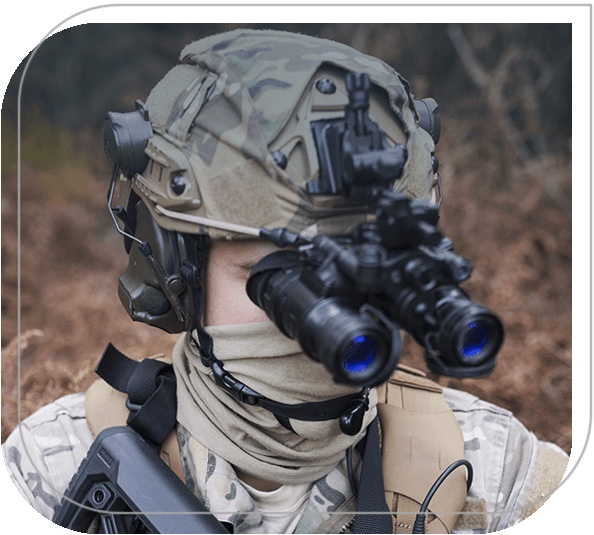
For Exosens is not simply selling optical equipment. It is supplying the tools that define how wars are increasingly fought — at night, at range, and with machines.
The most striking element in the company’s performance lies in its Detection and Imaging division, where revenues surged by more than 44 per cent. This is no coincidence. It reflects the explosive growth of drone and counter-drone technologies, now central to military planning from Ukraine to the Middle East.
Cheap, adaptable drones have transformed the battlefield. They demand sensors that can see, identify and track targets in darkness or obscured conditions. That is precisely where Exosens has found its niche.
Analysts note that its systems, unlike large and costly platforms, can be deployed rapidly and at scale — an increasingly valuable trait in conflicts defined by speed and attrition. In short, Exosens is benefiting from a shift away from heavy, capital-intensive defence systems towards lighter, more flexible capabilities.
If drones explain the pace of growth, geopolitics explains its durability.
The company’s chief executive has pointed explicitly to “rising geopolitical tensions” as a key driver of demand for its night-vision and digital imaging products. This is hardly surprising. The re-emergence of high-intensity conflict in Europe — and the expectation of it elsewhere — has elevated night-time operational capability from a specialist requirement to a baseline necessity.
Modern armies do not merely want to fight at night; they must. Night operations offer concealment, tactical advantage and, increasingly, survivability in an age of ubiquitous surveillance. As one industry observer recently noted, the ability to “own the night” is no longer optional — it is foundational.
Exosens, with its decades of expertise in light-intensifying tubes and advanced sensors, is well positioned to meet that demand.
The company’s growth is not occurring in a vacuum. Its amplification division — responsible for components used in night-vision goggles — also delivered solid gains, boosted in part by its first contract with the U.S. Army. Such agreements are more than incremental revenue streams; they are endorsements of credibility in a market where reliability can be as important as innovation.
Meanwhile, Exosens has confirmed its full-year guidance and is actively considering further capacity expansion, with plans already under way in Europe and the United States. This suggests management believes current demand is not a temporary spike but part of a sustained structural trend.
Investors appear to share that view, albeit with some caution. Analysts have observed that while the company’s shares are “not cheap”, they offer one of the few direct avenues into the rapidly expanding drone ecosystem.
There is a broader European story here as well. For all the attention lavished on defence giants — the Rheinmetalls and Thaleses of the world — companies like Exosens occupy a critical, if less visible, tier of the supply chain.
They produce the enabling technologies: sensors, detectors, components that make larger systems viable. Without them, the grand strategies of governments and generals would remain theoretical.
In that sense, Exosens represents a particular strength of the European defence sector — deep technical expertise in niche areas, often built over decades and difficult to replicate quickly.
Yet there are caveats. Defence demand is, by its nature, cyclical and politically contingent. Today’s surge is underpinned by heightened tensions; tomorrow’s trajectory will depend on how those tensions evolve.
There is also the question of valuation. Rapid growth in a fashionable segment — drones, counter-drones, night-vision — can attract exuberance as easily as it reflects genuine opportunity.
And competition is unlikely to stand still. As the importance of these technologies becomes clearer, larger players may seek to move further into the space, either organically or through acquisition.
For now, however, Exosens appears to be in precisely the right place at the right time.
Its technology aligns neatly with the defining trends of contemporary conflict: decentralisation, digitisation and the relentless expansion of the battlefield into the night. Its recent results, strong though they are, may therefore be less a peak than an early indicator.
In a defence landscape often dominated by the spectacular — fighter jets, missile systems, naval power — it is easy to overlook the quieter revolutions. But as Exosens’ latest figures suggest, it is sometimes the unseen technologies, peering through the darkness, that matter most.
Main Image: Exosens