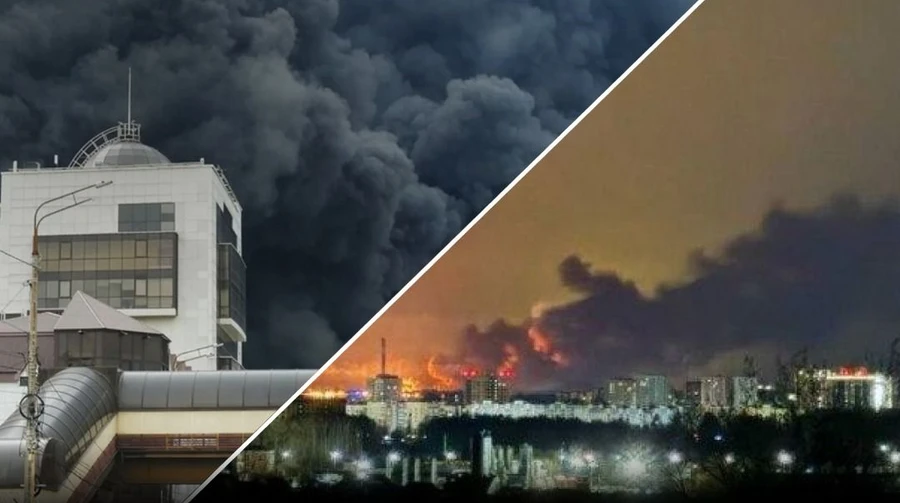
According to the General Staff of the Armed Forces of Ukraine, a strike carried out on April 26 against an oil refinery in the Russian city of Yaroslavl damaged a vacuum distillation unit, an important component in the refining process. The statement also said that an earlier strike on April 20 near the Tuapse oil refinery in Russia’s Krasnodar region destroyed 24 storage tanks and damaged four others.
Ukraine brings war to Russia’s energy network with co-ordinated overnight attacks
The updated assessment adds to a series of Ukrainian attacks on Russian energy infrastructure, which Kyiv has increasingly presented as part of its campaign to reduce Moscow’s ability to sustain the war. Refineries, oil depots, pumping stations and export terminals have become frequent targets, particularly where they are linked to fuel supplies, military logistics or export revenues.
The Yaroslavl facility lies deep inside Russian territory, north-east of Moscow, making the reported strike notable both for its range and for the type of equipment said to have been hit. Vacuum distillation units are used in the secondary stage of oil refining, processing heavier fractions after initial atmospheric distillation. Damage to such equipment can reduce a refinery’s ability to produce higher-value fuels and other petroleum products, depending on the scale of the impact and the availability of replacement capacity.
The Tuapse refinery, located on Russia’s Black Sea coast, has also been repeatedly affected by Ukrainian strikes this month. A major fire at the Tuapse oil refinery, caused by a Ukrainian drone strike on April 16, had burned for four days before open flames were brought under control. The refinery had halted operations following the attack, while local authorities warned residents about deteriorating air quality linked to toxic by-products from the fire, including benzene and xylene.
Russian officials had also acknowledged further Ukrainian attacks on April 20, which targeted transport infrastructure and oil storage facilities at Tuapse. Ukraine’s latest statement gives a more specific account of the damage, claiming the destruction of 24 tanks and damage to four more near the refinery.
The General Staff’s figures have not been independently verified. Moscow typically confirms drone attacks or fires only in limited terms and rarely provides detailed assessments of military or industrial damage. Ukrainian statements on long-range strikes are also often brief, with follow-up assessments issued after satellite imagery, local reports or intelligence analysis become available.
The attacks form part of a broader pattern. Reuters reported on April 22 that Ukraine had intensified strikes on Russian refineries and energy sites between February and April 2026, hitting facilities operated by Rosneft, Lukoil and other companies. Several refineries were reported to have suspended operations or suffered disruption after fires and drone attacks.
For Ukraine, such operations serve several purposes. They impose repair costs on Russia, disrupt fuel production, complicate logistics, and force Moscow to divert air defence assets to protect industrial sites across a wide geographic area. They may also affect Russia’s export infrastructure, particularly in locations such as Tuapse, which is connected to Black Sea oil and petroleum product logistics.
Russia has sought to adapt by dispersing air defence systems, increasing electronic warfare coverage and repairing damaged facilities where possible. However, the frequency of attacks has placed visible pressure on the country’s refining network. Even temporary outages can reduce margins, strain domestic fuel distribution and limit flexibility in supplying both civilian and military demand.
The latest Ukrainian assessment also comes as long-range drone warfare continues to reshape the conflict. Ukraine has developed a growing ability to strike targets hundreds of kilometres from the front line, while Russia has continued large-scale drone and missile attacks against Ukrainian cities, energy infrastructure and military facilities.
Kyiv maintains that Russian refineries and fuel depots are legitimate military targets because of their role in sustaining Moscow’s war effort. Russia has described Ukrainian strikes inside its territory as terrorism, while continuing its own attacks on Ukrainian infrastructure and civilian areas.
The confirmed damage claimed by Ukraine at Yaroslavl and Tuapse suggests that Russian energy assets remain vulnerable despite expanded air defences. If the Ukrainian assessment is accurate, the strikes would represent another significant disruption to Russia’s oil processing and storage capacity at a time when its energy sector is already facing repeated attacks, sanctions pressure and rising wartime demands.