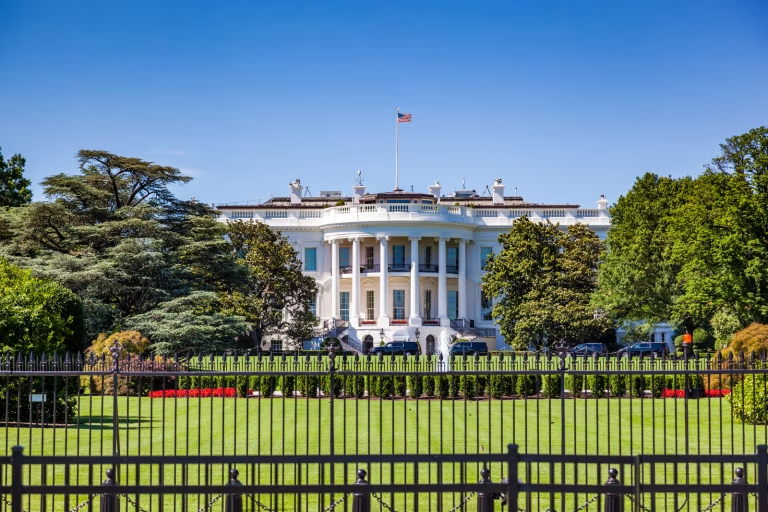
The 2025 strategy, published by the White House on 4 December, states that US policy for Europe should include “ending the perception, and preventing the reality, of NATO as a perpetually expanding alliance”. The document links this to a broader goal of shifting defence responsibilities to US allies, saying “the days of the United States propping up the entire world order like Atlas are over” and calling on wealthy partners to assume “primary responsibility for their regions”.
In the European chapter, the strategy portrays the continent as facing “economic decline” and a risk of “civilizational erasure”. It argues that activities of the EU and other “transnational bodies” are undermining political liberty and sovereignty, and singles out migration policies, “censorship of free speech and suppression of political opposition”, falling birth rates and “loss of national identities and self-confidence” as core problems. The paper says America’s aim is to “cultivate resistance to Europe’s current trajectory within European nations” and notes “optimism” about the growing influence of “patriotic European parties”.
On security, the document describes Russia as an actor that many Europeans now view as an “existential threat”, but stresses that European states retain a significant conventional advantage “by almost every measure, save nuclear weapons”. It argues that managing Europe’s relationship with Moscow will require “significant US diplomatic engagement” to restore “strategic stability across the Eurasian landmass” and to reduce the risk of conflict between Russia and European states.
The strategy sets out as a “core interest of the United States” the task of negotiating “an expeditious cessation of hostilities in Ukraine”. According to the text, such an outcome is intended to stabilise European economies, prevent escalation or geographic expansion of the conflict, and allow reconstruction that would “enable [Ukraine’s] survival as a viable state”, while also helping to re-establish strategic stability with Russia. The war is referred to as both “Russia’s war in Ukraine” and the “Ukraine War”; the document does not employ the terminology of “Russian aggression”.
The paper links the conflict directly to wider structural concerns, arguing that the “Ukraine War” has increased Europe’s economic dependencies, particularly Germany’s, and claiming that “a large European majority wants peace” but that this is not reflected in policy because “unstable minority governments” in Europe allegedly “trample on basic principles of democracy to suppress opposition”.
The publication of the strategy comes as Washington steps up its efforts to close a deal on the war, even at the risk that the terms fall largely in line with Russian demands and shift much of the cost onto Ukraine and Europe.
US Vice President JD Vance told NBC News he hoped that “good news” regarding the end of Russia’s war against Ukraine could emerge within weeks, describing his main frustration in office as the failure so far to secure an agreement – a formulation that places the emphasis on delivering a rapid outcome rather than on the substance of any settlement.
President Donald Trump has said his envoys Steve Witkoff and Jared Kushner came away from five hours of talks with Vladimir Putin in Moscow with the “impression” that the Russian leader wants to end the war, even though the Kremlin has publicly restated demands for full control over the Donbas and threatened renewed offensive action if Ukrainian forces do not withdraw.
Those talks revolve around a 28-point US “peace plan” that, in its original form, would require Ukraine to accept far-reaching compromises. Leaked drafts published by outlets including Axios, Sky News and Al Jazeera indicate that the proposal envisages Ukraine formally renouncing NATO membership, ceding all of Crimea, Luhansk and Donetsk to Russia, freezing the front line in the occupied parts of Kherson and Zaporizhzhia, sharply cutting the size of its armed forces, giving up long-range missiles and accepting a ban on foreign (NATO) bases on its territory.
Other reporting suggests the scheme was initially drafted from a Russian “non-paper” and tabled with Moscow before European capitals were properly informed, while separate clauses on frozen Russian assets would channel part of that money into joint US-Russian projects rather than exclusively into Ukrainian reconstruction.
In effect, critics argue, Washington is asking Kyiv to give up territory it still controls, accept a permanently weakened security posture and live under long-term constraints on its alliances in exchange for a ceasefire that would also relieve pressure on Russia.
European leaders have responded with open mistrust of this approach. According to a leaked call reported by Der Spiegel and summarised by Reuters, French President Emmanuel Macron and German Chancellor Friedrich Merz warned President Volodymyr Zelenskyy that the United States might “betray” Ukraine by trading away territory “without clarity on security guarantees”, and urged him to treat US proposals with extreme caution.
EU foreign policy chief Kaja Kallas and other senior officials have meanwhile confirmed that the 28-point blueprint was drawn up without European participation and would, in its unamended form, have forced Kyiv to give up additional land, drastically reduce its armed forces and abandon its NATO aspirations – terms they describe as rewarding Russian aggression and increasing the long-term threat to Europe.
At the same time, there is considerable uncertainty about what exactly now constitutes the “latest” peace package being discussed between Trump’s envoys and Putin. The original 28-point text became public only because it was leaked by a Ukrainian official, and subsequent revisions after US-Ukrainian and US-European talks have not been released in full.
Kyiv is reported to have worked with the UK, France and Germany on a counter-proposal to Washington’s original 28-point blueprint, but the version presented by US envoys in Moscow this week has not been made public, and there is no clear evidence that Ukrainian or European amendments were fully incorporated into the text discussed with Vladimir Putin.
In this context, European concerns that the United States is prepared to settle the conflict over the heads of Ukraine and the EU are reinforced by the new US security strategy itself, which explicitly criticises European governments for “obstructing” American efforts to stop the war and frames an end to hostilities as part of a broader attempt to restore “strategic stability” with Russia while shifting security burdens onto Europe.