Italy has conditionally approved a joint venture between Leonardo and Turkey’s Baykar to produce unmanned aerial vehicles, imposing national-security restrictions on a partnership designed to strengthen Europe’s position in the drone market.
The approval, granted at a cabinet meeting on Tuesday, allows the 50-50 venture to proceed but places limits on where its drones may be sold and how the partnership can expand internationally. Under the conditions reported after the decision, sales and further international development will be restricted to countries politically aligned with Europe and NATO, while the technology used in the drones will be classified.
The decision was taken under Italy’s so-called “golden power” rules, which allow the government to impose conditions on, or block, corporate transactions involving strategic national interests. In this case, Rome did not stop the venture. Instead, it allowed the project to move forward while keeping control over its export direction, technology base and political alignment.
The joint venture, known as LBA Systems, was formally established by Leonardo and Baykar at the Paris Air Show in June 2025, after the two companies had signed a memorandum of understanding in Rome earlier that year. It is legally and operationally based in Italy and is intended to develop, produce, maintain and support unmanned aircraft systems.
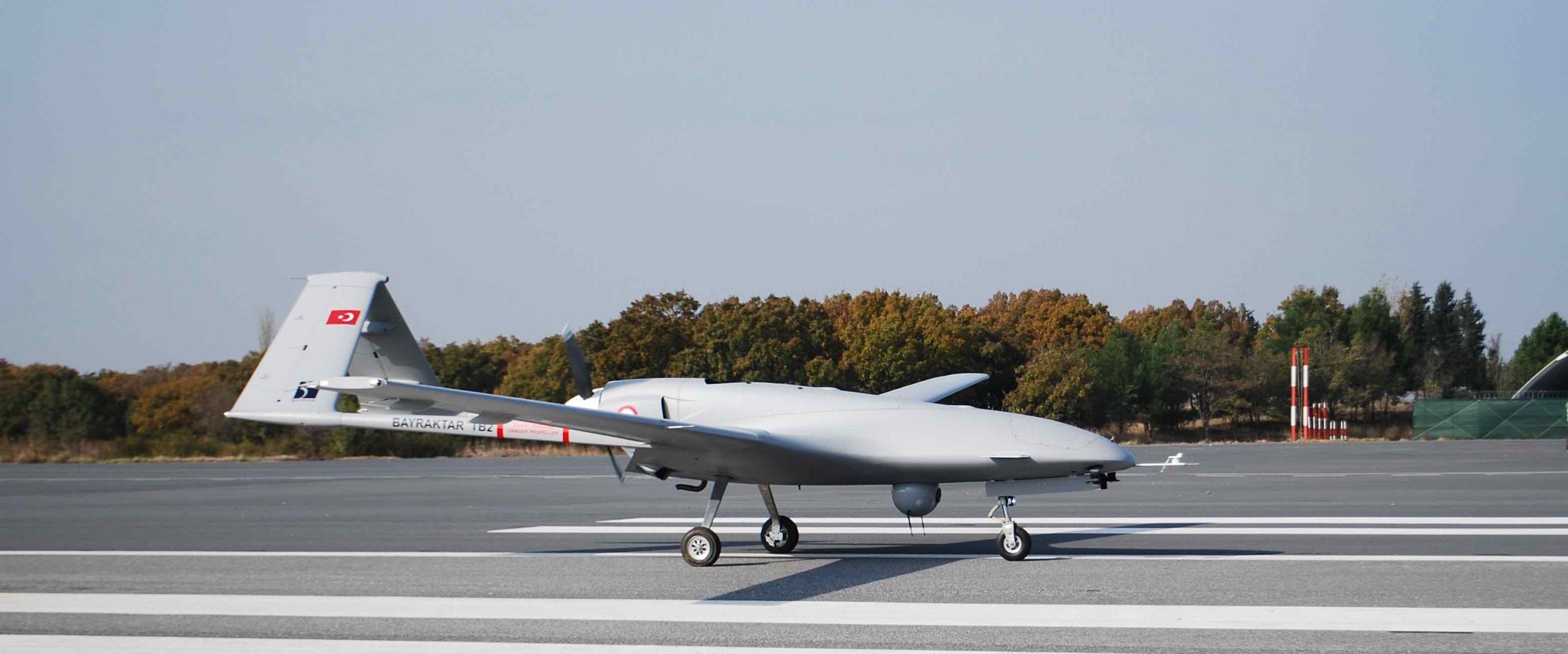
The partnership brings together two very different industrial profiles. Leonardo is Italy’s state-controlled defence and aerospace group, with established positions in sensors, electronics, avionics, systems integration and European military procurement. Baykar is one of the most visible drone manufacturers outside the United States and China, known internationally for its Bayraktar systems and for its role in supplying unmanned aircraft to Ukraine and other customers.
The strategic logic is clear. Europe has identified drones as a capability gap after the war in Ukraine showed the operational value of unmanned systems at scale. Surveillance drones, strike drones and loitering munitions have become central to modern battlefield operations, but European production has remained fragmented and, in some segments, behind faster-moving suppliers from Turkey, Israel, the United States and China.
Leonardo and Baykar have presented the venture as a way to address that weakness. The companies have said the unmanned-aircraft market could be worth around $100 billion over the next decade. For Italy, the partnership offers a route into a fast-growing segment of defence production while anchoring manufacturing and operational control on Italian territory. For Baykar, it provides access to the European defence market and a formal industrial bridge into NATO-aligned procurement.
Rome’s conditions show the political sensitivity of that opening. Baykar is a Turkish company, and Turkey occupies a complex position in European security. It is a NATO member with a large defence industry and a substantial drone-export record, but it is not an EU member and has often pursued an independent foreign policy. Italian approval therefore had to balance industrial need, alliance politics and control over sensitive military technology.
The restrictions also reflect wider concerns in Europe over defence-industrial sovereignty. European governments want to increase output quickly, but they are increasingly cautious about ownership, export rights, classified technologies and dependence on non-EU partners. The drone sector is particularly sensitive because unmanned systems combine aircraft design, command-and-control software, sensors, targeting systems and data links.
Italy’s decision suggests that cooperation with non-EU defence companies will remain possible, but not unconditional. By limiting sales to Europe- and NATO-aligned countries, Rome is seeking to prevent the venture from becoming a platform for uncontrolled exports or politically problematic downstream use. By classifying the relevant technology, it is also placing the project inside a security framework rather than treating it as an ordinary industrial deal.
The approval comes at a time when European states are under pressure to expand defence production more quickly. The war in Ukraine has exposed shortages in ammunition, air defence, electronic warfare and unmanned systems. Governments have increased defence budgets, but industrial capacity remains uneven. Partnerships with companies that already have operational drone experience are therefore attractive, even where they raise sovereignty questions.
For Leonardo, the venture could strengthen its position in unmanned systems at a time when the European defence market is moving towards more integrated platforms, sensor networks and autonomous capabilities. For Baykar, the deal increases its European profile and may help it compete for future contracts in markets where European industrial participation is politically important.
The Italian government’s intervention does not weaken the partnership. It defines its boundaries. The message is that drone production is now treated as a strategic sector in which market access, export destinations and technology control are matters of state policy.
The decision is also relevant beyond Italy. Other European governments are likely to face similar choices as they seek rapid access to drone technology while trying to preserve sovereign control over defence supply chains. Europe’s capability gap cannot be closed by regulation alone. It requires factories, suppliers, testing capacity, operational feedback and exportable systems.
The Leonardo–Baykar venture may help answer part of that problem. Rome’s conditions show the political price of doing so: Europe wants drone capacity, but it also wants to decide who controls it, where it is sold and under which alliance framework it is used.
Leonardo’s Renaissance: Italy’s Defence Giant Soars on Global Spending Boom
Main Image: By Bayhaluk – Own work, CC BY-SA 4.0, https://commons.wikimedia.org/w/index.php?curid=53447052