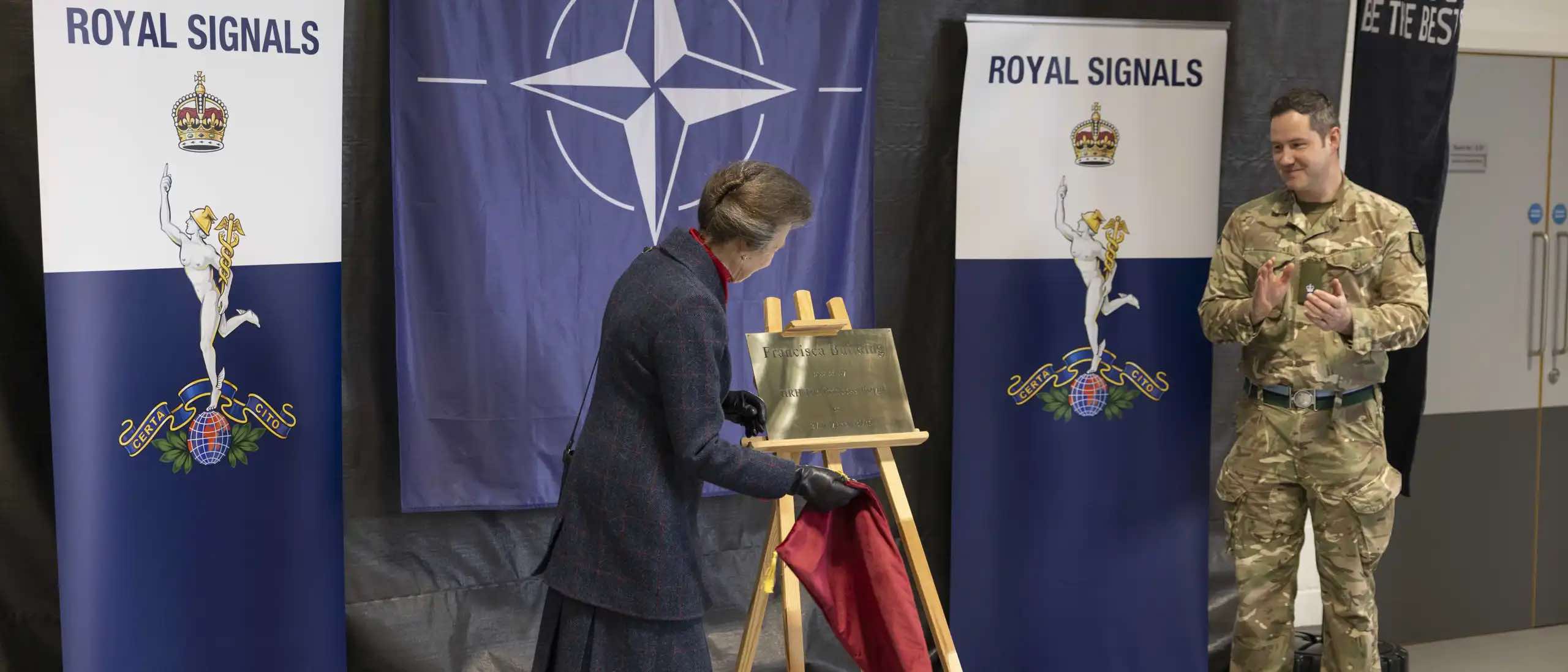
The Princess Royal, Colonel-in-Chief of the Royal Corps of Signals, formally inaugurated the purpose-built headquarters at Beacon Barracks in Stafford, providing a new home for 280 (NATO) Signal Squadron, the British Army’s only unit permanently assigned to NATO. The move marks a significant investment in the alliance’s communications infrastructure at a time when European security concerns remain at their highest level in decades.
The new headquarters is designed to support NATO operations around the world by providing secure and deployable communications systems for alliance commanders and multinational headquarters. Its completion reflects the growing importance of digital networks in military planning, where the ability to move information rapidly and securely has become as critical as the movement of troops and equipment.
During her visit, the Princess Royal toured the facility, unveiled a commemorative plaque and met personnel serving with the squadron. Her long-standing association with the Royal Corps of Signals stretches back nearly five decades, reinforcing the symbolic significance of the occasion for the regiment and the wider Army.
The investment also reflects a broader shift in NATO’s priorities. While tanks, aircraft and artillery remain indispensable, modern military operations increasingly depend upon resilient communications networks capable of functioning across multiple theatres and among forces drawn from different nations. The alliance’s ability to coordinate effectively depends on precisely the type of expertise provided by specialist signals units.
280 Signal Squadron forms part of NATO’s 1st NATO Signal Battalion and provides communications and information systems support to alliance headquarters during deployments and operations. The unit recently relocated from Dorset to Stafford, bringing together personnel and capabilities in a modern facility specifically designed for contemporary operational requirements.
Military planners frequently describe information as a strategic asset in its own right. Whether supporting humanitarian missions, deterrence operations on NATO’s eastern flank or large-scale multinational exercises, secure communications networks ensure commanders maintain situational awareness and can make decisions rapidly. The consequences of communications failure in modern warfare can be severe, making resilience and redundancy essential features of new facilities.
For the UK, the opening carries political as well as military significance. Successive governments have sought to position Britain as one of NATO’s leading contributors, particularly in areas where advanced technology and specialist expertise offer a comparative advantage. Signals intelligence, cyber resilience and communications infrastructure have become increasingly prominent components of that contribution.
The facility also highlights the transformation underway within the British Army. Traditional battlefield communications have evolved into highly sophisticated networks linking satellites, data systems, command centres and deployed formations across multiple domains. Signals personnel now operate at the intersection of military operations, cybersecurity and information management, making them among the most technically specialised members of the armed forces.
As NATO adapts to a more contested security environment, investments in communications infrastructure are likely to become more common. The ability to share intelligence, coordinate multinational responses and maintain secure command structures has become fundamental to alliance effectiveness.
Against that backdrop, the opening of the new headquarters in Stafford represents more than a routine infrastructure project. It is a visible demonstration of Britain’s continuing commitment to NATO and an acknowledgement that future military success will depend not only on firepower, but also on the networks that connect allied forces together.
In an era increasingly defined by information, the new signals headquarters may prove to be one of the most strategically significant defence investments of recent years.
Main Image: British Army
NATO cyber exercise shows Europe is still learning how to fight AI-backed disruption