 ByDefencematters.eu Correspondents
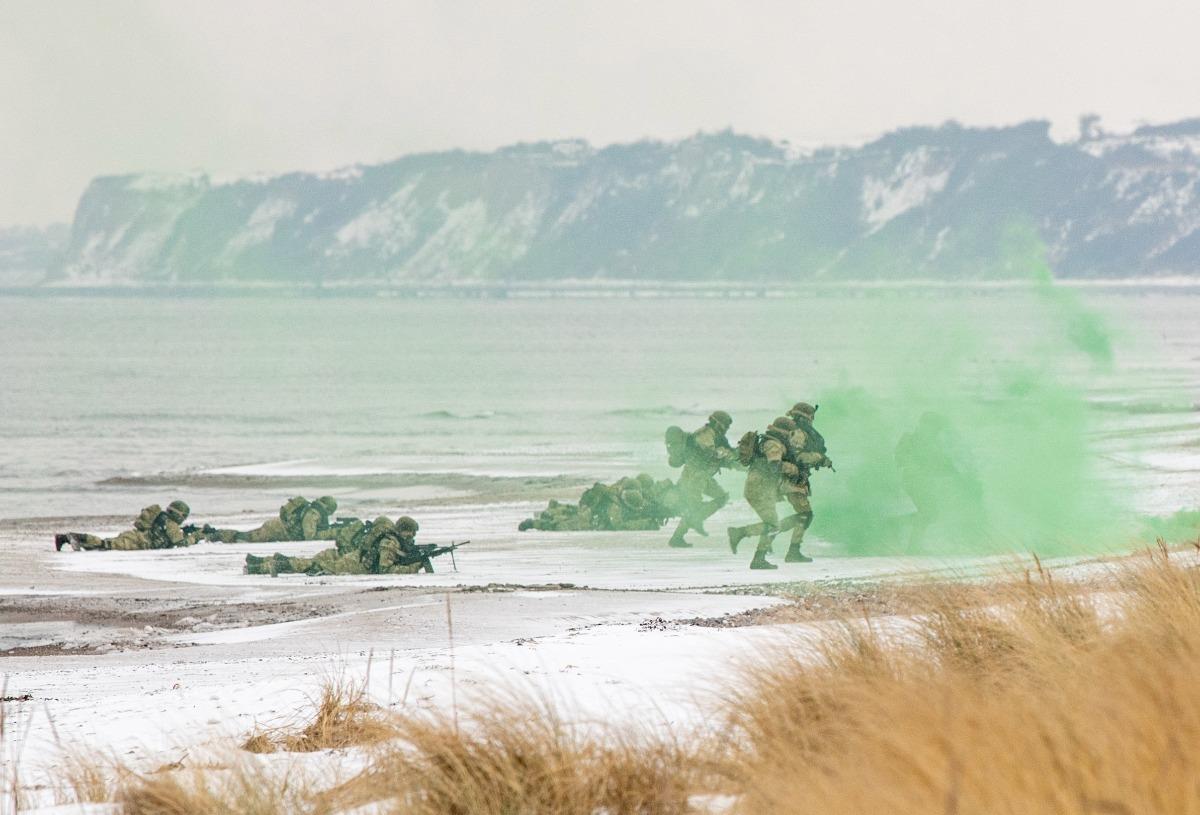
The beach-assault phase took place at the Putlos military training area in Schleswig-Holstein, near the island of Fehmarn. According to reports, the demonstration combined naval and special forces elements, supported by aircraft and a maritime task group that included around 15 vessels.
For NATO, amphibious training serves a specific purpose: it rehearses the movement of forces from sea to shore under contested conditions, and the rapid establishment of a lodgement for follow-on units and supplies. In practical terms, it tests whether national contingents can be integrated quickly—communications, command arrangements, air cover, logistics, and medical evacuation—while operating in a confined sea space close to an adversary’s anti-access capabilities.
The location is also part of the message. The Baltic Sea is narrow, heavily trafficked, and bracketed by NATO territory, with Russia holding key positions along its eastern edge, including the Kaliningrad exclave. A maritime landing only makes operational sense if it corresponds to scenarios incorporated in alliance planning, notably reinforcement of the Baltic states in a crisis and, in some contingencies, actions connected to Kaliningrad.
Kaliningrad is central to most Baltic military calculations because it hosts Russian forces and provides Moscow with a forward base from which it can threaten air and sea movement across the region. In a conflict scenario, NATO’s ability to open and maintain corridors for reinforcements—whether by land through Poland and Lithuania, by air into dispersed locations, or by sea to selected ports and beaches—would be decisive. Amphibious operations do not replace those routes, but they broaden options and complicate an opponent’s defensive planning.
The Steadfast Dart 2026 framework is designed to assess that sort of strategic mobility. It as a test of NATO’s capacity to shift forces rapidly across alliance territory, including from southern Europe towards the north-east.
The drill also comes as maritime tensions in the Baltic widen beyond purely military manoeuvres, driven by sanctions enforcement and shipping controls connected to Russian oil exports. In late January, a group of 14 European countries—11 of them EU member states—issued a joint memo stressing that vessels must sail under the flag of a single state, and that ships switching flags “according to convenience” may be treated as without nationality. The practical implication is that “stateless” vessels can be boarded and impounded under international law principles referenced by the signatories.
The memo also highlighted requirements around documentation, insurance, and maintaining clear communication with maritime authorities, against a backdrop of reported navigation interference in European waters. In policy terms, the thrust is to tighten scrutiny of tankers suspected of operating as part of a sanctions-evasion “shadow fleet”, including cases where ships turn off tracking systems or operate under opaque ownership structures.
It is against that backdrop that Nikolai Patrushev, a senior Kremlin aide and chair of Russia’s maritime board, has issued warnings about potential Western “seizures” of Russian-linked vessels. Patrushev said Russia could deploy naval forces to protect maritime interests and retaliate against European shipping if Russian vessels were taken. He also argued that any attempt at a naval blockade would be illegal and suggested that NATO might be contemplating pressure on Kaliningrad.
These statements intersect with military realities in the Baltic. Russia’s Baltic Fleet is a capable regional force, but it operates in a maritime environment where several NATO navies—Germany and Poland among them—maintain significant numbers of modern vessels, backed by air power, coastal defences, and surveillance assets spread across multiple allied states. The balance of forces and geography mean that talk of “breaking” a blockade raises questions about what a blockade would look like in practice, who would attempt to interdict whom, and how quickly escalation might follow.
For NATO planners, amphibious drills near Kiel are therefore less about a single dramatic landing and more about rehearsing the practical steps of reinforcement under pressure: assembling a task group, protecting it against air and missile threats, landing troops and equipment, and sustaining them once ashore. It is also a signal of readiness in a region where sanctions enforcement, maritime incidents, and military posturing are increasingly intertwined.
The exercise underlines a basic point: NATO wants to demonstrate that it can move forces into the theatre quickly, including by sea, and that it is training for scenarios that assume the Baltic littoral could become contested at short notice.