France has formally committed to building a new generation aircraft carrier, a decision President Emmanuel Macron unveiled this week during a visit to French troops stationed in the United Arab Emirates. The project marks a bold stride for French defence capability and national industry alike — and underlines Paris’s ambition to remain a leading global naval power well into the next decade.
The new vessel, which will eventually replace the aging Charles de Gaulle, has been designated the Porte-Avions Nouvelle Génération (PANG) and is projected to be operational by 2038. While the current flagship has served with distinction since 2001, advancing technology and the evolving security environment have made a successor not just desirable but essential.
Addressing troops in Abu Dhabi, President Macron framed the initiative as much a statement of national identity as a strategic necessity. In an era marked by geopolitical uncertainty, from renewed Russian assertiveness to varied commitments from international partners, he said France must retain the ability to project power and protect interests across the globe.
“This new aircraft carrier will be an illustration of the power of our nation, the power of industry and technology — power placed at the service of freedom on the seas and amid the upheavals of our time,” Mr Macron said. It was a vivid expression of France’s determination to combine strategic capability with economic and technological prowess.
This project also carries deep symbolic resonance, carrying forward centuries of French naval tradition while paving the way for future defence engagements. The PANG is expected to be the largest warship ever constructed in Europe, a floating testament to France’s commitment to sovereignty and international presence.
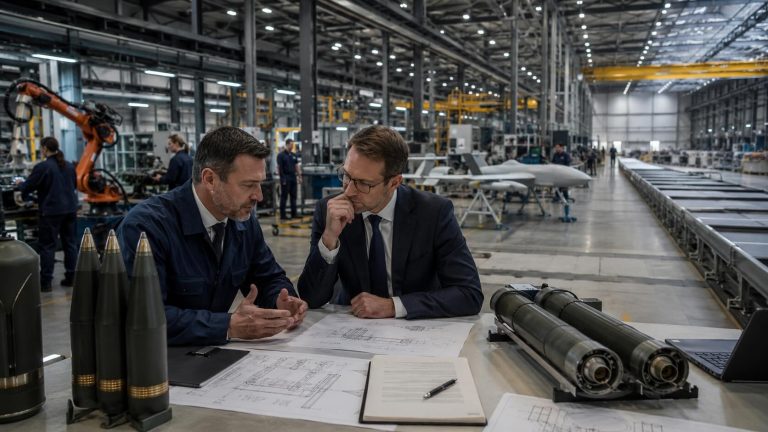
Building the PANG is not only about strategic reach — it is also an economic catalyst. The programme is expected to cost in the region of €10.25 billion, but its wider impact on French industry could be far larger. Hundreds of companies — from large defence contractors to small and medium-sized enterprises — stand to benefit from contracts linked to design, propulsion, weaponry and electronics.
Work on key components, including the nuclear propulsion system, has already begun, with progress on cutting-edge engineering that will sustain the ship’s performance for decades. The PANG will incorporate advanced technologies and likely features such as electromagnetic aircraft launch systems, bringing France into the very forefront of naval innovation.
According to defence analysts, the ripple effect from such a programme extends beyond direct employment. Shipbuilding hubs such as Saint-Nazaire — already an icon of French maritime industry — are poised to become centres of innovation and craftsmanship, reinvigorating local economies and strengthening ties between government, academia and private enterprise.
France’s decision to pursue a new carrier arrives at a time when Europe’s security architecture is under intense review. As the only European nation operating a nuclear-powered carrier, Paris has consistently emphasised its unique role in collective defence and crisis response. The PANG programme reinforces this posture, ensuring France continues to possess a mobile, sovereign platform capable of wide-ranging missions — from humanitarian relief to high-intensity operations.
Strategists note that a modern aircraft carrier also enhances France’s cooperation with allies. Carrier task groups are central to NATO’s power-projection capabilities, and a new French ship will complement existing assets from partners such as the United States and the United Kingdom. There are strong prospects for interoperability, joint exercises and strategic dialogues that could flow naturally from France’s expanded reach.
Yet this is not merely a matter of fleet composition. It is a diplomatic signal: that France sees its future intertwined with the stability of international waterways and the security of partners across continents, from the Mediterranean to the Indo-Pacific.
Details released so far suggest the PANG will be a substantial enhancement over its predecessor. Early reports indicate a displacement of nearly 80,000 tonnes, with capacity for over 30 fighter jets and a complement of around 2,000 personnel — a marked step up from the Charles de Gaulle.
Commissioning the carrier by 2038 also places the programme on a timeline that synchronises with broader French defence planning and the next generation of naval aviation. As France looks to modernise not only its ships but its overall military posture, the new carrier could underpin efforts well into the mid-21st century and beyond.
Domestic debate on the project has not been without intensity. Questions about cost, national priorities and defence spending inevitably arise whenever such major programmes are launched. Yet the government has stood firm, arguing that the long-term strategic dividends justify the investment. The capability to operate independently, to respond swiftly across oceans, and to anchor French presence in global hotspots resonates strongly with both military leaders and many citizens.
Looking ahead, the PANG project also promises to be a training ground for the future generation of French naval officers, engineers and technicians. As they prepare for service aboard this flagship of the future fleet, they carry forward a legacy of innovation, resilience and national service.
In an era of shifting alliances and evolving threats, France’s decision to build its next aircraft carrier is more than a defence procurement — it is a statement of confidence and ambition. With steel already being shaped and plans moving forward, this grand vessel will soon stand as a proud symbol of French ingenuity and enduring global engagement.
Royal Navy Confronts Surge in Russian Incursions as Moscow Tests Britain’s Maritime Defences