Mali’s military authorities are facing their most serious security crisis in years after a wave of coordinated insurgent attacks killed Defence Minister Sadio Camara and placed renewed pressure on the junta’s alliance with Russia.
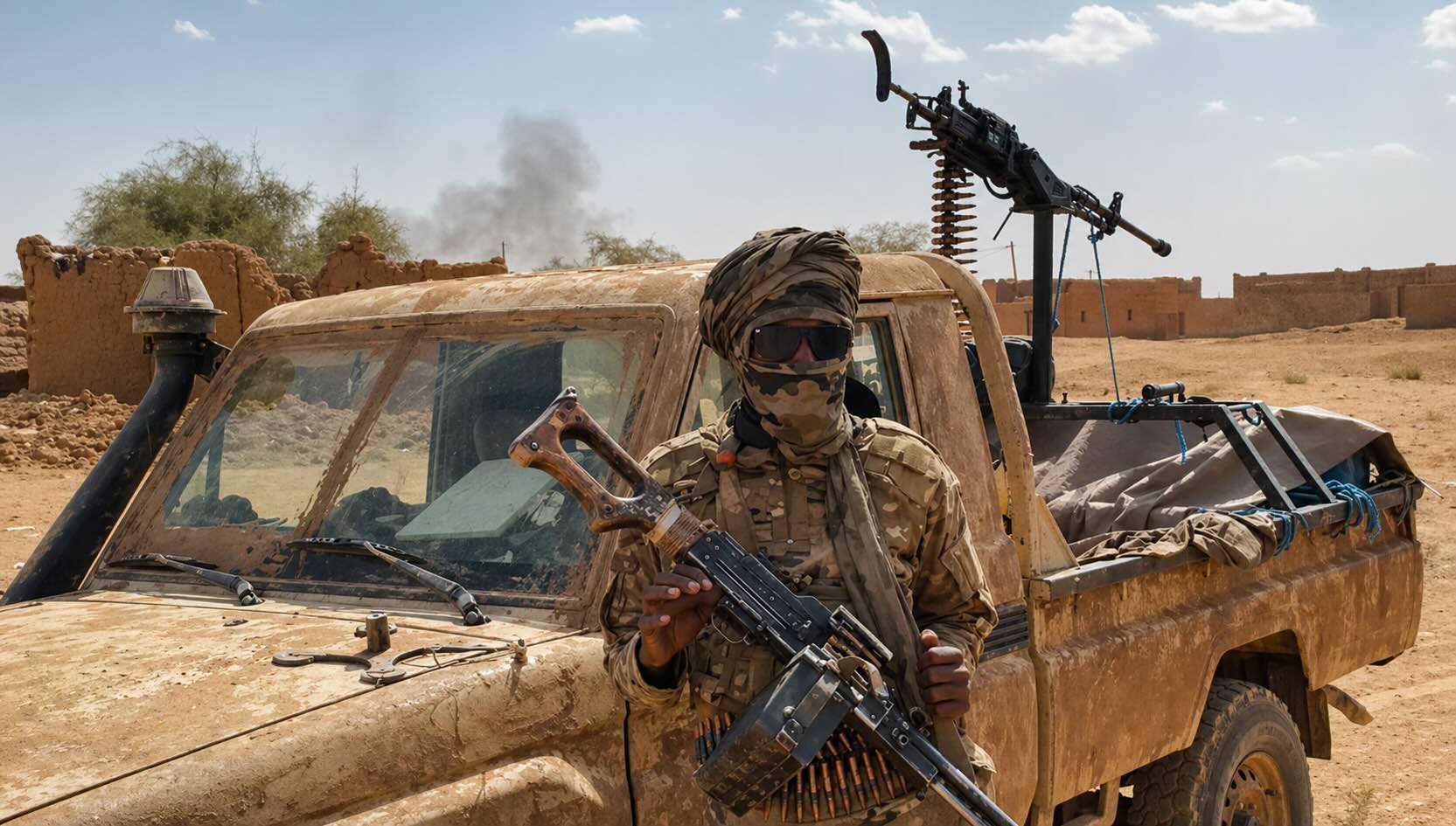
Camara was killed during an assault on his residence in Kati, near Bamako. The attack formed part of a broader operation by Jama’at Nusrat al-Islam wal-Muslimin, an al-Qaeda-linked group, and the Tuareg-led Azawad Liberation Front, known as the FLA. The assaults struck several locations, including areas near Bamako, Gao, Mopti and Kidal.
The events have dealt a significant blow to the junta’s claim that Russian support can restore security after the departure of French forces and the end of the UN peacekeeping mission. Bamako has relied heavily on Russian personnel since relations with Western partners deteriorated. What began under the Wagner brand has since been reorganised under the Kremlin-controlled Africa Corps, giving Moscow a more direct role in Mali’s security architecture.
Wagner’s Shadow System in Mali: Torture, Secret Prisons, and the Export of Russian Repression
The situation in Kidal is particularly important. The northern city was retaken by Malian forces and Russian fighters in November 2023, an operation presented by the authorities as a turning point in restoring state authority. Its renewed vulnerability undermines that message. Associated Press reported that Malian troops and Russian mercenaries withdrew from Kidal after rebel attacks, although Bamako has described military movements as operational repositioning rather than defeat.
The fall or effective loss of control over Kidal carries political weight beyond the battlefield. The city has long been central to Tuareg demands for autonomy or independence in northern Mali. Its seizure by Malian forces in 2023 was intended to demonstrate that the junta could replace Western-backed counter-insurgency with a national campaign supported by Moscow. The latest attacks suggest that territorial control remains fragile.
Moscow’s supporters have sought to attribute Russian reverses in Mali to Western and Ukrainian involvement. Similar accusations followed an ambush in 2024 that killed Malian soldiers and Russian fighters, after which Bamako cut diplomatic ties with Kyiv. Ukraine denied involvement in terrorism and described Mali’s decision as hasty.
However, the present crisis appears to be rooted principally in Mali’s internal instability. The state has struggled for years to contain overlapping conflicts involving jihadist groups, separatist movements, local militias and weak security institutions. The collapse of the 2015 peace framework, the expulsion of Western and UN forces, and the junta’s reliance on Russian paramilitary support have not produced a durable settlement.
The apparent coordination between JNIM and Tuareg-led forces is also notable. The two movements have different objectives. JNIM seeks to expand jihadist influence across the Sahel, while Tuareg separatists have historically focused on the status of Azawad in northern Mali. Their cooperation suggests that opposition to Bamako and its Russian partners can create temporary tactical alliances, even between groups with divergent political aims.
Camara’s death adds another layer of uncertainty. He was one of the most powerful figures in the ruling military structure and was closely associated with Mali’s turn towards Moscow. Le Monde described the junta as more vulnerable than at any point since taking power, with opposition voices calling for a transition to civilian rule.
The junta has not collapsed, and it continues to control state institutions and much of the security apparatus. Yet the attacks have exposed the limits of its strategy. Russian forces can provide weapons, advisers and combat support, but they have not resolved the political and territorial fractures that continue to weaken Mali.
The implications extend beyond Mali. Burkina Faso and Niger, both ruled by military governments and aligned more closely with Moscow, are also testing security partnerships that move away from France and the West. If Mali’s Russian-backed model continues to falter, the broader political project now emerging across parts of the Sahel may face greater scrutiny.
Kidal is therefore more than a local military setback. It is a test of the claim that Russian support can stabilise states where Western missions have failed. For now, Mali appears more militarised, more fragmented and less secure than when the junta promised to restore order.
Russia’s Africa Corps accused of atrocities in Mali as refugees flee to Mauritania