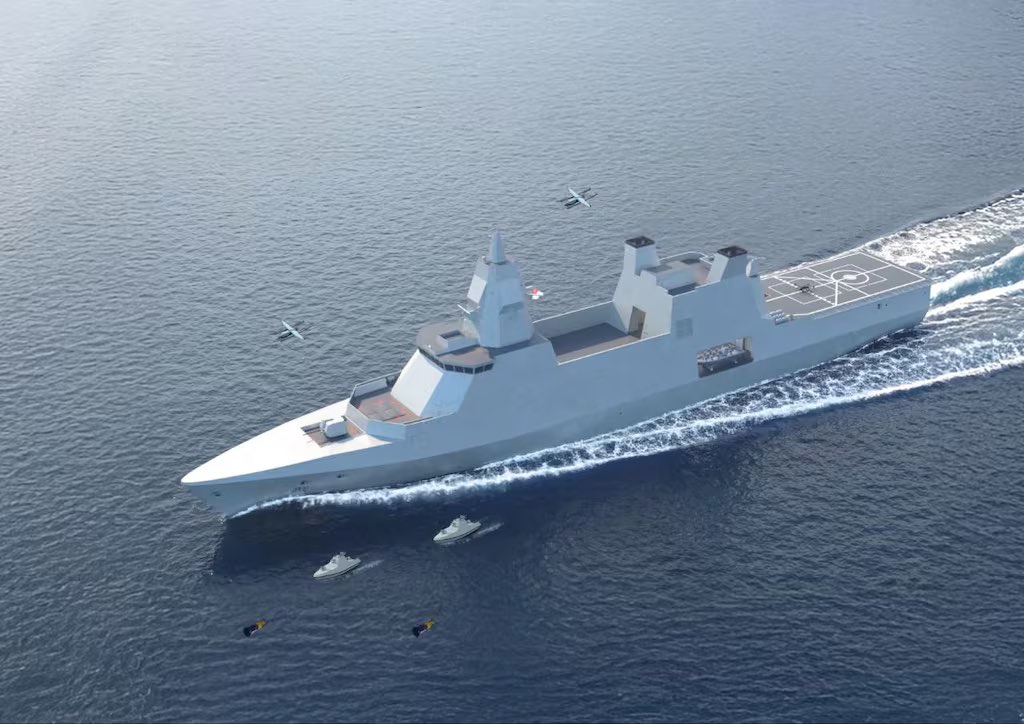
The newly launched Multi-Role Combat Vessel (MRCV), christened Victory, embodies a bold bid by the Republic of Singapore Navy to stay ahead in Asia’s silent race for naval sophistication.
At 8,000 tons and 150 m in length, Victory is already the largest surface combatant in Singapore’s fleet. However its true innovation lies not in size, but in concept: it is designed as a mothership for unmanned systems, capable of orchestrating fleets of drones, unmanned surface vessels, and submersibles, while also performing conventional warship duties.
In effect, Singapore is betting that future naval warfare will rely less on individual capital ships and more on distributed systems, networked assets, and man-machine orchestration. As Chan Chun Sing put it at the launch, the MRCV “isn’t just a ship by itself, but one integrated with artificial intelligence and an evolving brain.”
The ship is engineered for flexibility. It sports a stern flight deck, mission bays for containerised systems, cranes and launch/recovery systems for smaller vessels, and modular payload capacity. Unmanned systems can be mixed or swapped depending on mission—whether anti-submarine warfare, mine countermeasures, maritime domain awareness, or even disaster relief.
From a crew standpoint, Victory marks a sharp departure from traditional naval norms. Singapore aims to staff it with fewer than 100 sailors; under crisis conditions, just two crew members might operate the bridge. Behind this is a full electric propulsion system, a high-voltage electrical distribution network, and advanced sensors, all demanding compact power and efficient energy architecture.
The shipmaker—ST Engineering, in partnership with Saab (which provided the design and composite superstructure elements)—has aimed for stealth, reduced top weight, and corrosion resilience. The use of carbon fibre composite structures is one of the visible signs that Singapore is seeking performance gains through lightweight, advanced materials.
Armament is conventional enough to ensure the vessel remains credible. A Leonardo Strales 76 mm naval gun, remote weapon stations (Rafael Typhoon MK 30-C), and anti-air missiles (MICA, Aster) leave room for classified anti-ship missile integration. Some speculation points to the likely adoption of Blue Spear missiles from Proteus.
Singapore is a city-state with global trade ambitions, and its geographic location gives it an outsized interest in securing sea lines of communication. More than 100,000 vessels transit the Singapore Strait annually. As the minister noted, the navy’s remit has expanded beyond littoral defence: the country now aims to safeguard distant maritime interests, and that requires platforms with reach, endurance, and flexibility.
The MRCV is slated to replace six ageing 595-ton Victory-class corvettes by 2028. Singapore plans to field six of these new vessels, slotting them alongside six Type 218SG submarines, six frigates, eight littoral mission vessels, and various smaller craft—an ambitious force structure for a population of just six million. In regional terms, Singapore is joining a trend of navies reimagining surface fleets around modularity, autonomy and unmanned integration. In that sense, Victory may serve not only Singapore’s defence but also as a proving ground for export or regional cooperation. Indeed, Saab is already marketing joint Singapore-Swedish tech to other navies.
Ambition aside, the MRCV concept is not without its challenges. Integrating a swarm of unmanned systems into a human-centric naval structure is a systems engineering puzzle. Communications, command and control, cybersecurity, and risk management of assets will be vital.
Singapore’s small size presents both an advantage and a constraint. On the one hand, its defence decisions can be nimble and focused. On the other, budgetary limits and manpower constraints mean that the MRCV must deliver high operational tempo and low maintenance burdens. The reliance on advanced technology raises the bar for sustainment and electronic warfare resilience.
Further, the pace of regional naval modernization means that Victory enters a theater of intensifying competition. Larger neighbours—Australia, Japan, India, Indonesia—are pushing drone fleets, ship classes, and anti-access/area denial systems. Singapore’s MRCV will need not only to stay ahead of regional rivals, but to be interoperable, credible and avoid being outgunned by a fleet of specialised platforms.
What Victory signals is not just a new ship, but Singapore’s worldview: that small states must be innovators in an era of asymmetric maritime competition. Traditional metrics—displacement, armor, gun count—are being supplanted by adaptability, autonomy, networking and resilience.
With Victory, Singapore is betting that platform proliferation (mothership + drones) outweighs platform size. The next naval arms race may not be between ever-bigger vessels, but between ever-smarter fleets. In that contest, Victory is Singapore’s opening gambit.
Main Image: Singapore Ministry of Defence.