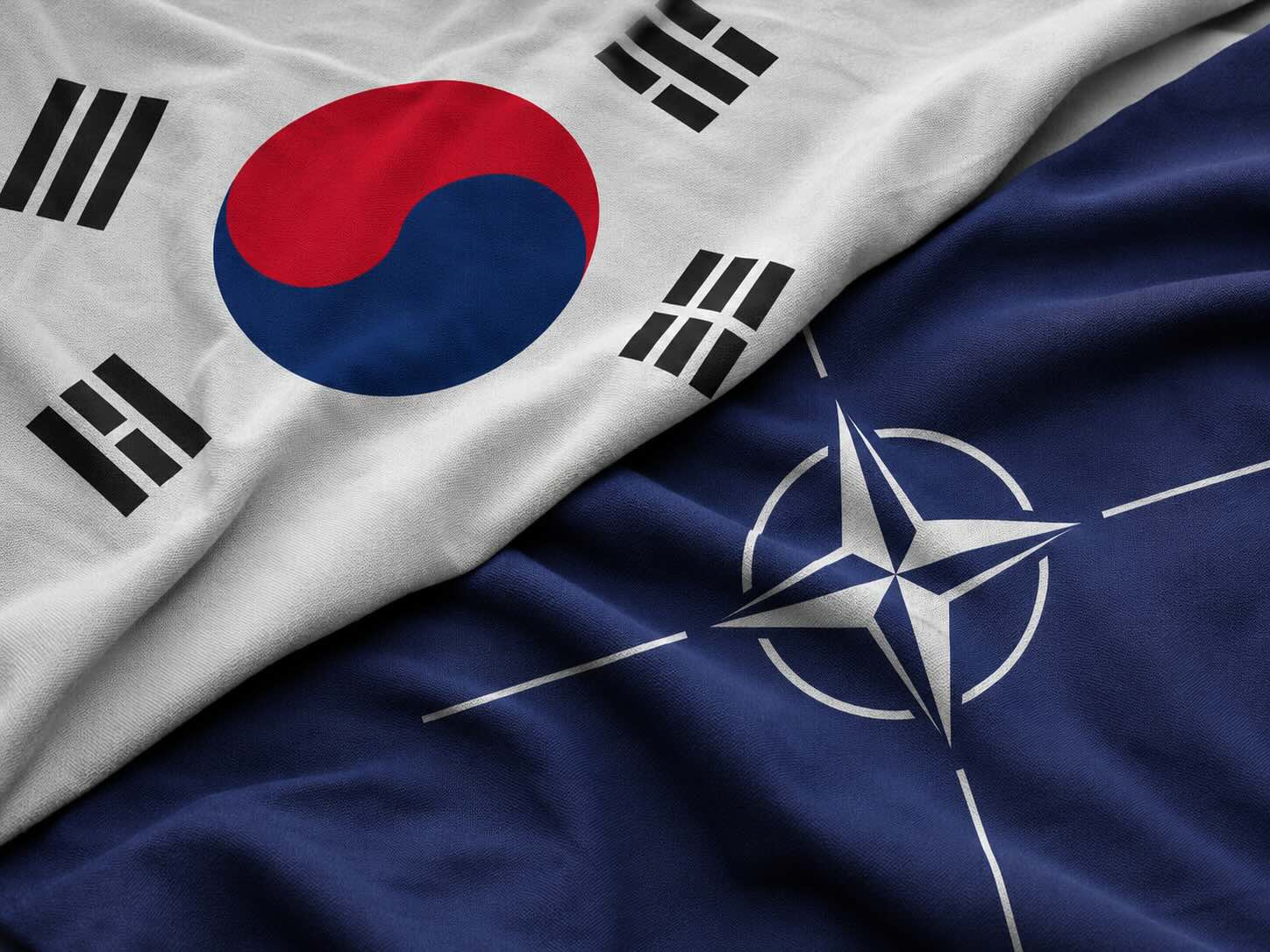
South Korean President Lee Jae Myung has proposed a new stage in cooperation with NATO built around joint weapons research, development, production and operation, rather than a conventional exporter-customer relationship.
Speaking at the Defence Industry Forum in Ankara, Lee described the proposal as a “South Korea-NATO defence industry partnership 2.0”. He argued that South Korea’s production capacity and tested technology could be combined with NATO’s operational knowledge to strengthen both sides.
The proposal reported from the summit reflects a wider change in the Alliance’s industrial geography. NATO remains transatlantic in treaty membership, but the supply base supporting its militaries increasingly extends to capable democratic partners in the Indo-Pacific.
South Korean firms have expanded rapidly in European markets because they can deliver mature systems on comparatively short timelines. Poland’s large orders for K2 tanks, K9 howitzers and FA-50 aircraft demonstrated the appeal of available production when European factories were unable to meet urgent demand.
That model is evolving. Local assembly, technology transfer and European production are becoming central to contracts. Joint research and operation would go further by integrating Korean systems into NATO standards and development cycles from the outset.
For European governments, this could expand capacity in land systems, ammunition, missiles, electronics and shipbuilding. It could also create competitive pressure on domestic suppliers facing long delivery times and rising costs.
Equipment must operate inside NATO command, communications and logistics networks. Data links, identification systems, ammunition standards, cybersecurity and software access all matter. A platform that performs well nationally may require substantial integration before it can serve in a multinational force.
Joint development can address those issues earlier. It can also divide cost and provide larger production runs. However, governments will need agreements on intellectual property, export controls and the treatment of sensitive technology.
South Korea has its own security priorities on the Korean Peninsula. NATO customers must be confident that production allocated to Europe will remain available during simultaneous crises in Asia. Seoul, in turn, will want access to European markets and technology rather than a one-sided expectation that its factories provide emergency capacity.
Europe’s rearmament strategy emphasises strengthening domestic manufacturing. Cooperation with South Korea can support that objective if it includes European production and supply chains. It can undermine it if urgent imports become a permanent substitute for investment at home.
The same tension is visible in NATO’s reliance on specialised external systems. Defence Matters has examined how Europe remains exposed in capabilities traditionally supplied by the United States. South Korea offers diversification, but diversification is not identical to autonomy.
European policymakers therefore need to distinguish among three goals: obtaining equipment quickly, increasing allied industrial resilience and preserving sovereign control over critical capabilities. A well-designed Korean partnership can contribute to all three; a simple purchase may deliver only the first.
The proposal also reflects the strategic connection between European and Indo-Pacific security. Russia’s cooperation with North Korea, and growing alignment among Moscow, Beijing, Pyongyang and Tehran, has made defence production and technology transfer a cross-regional concern.
NATO already works with South Korea as an Indo-Pacific partner. Expanding that relationship into production could create shared stockpiles, common testing and reciprocal access to facilities. It may also help Europe learn from South Korea’s ability to maintain large-scale manufacturing alongside advanced technology.
Lee’s speech is not yet a procurement agreement. The significant next steps would be named projects, participating allies, investment commitments and rules for production during crisis.
The political signal is nevertheless clear. NATO’s industrial problem is too large to solve through the traditional transatlantic base alone. South Korea sees an opportunity to become more than an outside supplier. Europe must decide whether it wants that capacity merely as a faster source of weapons or as part of a deeper, mutually governed defence-production network.