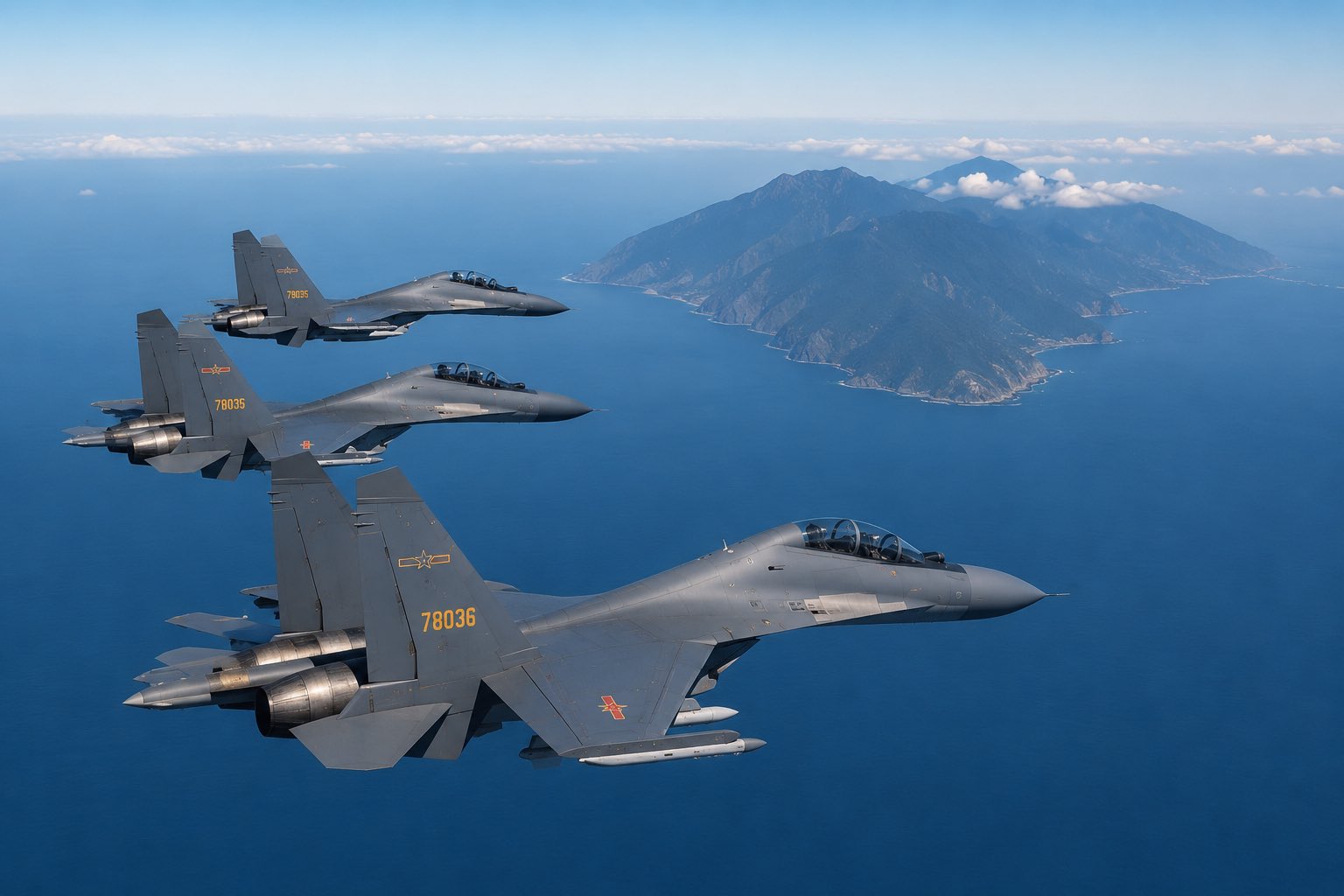
Taiwan’s defence ministry said it detected 21 Chinese military aircraft operating around the island, including J-16 fighter jets and unmanned aerial vehicles, alongside warships from the People’s Liberation Army Navy. Taiwanese armed forces responded by scrambling aircraft, deploying naval vessels and activating coastal missile systems to monitor the activity.
The manoeuvres came only days after a similar Chinese patrol coincided with the first anniversary of Taiwanese President Lai Ching-te taking office. Beijing has repeatedly branded Lai a “separatist” and has hardened its rhetoric since his inauguration, accusing his administration of pushing the island closer to formal independence.
For investors and policymakers alike, the tempo of Chinese military operations has become less notable than their consistency. What was once treated as exceptional signalling by Beijing is increasingly regarded as the new operating environment across the Taiwan Strait. Chinese naval and air incursions now occur almost daily, gradually eroding the informal boundaries that long helped preserve a fragile equilibrium.
Senior Taiwanese security officials reacted sharply to Monday’s activity. Joseph Wu, secretary-general of Taiwan’s National Security Council and a former foreign minister, said Beijing had become “the sole source of instability” in the Indo-Pacific region. Taipei argues that China’s sustained military pressure is intended not only to exhaust Taiwan’s defences but also to normalise the permanent presence of PLA forces close to the island.
The latest patrols follow recent talks between Chinese President Xi Jinping and US President Donald Trump in Beijing, discussions that reportedly included Taiwan among broader strategic issues. Taipei has remained on heightened alert since the meeting, concerned that China may seek to exploit geopolitical uncertainty and shifting priorities in Washington.
The pattern reflects a broader transformation in China’s military doctrine. Rather than relying solely on headline-grabbing exercises, the PLA has increasingly embraced what regional analysts describe as “persistent pressure” tactics — calibrated displays of force designed to wear down Taiwanese readiness while avoiding outright conflict.
Taiwanese officials say some Chinese warships have recently approached within 24 nautical miles of Taiwan’s coastline, distances that raise concerns over rapid missile strike capabilities and compressed response times. The defence ministry has also been tracking movements by the Chinese aircraft carrier group led by the Liaoning in the western Pacific.
The maritime dimension of the standoff has become especially sensitive. Over the weekend, Taiwan’s coast guard was involved in a tense confrontation near the Pratas Islands after a Chinese coast guard vessel entered nearby waters claiming jurisdiction over the territory. Taiwanese authorities issued radio warnings before the vessel eventually withdrew.
Such incidents are contributing to a growing sense among regional governments that the Taiwan Strait and South China Sea are becoming increasingly interconnected theatres of strategic competition. Japan, the Philippines and Australia have all deepened defence co-operation with the United States over the past two years, reflecting mounting anxiety over Chinese naval expansion.
Beijing, however, continues to insist that its actions are legitimate military operations within what it considers sovereign Chinese territory. China views democratically governed Taiwan as part of its territory and has never renounced the use of force to achieve unification. Taiwan’s government rejects those claims, arguing that the island’s future should be determined only by its 23mn people.
For financial markets, the immediate implications remain contained. Yet the longer-term economic risks are substantial. Taiwan sits at the centre of the global semiconductor supply chain, producing advanced chips essential to industries ranging from artificial intelligence to automotive manufacturing. Any escalation in cross-strait tensions would reverberate far beyond Asia.
Western officials increasingly fear that the danger lies less in deliberate conflict than in miscalculation. With Chinese and Taiwanese forces operating in ever closer proximity, the probability of an accident — a collision at sea, a misread manoeuvre or an unintended escalation — rises steadily.
The current cycle of patrols suggests Beijing is seeking to test not only Taiwan’s military endurance but also the political stamina of its allies. Whether Washington and regional partners can sustain credible deterrence without provoking further escalation is rapidly becoming one of the defining strategic questions of the decade.