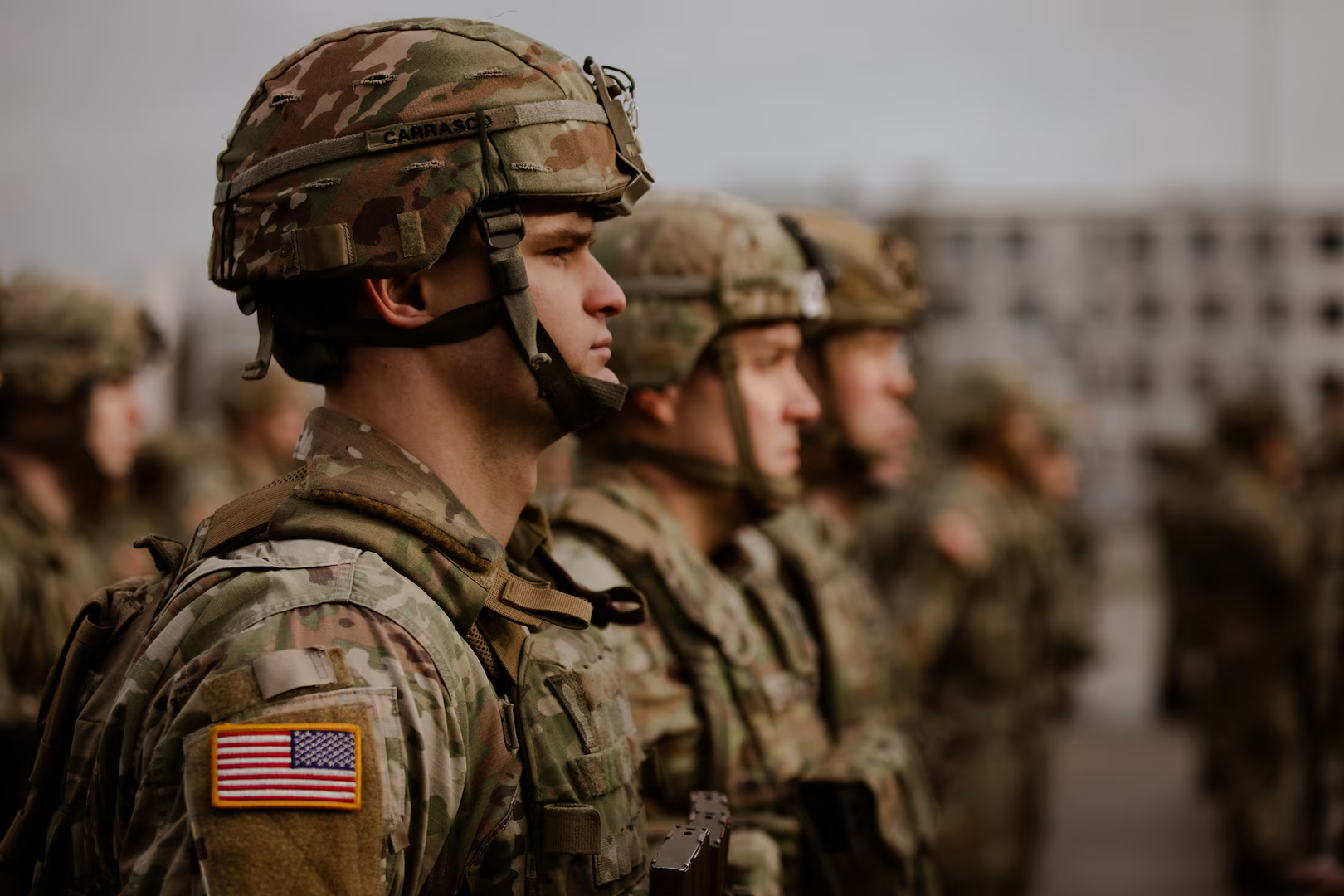
Lithuanian Defence Minister Robertas Kaunas said the United States had committed to maintaining troop rotations, but that the timing, scale and composition of the next deployment were not yet clear. According to Reuters, the current US personnel in Lithuania are leaving, while their replacements have not yet arrived.
The issue is not simply administrative. Lithuania has hosted rotational US armoured units since 2020, with deployments that have included Abrams tanks, Bradley infantry fighting vehicles and Paladin self-propelled howitzers. The presence has become part of the practical deterrence architecture along NATO’s north-eastern border, particularly because Lithuania borders Belarus and lies close to Russia’s Kaliningrad exclave.
The latest rotation, which arrived in October 2025, included two battalions from the Texas-based 1st Cavalry Division and was the first to use newly built permanent infrastructure at Pabradė, near the Belarusian border. Lithuania’s Defence Ministry said the facilities were designed to support Allied readiness and host heavy US forces, with accommodation, maintenance and training infrastructure at the site.
That investment reflects a broader Baltic assumption: that national defence spending, host-nation support and integration with Allied units would help sustain a visible American presence in the region. Lithuania’s defence ministry has said the country plans to spend 5.4 per cent of GDP on defence in 2026, one of the highest levels in NATO. Vilnius has sought to present itself as a reliable host for US and Allied troops rather than as a passive security recipient.
The uncertainty over the next US rotation therefore carries significance beyond Lithuania. It comes after separate reports that the United States is considering or implementing changes to parts of its European force posture, including reductions affecting deployments in Germany and uncertainty around troops in Poland. Washington has repeatedly pressed European allies to assume a greater share of the burden for continental defence, while NATO governments have sought clarity on how far this will affect actual deployments.
For Lithuania, the immediate question is whether a gap between rotations could weaken the credibility of deterrence on its territory. Rotational deployments do not carry the same permanence as a fully stationed force, but they provide visible reassurance, operational familiarity and the ability to train with local and Allied units in the same terrain where any crisis would unfold. A pause, reduction or change in the composition of those deployments would be watched closely by both allies and adversaries.
The Baltic states have long argued that geography makes forward defence essential. Lithuania sits between Latvia, Poland, Belarus and Kaliningrad, making its territory central to NATO planning for the region. The Suwałki corridor, the narrow land connection between Poland and Lithuania, is often treated as one of the alliance’s most sensitive points because it links the Baltic states to the rest of NATO by land.
The American presence has also had political value. For Vilnius, US troops on Lithuanian soil have been a signal that any attack would immediately involve the United States. That is why uncertainty over future rotations is politically sensitive even if Washington says the broader commitment remains intact.
There is no confirmed decision to end the US presence in Lithuania. Kaunas’ statement indicates a review rather than a withdrawal announcement. But in deterrence policy, ambiguity can itself become consequential. Allies need to plan exercises, infrastructure use, logistics, local training schedules and reinforcement assumptions. If rotation timelines become uncertain, host nations must adjust around gaps they cannot fully control.
The issue also highlights a wider strategic problem for Europe. Even countries that have sharply increased defence spending remain dependent on US enablers, heavy formations, air defence, logistics and political signalling. Lithuania’s spending is high by NATO standards, but its national capabilities cannot substitute for the role played by American armoured forces in the region.
For NATO, the Lithuanian case comes at a difficult moment. The alliance has strengthened its forward presence since Russia’s full-scale invasion of Ukraine in 2022, including through the reinforcement of its eastern-flank posture. But the sustainability of that posture depends on political decisions in Washington as much as on spending pledges in Europe.
A review of one rotation in one Baltic state may appear narrow, but it touches the central question facing European defence: how much of NATO’s eastern-flank deterrence remains dependent on US decisions that may change with American priorities.
The practical outcome of the review will matter. A like-for-like replacement would suggest continuity. A smaller or delayed deployment would reinforce concerns that the United States is reducing its European footprint while asking allies to take on more responsibility. A change in equipment or unit type could also alter the character of the deployment, even if the political message remains one of commitment.
Lithuania has built facilities, raised spending and positioned itself as a frontline NATO ally. The uncertainty now lies less in Vilnius than in Washington. For Baltic governments, that is the uncomfortable part: deterrence on NATO’s eastern flank still depends not only on what Europe is willing to spend, but on what the United States is willing to keep in place.