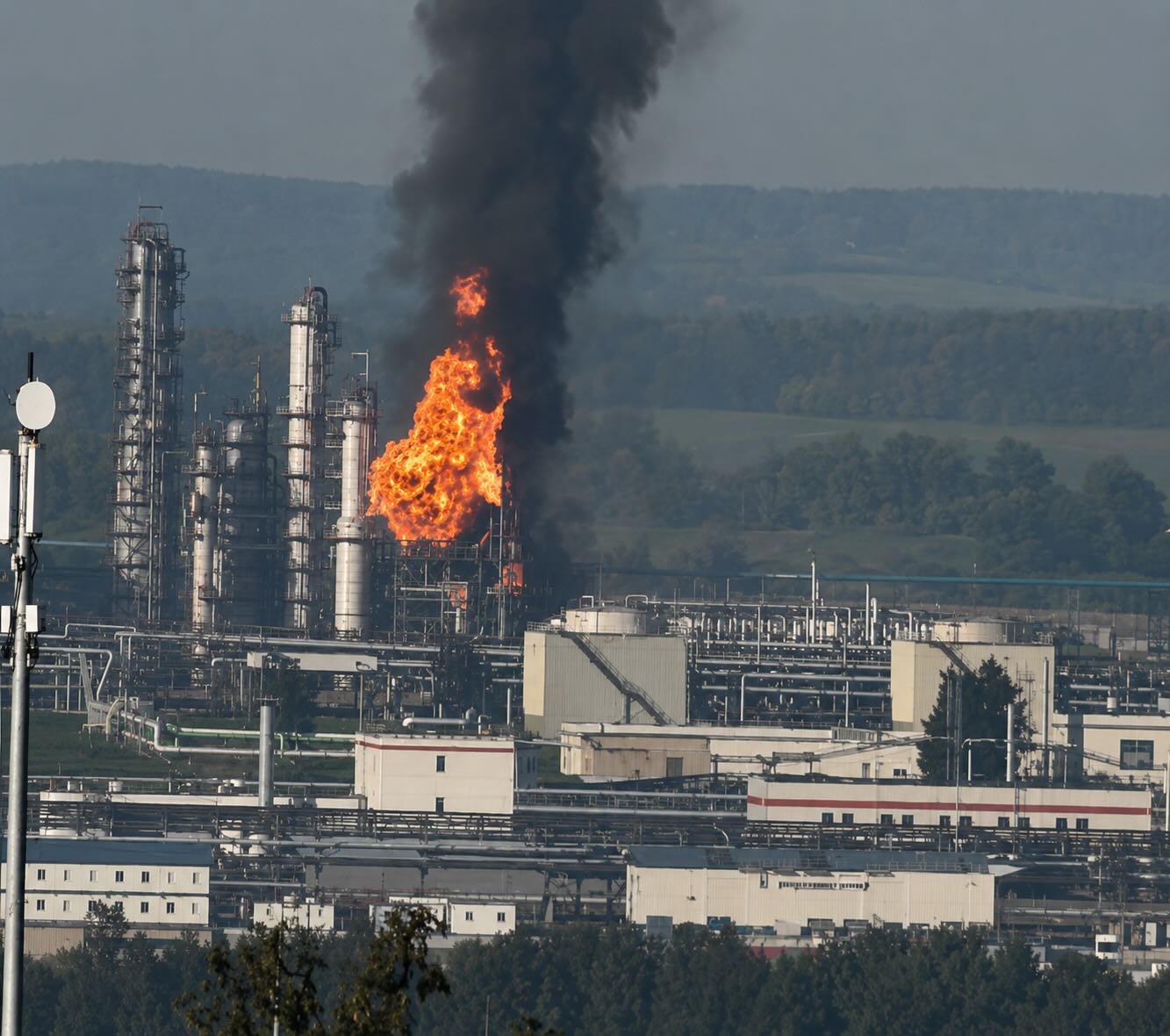
A major Lukoil refinery in Russia’s Nizhny Novgorod region was reported burning on Wednesday after an overnight drone attack, the second strike on the Kstovo facility in three days and part of a wider Ukrainian campaign against Russia’s energy and military-industrial infrastructure.
Gleb Nikitin, governor of Nizhny Novgorod region, said Russian air defences had downed 30 drones overnight and in the morning. He said falling debris had damaged two industrial facilities in the Kstovo district, causing fires, but did not identify the sites. Ukrainian media and the Russian Telegram channel Astra identified one of the affected sites as Lukoil-Nizhegorodnefteorgsintez, also known as NORSI, one of Russia’s largest refineries.
Footage circulated on social media showed thick black and grey smoke rising above an industrial area and visible flames at the plant. Astra reported, citing local residents and visual material, that the strike appeared to have hit the south-western part of the refinery, possibly an ELOU-AVT primary crude-processing unit. Such units are central to initial refining operations, separating crude oil into basic fractions including petrol components, kerosene, diesel, vacuum gas oil and heavy residue.
The Kstovo refinery has an installed processing capacity of around 16 to 17 million tonnes of crude oil a year. It is one of the principal refineries serving central Russia and is significant for fuel supplies to the Moscow region. Reuters has previously identified NORSI as Russia’s fourth-largest refinery and second-largest producer of petrol.
The attack followed a reported strike on the same plant on May 18. It also came after a broader series of Ukrainian drone operations against Russian refineries, fuel depots, pumping stations and export-linked oil infrastructure. Moscow’s defence ministry said that 273 Ukrainian drones had been intercepted or destroyed overnight across Russian regions, occupied Crimea and the Black Sea and Azov Sea areas. The Russian figure has not been independently verified.
The immediate operational effect at Kstovo remains unclear. Lukoil has not issued a detailed public assessment of damage, and Russian regional officials have limited their statements to fires at industrial sites. However, the repeated targeting of the same refinery suggests that Ukraine is seeking cumulative disruption rather than isolated damage.
That pattern is now visible across Russia’s refining network. Reuters reported this week that the Ryazan refinery, owned by Rosneft and responsible for nearly five per cent of Russia’s refining output, halted operations after a May 15 drone attack. The plant processed 13.1 million tonnes of crude in 2024 and produced large volumes of petrol, diesel and fuel oil.
The Moscow refinery also stopped processing after a Ukrainian drone attack at the weekend, according to two industry sources cited by Reuters. The shutdown was reported as temporary, but it added to pressure on the group of refineries and oil-product routes that supply the capital and surrounding region.
The pattern of strikes indicates that Ukraine is seeking to apply pressure across Russia’s fuel supply chain rather than relying on isolated attacks. The Moscow, Ryazan and Kstovo refineries all have relevance for supplies to central Russia, including the capital region. Repeated attacks on refineries, fuel depots and pumping stations could complicate repairs, reduce refining flexibility and force Moscow to devote additional air-defence resources to industrial sites far from the front.
The same source also pointed to reported drone activity around Nevinnomyssk in Stavropol region, where the Nevinnomyssk Azot chemical plant is located. Reuters reported that drones had targeted industrial areas around Nevinnomyssk and that the site has previously been attacked. The plant is a major chemical facility and part of Russia’s wider industrial base, although the extent of damage from the latest reported incident has not been independently confirmed.
Ukraine’s long-range drone campaign has expanded sharply in 2026. Reuters reported that attacks on Russian oil refineries have doubled this year, with strikes affecting refineries, pipelines and storage facilities. According to that reporting, around 700,000 barrels per day of Russian refining capacity was knocked offline across 16 refineries between January and May 2026.
The strategic logic is clear. Refineries support civilian fuel supply, military logistics, aviation fuel production and export revenue. Even temporary shutdowns can force Russia to reroute crude, reduce processing, draw on inventories, or shift more oil towards export channels already constrained by infrastructure capacity. Reuters reported separately that Russian exports from western ports rose in early May as refinery disruptions pushed more crude towards seaborne export routes, though pipeline capacity limited further growth.
Kyiv rarely comments officially on individual attacks inside Russia. Ukrainian officials have, however, repeatedly argued that oil refineries, fuel depots and logistics hubs are legitimate targets where they support Russia’s war effort. Moscow describes such strikes as terrorism, while continuing its own large-scale missile and drone attacks against Ukrainian cities, power infrastructure and industrial sites.
The Kstovo strike therefore matters beyond the immediate fire. It shows that Ukrainian drones can repeatedly reach high-value industrial targets deep inside Russia, including facilities hundreds of kilometres from the front. It also adds to a wider problem for Moscow: the need to protect a vast network of refineries, storage sites, pumping stations and export terminals against increasingly frequent long-range attacks.