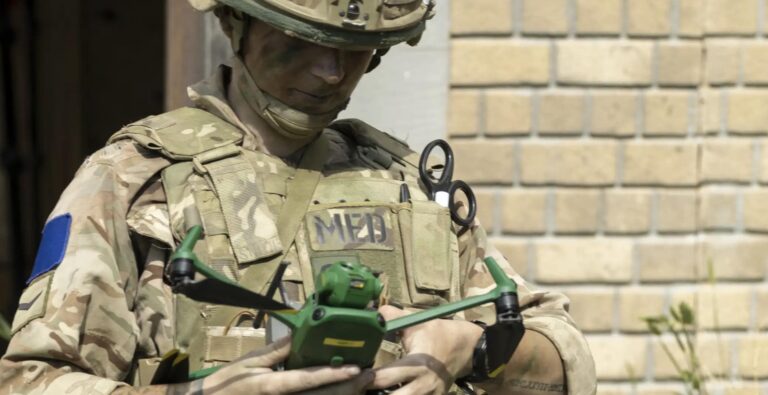
The device came down inside the compound of the 2nd Radioelectronic Centre, a specialist unit linked to signals intelligence and electronic warfare. Radio ZET reported that personnel on duty observed the drone flying over the base and that it crashed about 70 metres from a weapons storage area. The broadcaster also said the drone was carried into a building after it fell.
Military Police said it was examining the circumstances of an unauthorised flight into controlled airspace. State-linked reporting described the drone as “toy-like”, without identifying its origin or operator. No injuries were reported and authorities have not said whether any material damage was recorded.
The location matters because the Przasnysz unit’s remit includes monitoring the radio environment in north-eastern Poland, including the Suwałki Gap — the stretch of territory along the Poland–Lithuania border that forms the only land route linking the Baltic states to the rest of the Alliance. The area sits between Russia’s Kaliningrad exclave and Belarus, and is treated in NATO planning as a sensitive point in any regional contingency.
Radio ZET suggested the drone may have been used for reconnaissance, including potential scanning of antenna arrays. Polish authorities have not publicly endorsed that assessment, but it aligns with wider European concerns that small drones can be used to collect information, test responses, or map electronic emissions.
Poland has previously reported airspace incidents amid Russian strikes on Ukraine, including objects entering Polish airspace and occasions when Warsaw has scrambled aircraft. The Przasnysz episode differs in that the drone fell inside a secured facility, and because the base’s role includes electronic surveillance and countermeasures.
Across Europe, drone sightings near military sites and critical infrastructure have driven debate about detection and the legal basis for neutralising unmanned aircraft. In Germany, the cabinet agreed draft legislation in October to give police explicit authority to bring down rogue drones in cases of acute danger. Germany’s military intelligence service later said drone sightings over German bases had reached record levels in October 2025, with increased attention on naval facilities.
For NATO members, small unmanned aircraft present a practical problem because they can be cheap, commercially available and difficult to attribute. Even an unsophisticated platform can carry sensors capable of collecting signals or imagery. Incidents also provide an opportunity for an operator to gauge response times, identify coverage gaps and observe how a site manages evidence and safety.
In Przasnysz, the reported handling of the device after it fell has added an operational dimension. In comparable cases, security services typically treat unknown drones as potential evidence and as possible explosive hazards, restricting access until specialist teams can secure and assess the object. Polish authorities have not detailed the procedures used on the day, and it remains unclear whether the drone was still powered when it was moved.
Warsaw has invested in air defence and counter-drone capabilities since 2022, including procurement of systems and expanded training. The incident is likely to intensify questions about how base-level response plans are written, rehearsed and resourced, particularly at installations whose mission includes detecting and countering electronic threats.
The episode also coincides with Poland’s diplomatic agenda on Ukraine and regional defence. Prime Minister Donald Tusk said he would travel to Kyiv in the coming days at the invitation of President Volodymyr Zelenskyy, according to Polish and Ukrainian media reports.
For Polish investigators, the immediate task is to establish how the drone entered the area, what it carried, and whether it was operating as part of a deliberate mission or a loss-of-control incident. For NATO planners, the broader question is how rapidly small unmanned aircraft can be detected, tracked and neutralised above protected sites, and how procedures at the tactical level translate into alliance-wide resilience.