The impending expiry of the New START treaty on February 5th marks the quiet death of the last surviving pillar of Cold War-era arms control. For more than a decade, it capped deployed strategic warheads, constrained delivery systems and, crucially, allowed American and Russian inspectors to verify each other’s compliance. Its lapse does not mean missiles will immediately multiply, but it does mean that the habits, assumptions and guardrails of nuclear management are dissolving.
Ryabkov’s remarks, delivered in Beijing, were striking not for their aggression but for their fatalism. The message was not “we will escalate”, but “this is how the world now works”. In Moscow’s view, Washington has shown neither the political will nor the strategic coherence required to preserve bilateral arms control, let alone adapt it to a multipolar age. The absence of a reply, Ryabkov implied, was itself a reply.
That framing matters. Russia is positioning itself not as the wrecking ball of arms control but as a realist power adjusting to circumstances imposed by others. This narrative will find a receptive audience beyond the West, particularly among states that see American diplomacy as episodic and distracted. The Kremlin is betting that history will judge the treaty’s collapse as a symptom of Western drift rather than Russian belligerence.
Yet the strategic consequences are profound. Without New START, both the United States and Russia are free to expand their deployed arsenals without legal constraint. Even if neither side intends to do so immediately, the absence of verification alone increases suspicion. Nuclear stability depends less on goodwill than on predictability, and predictability is hardest to sustain when transparency evaporates.
The deeper problem is that arms control has failed to keep pace with geopolitical reality. New START was designed for a bipolar world that no longer exists. China’s rapid nuclear expansion has rendered the old US-Russia duopoly obsolete, yet Beijing has consistently refused to join trilateral talks. Ryabkov’s respectful nod to China’s position was revealing: Moscow sees no advantage in pressuring its most important strategic partner to accept limits it has never signed up to.
Washington, by contrast, finds itself trapped by its own logic. It is reluctant to extend or replace a bilateral treaty that excludes China, yet unable to persuade Beijing to participate in a broader framework. The result is paralysis. In attempting to solve tomorrow’s problem, the United States risks inheriting a worse version of today’s.
Europe sits awkwardly in the middle. While not a party to New START, it is the most exposed to its collapse. Any expansion in Russian or American strategic forces, any recalibration of doctrines, any renewed emphasis on missile defence or forward deployment will play out across the European theatre. For NATO allies already grappling with war in Ukraine and questions about American staying power, the disappearance of arms control only deepens unease.
There is also a technological dimension often overlooked in treaty debates. Hypersonic glide vehicles, space-based sensors, cyber interference with command-and-control systems and the integration of artificial intelligence into decision-making all strain the assumptions on which Cold War-era agreements were built. Treaties designed to count warheads struggle to address systems that compress warning times and blur the line between conventional and nuclear escalation.
None of this means a new arms race is inevitable. Nuclear weapons remain staggeringly expensive, politically sensitive and strategically blunt instruments. Russia, constrained by war and sanctions, has little incentive to embark on a dramatic numerical build-up. The United States faces its own fiscal and political limits. But restraint without structure is fragile, dependent on leadership continuity and mutual interpretation rather than binding rules.
Perhaps the most troubling aspect of Ryabkov’s comments is their normalisation of drift. A world without limits is presented not as a crisis demanding urgent diplomacy, but as a condition to be managed. That may be realistic. It is also dangerous. Arms control did not eliminate rivalry, but it channelled it. Its disappearance leaves great powers navigating nuclear competition by instinct rather than agreement.
The real test will not be how many warheads are deployed next year, but whether any serious effort emerges to rebuild a framework suited to a fragmented, multipolar nuclear order. For now, Russia’s message is clear: the age of rules is fading, and the age of raw strategic calculation has returned.
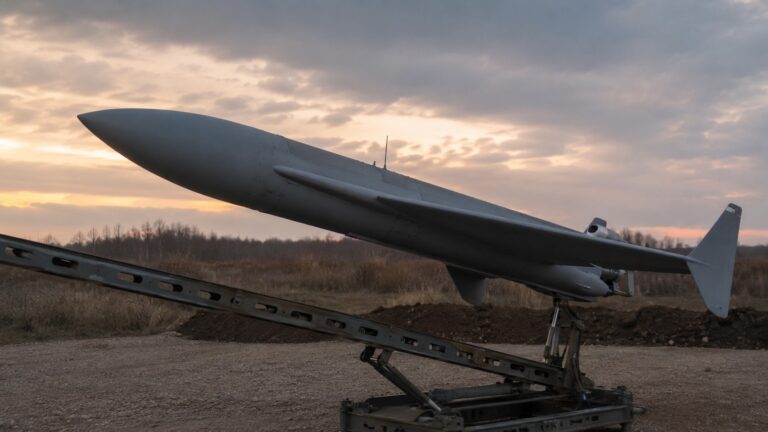
Main Image: By ISC Kosmotras – Source: ISC Kosmotras (approbation of use), CC BY 2.5, https://commons.wikimedia.org/w/index.php?curid=1820661
Latvia intelligence: Russia is starting to view Latvia as it viewed Ukraine before the invasion