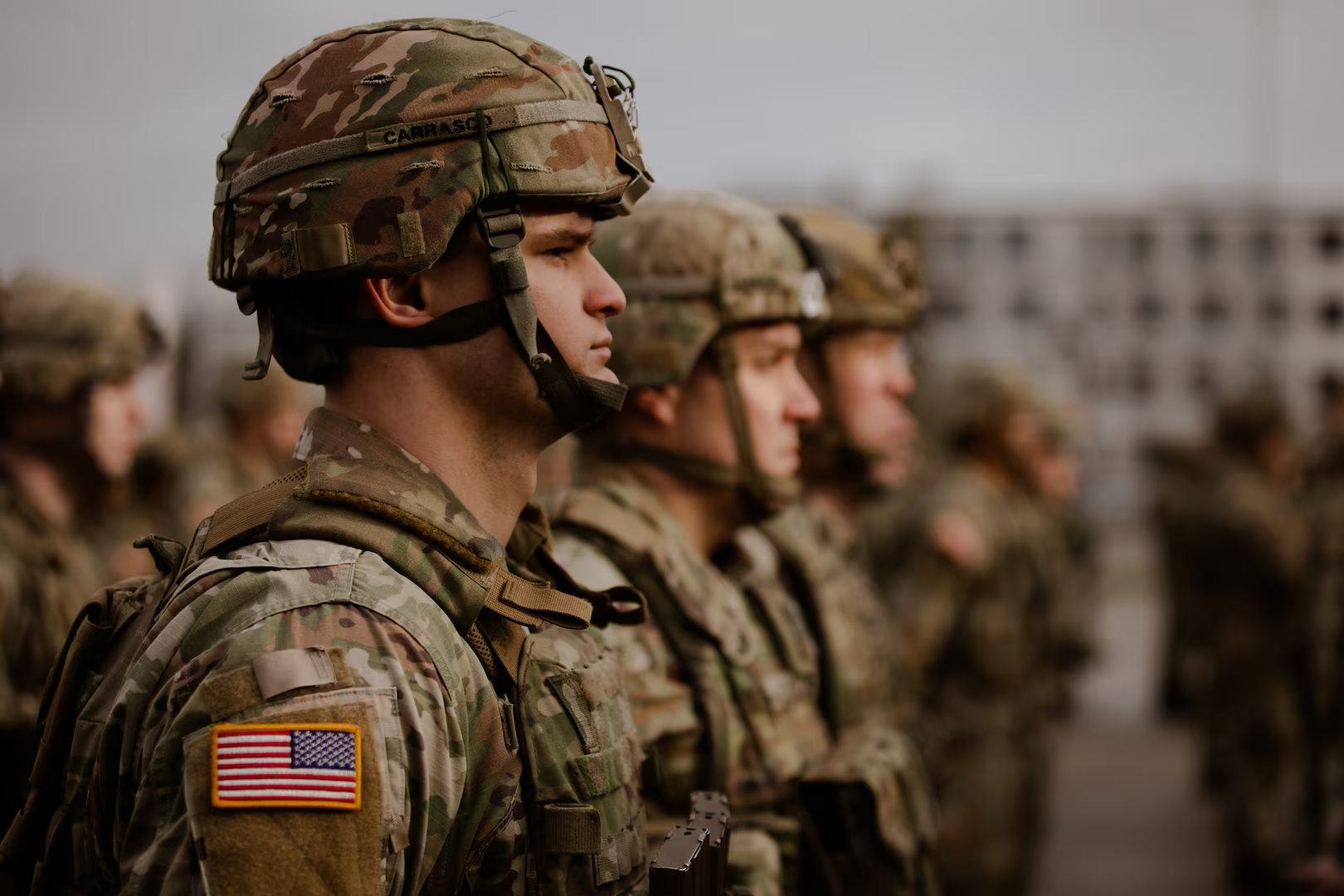
US President Donald Trump has said the United States will send an additional 5,000 troops to Poland, a move that appears to strengthen NATO’s eastern flank but also sits uneasily beside recent signals that Washington intends to reduce its broader military commitments in Europe. The announcement, made in a social media post and reported by Reuters, came as NATO foreign ministers met in Sweden amid renewed concern over the future of American security guarantees.
Trump linked the decision to his relationship with Poland’s President Karol Nawrocki, whom he had previously endorsed. He said the additional deployment reflected his support for the Polish leader and for Poland’s defence. The pledge followed earlier uncertainty after US Vice President JD Vance said that a planned American troop deployment to Poland had been delayed.
For Poland, the announcement is politically and militarily significant. Warsaw has long argued that a larger and more permanent US presence on its territory is essential to deterring Russia. Poland has increased defence spending, invested in large-scale military procurement, and positioned itself as one of the most active NATO members in support of Ukraine. Additional US troops would strengthen its claim to be the central eastern-flank state in NATO’s defence planning.
Yet the wider context is less straightforward. The Trump administration has been reviewing the US military presence in Europe and has repeatedly pressed European allies to assume greater responsibility for the continent’s defence. Earlier this week, Reuters reported that Washington was preparing to tell NATO allies it would reduce the pool of US capabilities available to the alliance in a major crisis. Under NATO’s force model, allies identify forces and assets that could be called upon during a conflict or emergency.
That makes the Poland pledge difficult to interpret as a simple reinforcement of Europe. It may represent an increase in one country while the overall US military commitment to NATO becomes less predictable. If the new troops are moved from elsewhere in Europe, rather than added to the total American presence on the continent, the deployment would shift the geography of US forces without necessarily increasing overall capacity.
The issue has direct implications for NATO planning. Deterrence does not depend only on the number of troops present in one country. It also depends on command structures, logistics, air defence, ammunition stocks, reinforcement routes, pre-positioned equipment and the availability of US strategic assets in a crisis. If Washington reinforces Poland while reducing other commitments, European allies will still need to understand which capabilities remain available, where they are based, and how quickly they can be deployed.
The timing also matters. Secretary of State Marco Rubio attended the NATO foreign ministers’ meeting in Helsingborg as allies faced pressure over several issues, including support for Ukraine, defence spending, the war involving Iran, and the balance between US commitments in Europe and other theatres. A separate Reuters report said European governments were trying to reassure Washington while also maintaining the priority of deterrence against Russia.
For European governments, the immediate problem is uncertainty. A larger US presence in Poland may reassure Warsaw and other eastern-flank allies, but it does not answer the broader question of whether the US is reducing its role as NATO’s main military backstop. Countries such as Germany, Italy, Spain and those hosting US infrastructure will be watching closely to see whether Poland’s gain is part of a wider redeployment rather than a net reinforcement.
The political dimension is also relevant. Poland’s current leadership is closer to Trump than several western European governments, and the president’s statement placed personal political relations at the centre of the decision. That risks creating the impression that US deployments in Europe may become more dependent on bilateral political alignment than on NATO-wide planning. For an alliance built on collective defence, that distinction matters.
The announcement comes at a time when Europe is already under pressure to fill gaps in ammunition production, air defence, long-range strike, drones and conventional forces. NATO Secretary General Mark Rutte has urged allies to turn higher defence spending into real industrial output and operational capability. The Poland pledge may therefore give eastern Europe additional reassurance, but it does not remove the requirement for European countries to prepare for a lower or less automatic US role.
For Ukraine, the signal is mixed. A stronger US posture in Poland could improve deterrence near Ukraine’s western border and support logistics for assistance to Kyiv. But if the pledge coincides with a reduction in US capabilities available to NATO during crises, it may also underline the need for Europe to provide more of the military support that Ukraine and the alliance require.
The central question is therefore not whether 5,000 additional US troops in Poland would be welcome in Warsaw. They almost certainly would be. The larger question is whether the move represents a coherent NATO force posture or a selective political deployment that leaves allies uncertain about the wider American plan for Europe.
Until Washington explains whether the Poland deployment adds to, replaces, or redistributes existing US forces, NATO planners will have to treat the announcement as both a reinforcement and a warning. It strengthens one part of the eastern flank while leaving unresolved the wider issue of how much American military power Europe can count on in a crisis.