By Liam Bowman, Co-Founder and Chief Technology Officer, ETA Green Power
The drone industry has advanced rapidly over the past decade. What was once dominated by hobbyist platforms has developed into a sector supporting infrastructure inspection, logistics, agriculture, emergency response, defence and, increasingly, autonomous aerial mobility.
Much of the industry’s attention has focused on software, sensors, communications and battery technology. Yet every unmanned aerial vehicle depends on a more fundamental component: the electric motor.
UAV designers face a persistent engineering challenge. They need longer flight times, greater payload capacity and higher reliability, while controlling weight, size and cost. Delivering all of these improvements simultaneously is becoming increasingly difficult using established propulsion architectures.
This is why electric motor design is likely to become a more important source of differentiation between future UAV platforms.
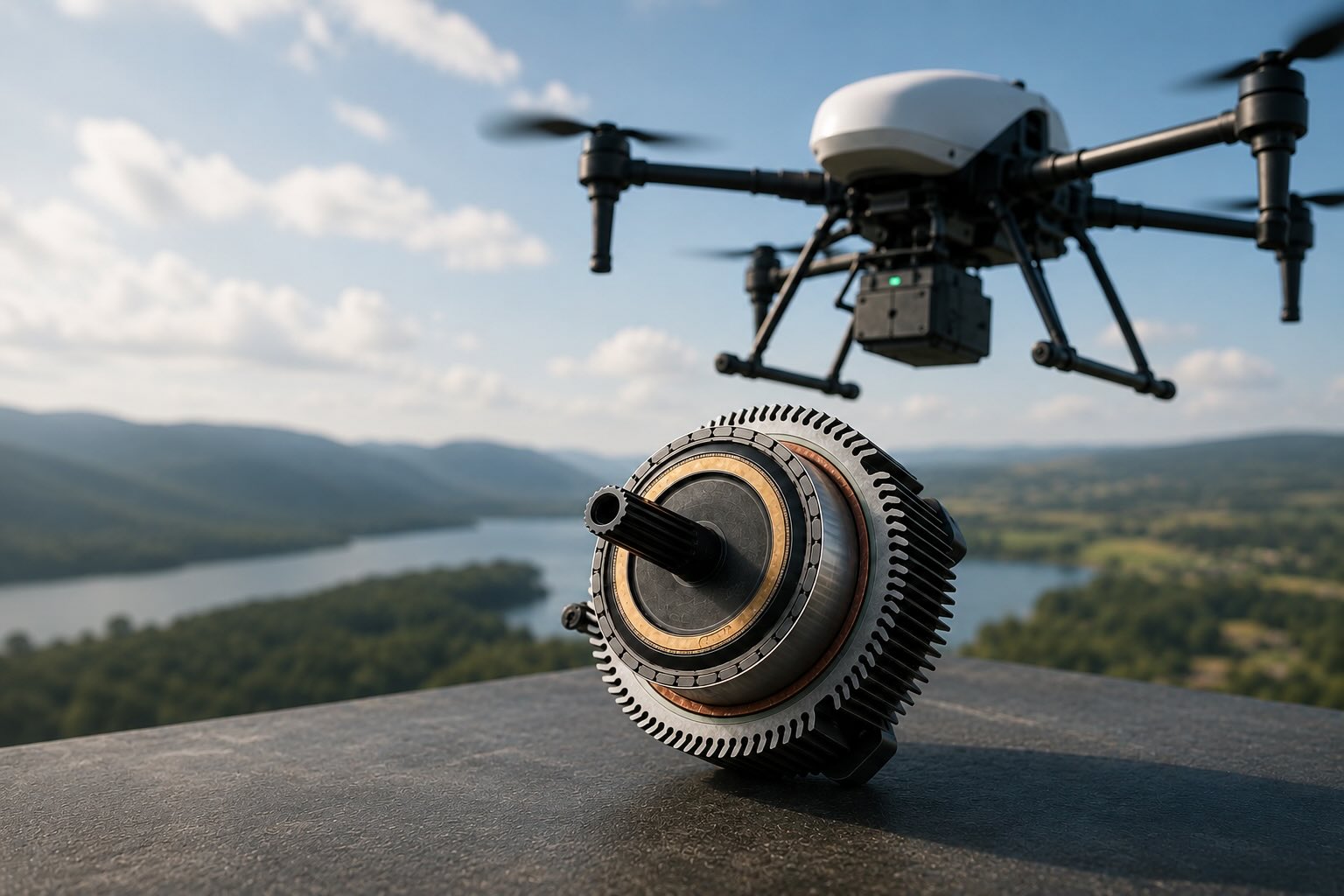
At ETA Green Power, we have been developing slotless permanent magnet motor technology intended to address some of the compromises associated with conventional slotted designs. The objective is to increase power density, reduce weight and improve efficiency, while making slotless technology suitable for commercial production.
Slotless motors are not new. Their smooth torque delivery and high-speed capability have long made them attractive for specialist aerospace, medical and industrial applications. However, manufacturing complexity and cost have historically restricted their wider adoption.
Recent advances in electromagnetic design, materials, thermal management and production methods may now make the technology practical for a broader range of applications.
Modern UAVs are moving well beyond recreational uses.
Industrial inspection drones must remain airborne while carrying increasingly sophisticated cameras and sensors. Cargo platforms are expected to transport heavier payloads over longer distances. Defence systems may require rapid acceleration, high manoeuvrability and reliable operation in demanding environmental conditions.
In each case, the performance of the propulsion system has a direct effect on mission capability.
Weight is particularly important. A reduction in motor mass can create benefits elsewhere in the aircraft. It may allow designers to reduce airframe weight, carry a larger payload or limit the battery capacity required for a given mission.
These effects are connected. A lighter propulsion system can reduce overall aircraft mass, which may in turn lower energy consumption and improve endurance.
Slotless motor technology offers one possible route to achieving these gains.
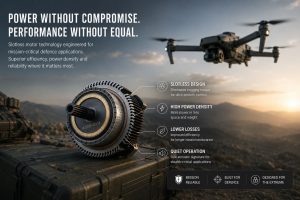
Conventional permanent magnet motors generally use stator teeth around which copper windings are placed. These teeth form part of the motor’s magnetic circuit, but they also add steel and structural mass.
A slotless motor removes the conventional toothed stator arrangement. Depending on the design, this can reduce the amount of magnetic steel required and allow a greater proportion of the motor’s mass to contribute directly to torque production.
The result can be a higher power-to-weight ratio than would be possible with some conventional architectures. The precise advantage will depend on the motor design, operating speed, thermal limits and the slotted motor used for comparison.
For UAV manufacturers, even relatively small improvements in specific power can be valuable. A lighter motor may increase payload capacity, extend range or create more flexibility in the overall aircraft design.
Removing stator slots also changes the electromagnetic behaviour of the motor.
In a conventional slotted motor, the interaction between the rotor magnets and stator teeth produces cogging torque. This can contribute to torque ripple, vibration and acoustic noise, although modern control systems can reduce its effects.
Slotless motors eliminate the conventional stator-slot mechanism that causes cogging torque. This allows smoother torque delivery and more precise speed control across much of the operating range.
For UAV applications, reduced torque variation can limit the vibration transmitted through the airframe. This may reduce mechanical stress on bearings, propellers and structural components.
Sensitive payloads may also benefit. Optical cameras, thermal imagers, LiDAR systems and surveying equipment all perform best in a stable mechanical environment. Reducing propulsion-related vibration may improve image quality and measurement consistency, although the result will also depend on propeller balance, airframe design and payload isolation.
Acoustic performance may become another important consideration. Lower mechanical and electromagnetic noise could be useful for inspection aircraft operating near populated areas and for defence platforms where acoustic detectability matters.
Battery development continues to improve UAV capability, but progress in energy density is generally incremental. Improving propulsion efficiency therefore remains one of the most practical ways to extend flight duration without fitting a larger battery.
Any efficiency gain must be considered as part of the complete aircraft system. Endurance depends on battery characteristics, propeller efficiency, aerodynamic drag, aircraft mass, weather conditions and mission profile.
Nevertheless, reducing motor losses means that a greater proportion of stored electrical energy can be converted into useful mechanical power. Depending on the application, this can support longer missions, increased payload capacity or a combination of both.
Lower losses also reduce heat generation.
Thermal management is frequently a limiting factor in electric propulsion, particularly during continuous or high-power operation. Lower operating temperatures can support higher continuous power ratings, improve reliability and extend component life.
These considerations are important in commercial and defence UAVs, where operational availability and maintenance costs can matter as much as peak performance.
Slotless motors may also be well suited to compact, high-speed propulsion systems.
Their relatively low inductance allows current to change rapidly, supporting fast dynamic response and operation at elevated rotational speeds. This may make the architecture attractive for future UAV systems using compact motors with optimised reduction drives or specially designed direct-drive propellers.
Low inductance, however, is not an advantage in every respect. It can place greater demands on the inverter, switching strategy and current-control system. Engineers must manage current ripple, electromagnetic losses and thermal behaviour across the full operating range.
Slotless technology therefore does not remove the need for careful system-level design. Its benefits depend on matching the motor, inverter, propeller, cooling system and control architecture to the aircraft’s intended mission.
No motor technology will achieve widespread adoption on technical performance alone.
For slotless motors to move beyond specialist applications, they must be manufacturable consistently and at a competitive cost. Winding design, material selection, magnet assembly, mechanical tolerances and thermal management all influence production complexity.
This has been one of the principal areas of development at ETA Green Power. Our work has focused on combining the performance characteristics of slotless machines with production methods intended to make them practical for commercial manufacture.
The wider industry is also benefiting from improvements in automated winding, advanced adhesives, magnetic materials, power electronics and manufacturing control.
As UAV markets mature, manufacturers are likely to examine propulsion systems more closely rather than treating motors as interchangeable components. Endurance, payload, reliability, vibration and acoustic performance will increasingly be determined by the integration of the complete propulsion package.
Slotless permanent magnet motors will not be the only architecture used in future unmanned aircraft. Conventional slotted motors will continue to offer advantages in many cost-sensitive and high-volume applications.
However, where weight, efficiency, smooth torque delivery and high-speed performance are priorities, slotless technology could become an increasingly important option.
The next generation of UAVs will not be defined solely by larger batteries, better sensors or more sophisticated software. Progress will also depend on improving the machines that convert electrical energy into propulsion.