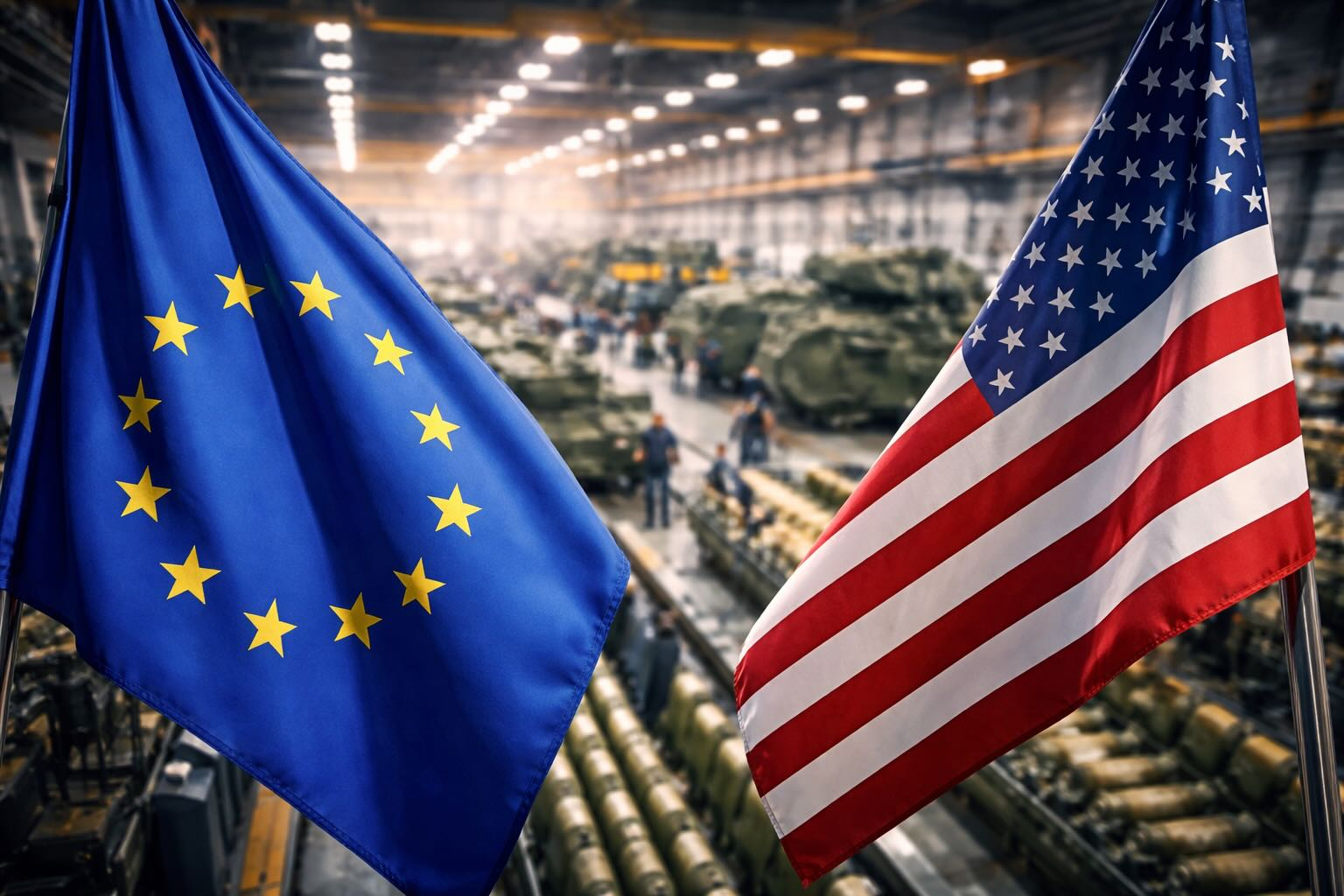
Reports this week indicate that the Trump administration warned the European Union against embedding stronger “Buy European” provisions in future defence procurement rules, with the Pentagon signalling that restrictions on US firms could prompt reciprocal action under existing American procurement waivers. According to reporting that cites remarks submitted to a European Commission consultation, Washington objected to changes that would reduce access for US defence companies to EU markets.
Single-market roadmap to 2028 takes shape as leaders meet in Belgium
At one level, the dispute is straightforward. Europe is increasing military spending because of Russia’s war against Ukraine and wider concerns about long-term US reliability. Reuters reported from the Munich Security Conference that European leaders are openly discussing a stronger European defence base, while longstanding disagreements remain over whether joint projects should prioritise EU suppliers or remain more open to non-EU firms.
At another level, the argument reflects two competing strategic logics.
The US position, as described in the reported Pentagon submission, is that European preference rules would be protectionist and would undermine a market in which European companies themselves continue to benefit from access to US contracts. The administration’s message appears to be that market access should remain reciprocal, and that any attempt to lock out American firms may be met with a review of current exemptions under “Buy American” frameworks.
The European argument is different and, in many capitals, increasingly urgent: if the continent is being asked to assume greater responsibility for its own defence, then part of that shift must involve expanding production capacity inside Europe itself. That means not only buying finished systems, but also securing supply chains, components, maintenance and industrial know-how on European territory.
This is not a new French view, but it is now spreading beyond Paris. Reuters noted that France has long pushed harder for “buy European” provisions, while countries such as Germany and the Netherlands have tended to favour a more open model. The current security climate has sharpened that debate rather than settled it.
The policy background matters. The EU’s SAFE instrument, adopted in 2025, provides up to €150 billion in loans for joint defence procurement and is part of the bloc’s broader effort to strengthen its defence industrial base. The European Commission and Council have presented SAFE as a mechanism to scale production and procurement at speed. Public reporting has also highlighted “EU-made content” thresholds in related measures, reinforcing the political direction of travel towards greater European sourcing.
EU Launches €150 Billion SAFE Instrument to Strengthen Defence Procurement and Industrial Capacity