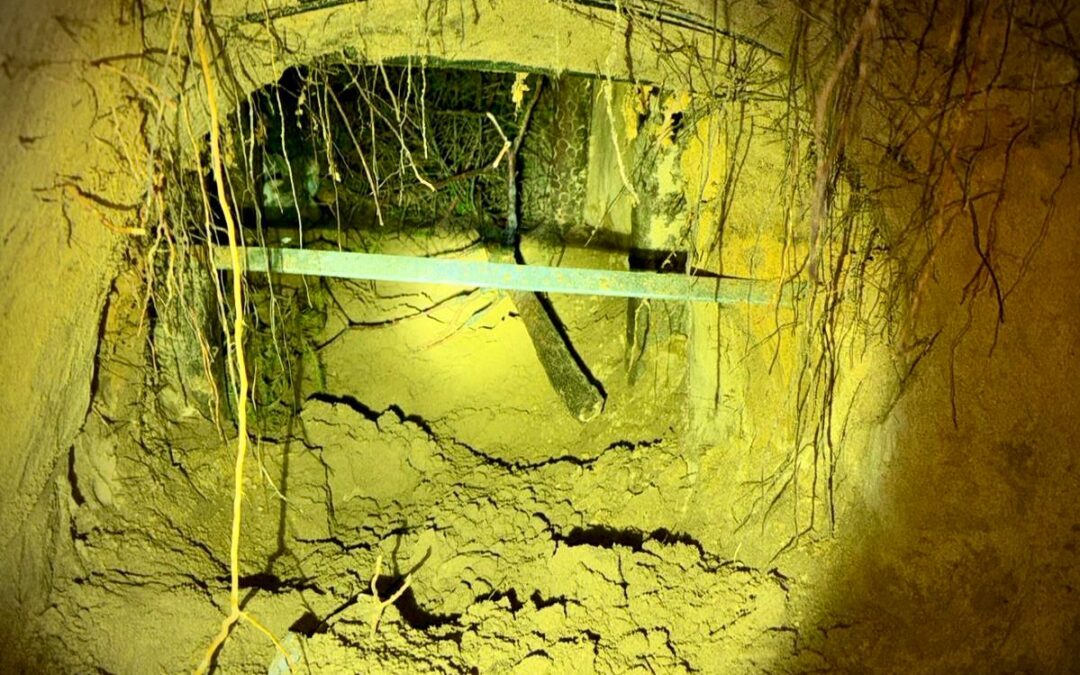
According to reporting by The Telegraph, citing Polish officials, border guards discovered four underground tunnels under the Belarus-Poland border in 2025, including one near Narewka that was used by around 180 migrants, most of whom were later detained. The tunnel was about 1.5 metres high and ran from roughly 50 metres inside Belarus to around 10 metres inside Poland.
For European security planners, the significance lies not only in the tunnel itself but in what it suggests about the evolution of hybrid warfare on the EU’s eastern border. The European Council and the European Commission have for several years described Belarus’s handling of migration as “instrumentalisation” for political purposes, while the European Parliament has explicitly referred to the actions of the Minsk and Moscow regimes as hybrid attacks on EU borders. In other words, the tunnels fit into an established pattern already recognised by EU institutions: the use of migration routes as a coercive instrument against member states.
The first security risk is straightforward: tunnels are designed to defeat the physical border system. Poland has invested heavily in fencing, cameras, thermal imaging and detection systems along its frontier with Belarus. Yet Polish Border Guard officials told The Telegraph that underground routes were still discovered, and Reuters reported that the Narewka tunnel was found only after surveillance picked up the people using it rather than the passage itself. This matters because it exposes a vulnerability in one of the EU’s most heavily monitored land borders. If a route can be opened beneath a fortified frontier, even briefly, it creates a gap that may be exploited not just for irregular migration but for the covert movement of couriers, facilitators or trained hostile actors.
The second risk concerns expertise and external support. The Telegraph reported that Polish officials believe specialists from the Middle East were used to design or dig the tunnels, and Ynet News, summarising the same reporting, said Polish officials linked the work to individuals with a “high level of expertise”. Notes from Poland also reported remarks by Polish officials pointing to “specialists from the Middle East”. These claims have not been independently verified in public by technical forensic evidence, but the implication is serious: hostile border operations may be drawing on imported engineering know-how rather than improvised smuggling methods alone. That points to a more organised and adaptive threat environment.
The third risk is that migration pressure becomes a cover for intelligence and sabotage activity. EU institutions have already framed Belarusian and Russian pressure on the border as part of a broader hostile campaign. The concern for European governments is not that every migrant is a security operative, but that irregular routes created and controlled by state-backed or state-tolerated networks can be used selectively to insert individuals whose purpose is reconnaissance, logistics or disruption. Once such a route exists, screening becomes far harder because the crossing itself has already bypassed the formal border control point. That is the core hybrid-warfare problem: migration is used not only to create humanitarian and political strain, but also to impose uncertainty on the internal security apparatus of the target state.
The fourth risk is cumulative pressure. Frontex said irregular crossings at the EU’s external borders fell by 26 per cent in 2025, and crossings on the eastern border with Belarus also declined. Yet that overall reduction does not remove the strategic problem. On the contrary, it may explain why more complex methods are being attempted. Polish deputy interior minister Czesław Mroczek said tunnel-digging suggested Poland’s border enforcement had become sufficiently effective that new methods were required. In security terms, that means pressure has not ended; it has adapted.
The fifth risk is diversion and overload. The same reporting links tunnel activity to other low-cost, disruptive methods attributed to Belarus, including balloons carrying contraband cigarettes into neighbouring NATO states. Polish prosecutors this month charged five men in connection with balloon-based cigarette smuggling from Belarus to Poland. On their own, such incidents may appear criminal rather than strategic. Taken together, however, they force border and internal-security services to split attention between airspace anomalies, contraband routes, migrant crossings and possible underground infiltration. That is a classic hybrid effect: not a single decisive breach, but sustained pressure through multiple low-threshold channels.
For the EU, the lesson is not merely that the Belarus-Poland border remains tense. It is that Europe’s eastern frontier is being tested as an integrated security system. Physical barriers, sensors and patrols remain necessary, but they are not sufficient if the adversary combines migration pressure, organised smuggling, underground engineering and information warfare in one theatre. The tunnel cases reported by Poland suggest that the contest on the EU’s eastern border is no longer only about entry. It is about whether hostile states can use deniable, low-visibility methods to exhaust Europe’s border, policing and counter-intelligence capacities at the same time.