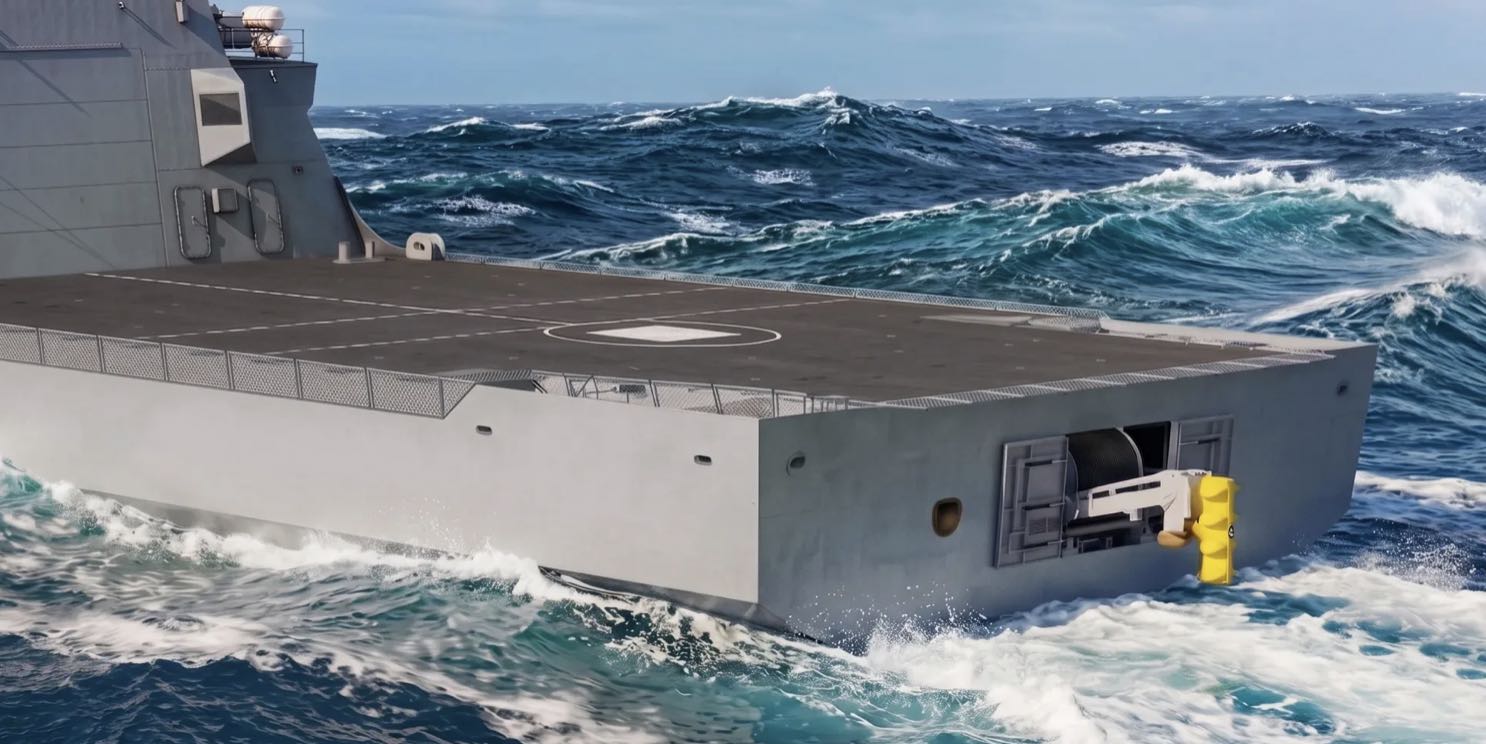
The contract, awarded by Thales Group through Lockheed Martin Canada, will see the Royal Canadian Navy’s next generation of warships fitted with one of the most respected anti-submarine warfare systems currently in service. The S2087, part of the CAPTAS family of low-frequency sonars, is designed to detect and track increasingly quiet submarines across long distances and in challenging maritime environments.
At first glance, the announcement appears highly technical. Yet it reflects a broader shift taking place across NATO, where concerns over Russian submarine activity, Arctic security and the protection of critical undersea infrastructure have driven renewed investment in anti-submarine warfare capabilities.
Canada’s River-class destroyer programme, formerly known as the Canadian Surface Combatant project, represents the largest naval procurement effort in the country’s history. The programme is intended to deliver up to 15 warships that will replace the aging Halifax-class frigates and the already-retired Iroquois-class destroyers. The vessels are based on the British Type 26 design, itself conceived during a period when anti-submarine warfare was once again becoming a strategic priority.
The choice of the S2087 therefore aligns Canada with a growing club of allied navies pursuing common solutions to shared threats. The system is already deployed aboard Royal Navy Type 23 frigates and has been selected for Britain’s new Type 26 fleet. Australia’s Hunter-class frigates, also derived from the Type 26 design, will carry the same technology.
Such standardisation is increasingly valuable. NATO planners have spent years attempting to improve interoperability among allied fleets, particularly in the North Atlantic where submarine activity has intensified. Shared sensors, communications systems and operational procedures reduce complexity during joint operations and allow navies to exchange expertise more effectively.
The undersea domain has become a focal point of strategic concern since Russia’s full-scale invasion of Ukraine in 2022. While attention has often centred on land warfare, Western military planners have simultaneously grown more concerned about the vulnerability of subsea cables, energy pipelines and maritime infrastructure. Incidents involving damaged undersea communications links in both the Baltic and North Atlantic have reinforced those anxieties.
Against that backdrop, anti-submarine warfare is no longer viewed as a specialist capability but as a core requirement. Modern submarines, particularly those operating on quiet propulsion systems, are notoriously difficult to detect. The challenge becomes even greater in shallow coastal waters, where background noise and environmental conditions complicate tracking efforts.
Thales describes the S2087 as a proven long-range system capable of identifying quiet submarines in both littoral and open-ocean environments. The company argues that the technology contributes not only to operational effectiveness but also to fleet readiness through mature support arrangements and established maintenance networks.
For Canada, the Arctic dimension is particularly significant. Climate change is gradually transforming northern sea routes from seasonal passages into increasingly navigable waterways. That reality is generating new economic opportunities but also fresh security challenges. Ottawa has repeatedly emphasised the need to strengthen its maritime awareness across northern waters, especially as Russia continues to expand military infrastructure throughout the Arctic region.
The River-class destroyers are expected to become the backbone of Canadian maritime power well into the second half of the century. Measuring approximately 151 metres in length and displacing around 7,800 tonnes, the ships will possess substantial air-defence, anti-surface and anti-submarine capabilities. Their design reflects a recognition that future naval operations will demand versatility across multiple threat environments.
The sonar announcement also carries industrial implications. Defence procurement has increasingly become a tool of economic policy, particularly in Canada where governments have sought to ensure major programmes generate domestic employment and technological expertise. Thales has stressed its commitment to local investment and partnerships, presenting the contract as part of a broader effort to strengthen Canadian sovereign capabilities.
Yet challenges remain. The River-class programme has faced scrutiny over costs, with estimates running into tens of billions of Canadian dollars. Large naval projects rarely proceed without delays or budget pressures, and Canada’s effort is unlikely to prove an exception. Critics will inevitably question whether increasingly sophisticated technologies can be delivered on time and within budget.
Nevertheless, the selection of the S2087 appears a relatively low-risk decision. Rather than pursuing an entirely new and untested system, Ottawa has chosen equipment already operational with key allies. In an era when defence ministries are under pressure to deliver capability quickly, proven technology often carries considerable appeal.
The deeper significance of the announcement lies in what it says about the future of naval warfare. For much of the post-Cold War period, surface combatants were optimised for expeditionary operations and power projection. Today, the emphasis is shifting back towards high-end conflict and the contest for control beneath the waves.
Canada’s embrace of Thales’ S2087 is therefore not merely a procurement milestone. It is another indication that the Atlantic alliance increasingly views undersea dominance as one of the defining military challenges of the coming decades. As great-power competition intensifies, the ability to find what cannot easily be seen may become one of the most valuable capabilities a navy can possess.
Canada turns to Brussels to fund next-gen jets and submarines