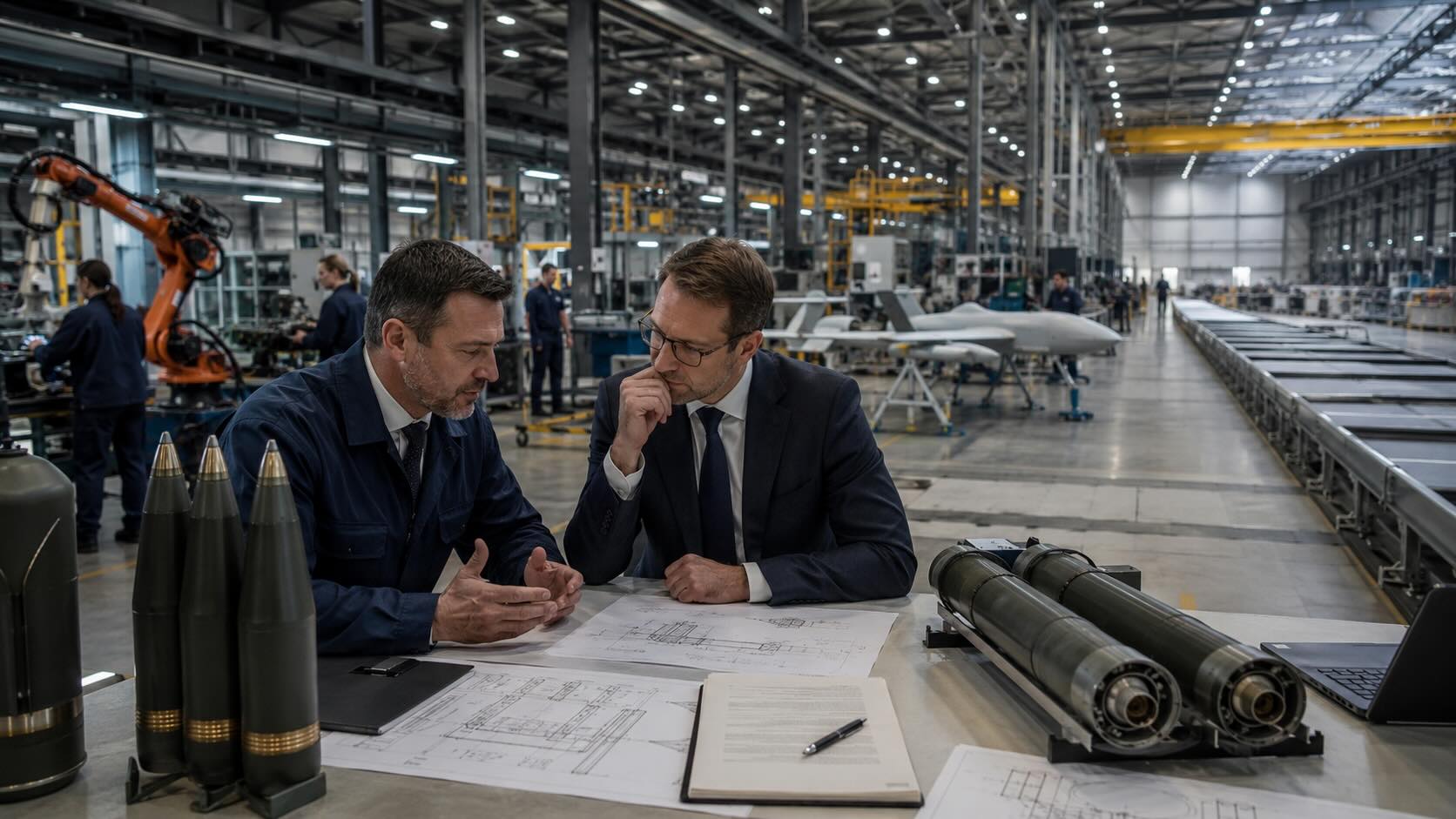
Finance executives at Farnborough say private capital will be needed to fund Europe’s defence-industrial expansion, while procurement delays and unclear government demand continue to deter investors. A Reuters report carried by 95 KQDS cited senior bankers and investors arguing that public spending alone will not be enough and that governments must provide greater clarity.
The argument is not simply that Europe lacks money. Defence budgets are rising across the continent. The problem is whether those budgets become contracts soon enough and reliably enough for companies to build factories, hire workers, expand ammunition lines and bring new technologies into service.
Private capital can help only if investors believe there will be demand. A company may raise money to expand missile, drone or artillery-shell production, but only if governments place orders beyond pilot projects and emergency batches. Without predictable multiyear commitments, investment risk remains high.
Defence Matters has recently covered the KNDS IPO delay and proposals for a global defence bank. The Farnborough comments connect those cases to a wider problem: increased defence urgency is not automatically translating into investable industrial growth.
Procurement is the central bottleneck. Governments often announce spending targets before deciding precise requirements. Ministries then run competitions, negotiate workshare, manage legal challenges and adjust budgets. Industry cannot build capacity on speeches. It needs signed contracts, delivery schedules and confidence that orders will not disappear after the next election.
The war in Ukraine has made the problem visible. Europe needs artillery ammunition, air-defence missiles, drones, electronic-warfare systems and repair capacity. Many companies could expand production, but expansion requires capital expenditure. Investors want to know whether wartime demand will persist long enough to justify that expenditure.
Public markets are another constraint. Defence stocks rose sharply after 2022, but investor sentiment can cool quickly if valuations look stretched or if governments delay orders. The postponed KNDS flotation showed that even major defence groups can face timing problems when market conditions and political signals are uncertain.
Private equity and infrastructure funds may be willing to invest in defence supply chains, especially dual-use technologies, components and manufacturing capacity. But some institutional investors still face environmental, social and governance restrictions or reputational concerns. Europe’s political message on defence has changed faster than some investment mandates.
The exit problem also matters. Venture investors need acquisition routes or public-market access. If large primes buy successful start-ups, innovation can scale. If competition concerns, export controls or slow procurement prevent exits, early-stage capital will remain cautious.
Governments can improve the picture without funding everything directly. They can publish longer procurement pipelines, standardise requirements, use advance purchase agreements, support working-capital facilities and reduce fragmentation between national programmes. They can also clarify which defence activities are eligible under public financial institutions.
The danger is that Europe mistakes budget announcements for capacity. A pledge to spend 3 per cent of GDP on defence does not automatically produce interceptors, shells or drones. Industrial capacity appears only when companies have enough certainty to invest.
Private capital is not a substitute for public responsibility. Defence demand ultimately comes from states. But if governments want industry to expand faster than public balance sheets allow, they must make defence investable. That means predictable orders, credible margins, export clarity and procurement systems that move at the speed of the threat.
That requires a different compact between governments, primes, banks and specialist suppliers. Defence companies cannot expand production lines on speeches; they need purchase commitments, advance payments, export clarity and permission to hold larger inventories. Smaller firms need predictable routes into programmes instead of years of demonstrations that never become orders. Private investors can provide growth capital, but they will price uncertainty ruthlessly. If European governments want private money to help close the capacity gap, they have to make procurement legible enough for capital markets to understand. Otherwise the continent will remain caught between strategic ambition and financing hesitation.
The distinction matters because Europe’s threat environment is no longer theoretical. Ukraine’s ammunition consumption, Russia’s rearmament cycle and pressure on air-defence stocks have made industrial depth a live security issue. Investors can help fund factories, software, sensors and dual-use production, but they cannot replace political choice. A more investable defence sector would still need democratic oversight and export controls. The point is not to financialise security for its own sake. It is to ensure that capital waiting on the sidelines can be channelled into capacity Europe already says it urgently needs.