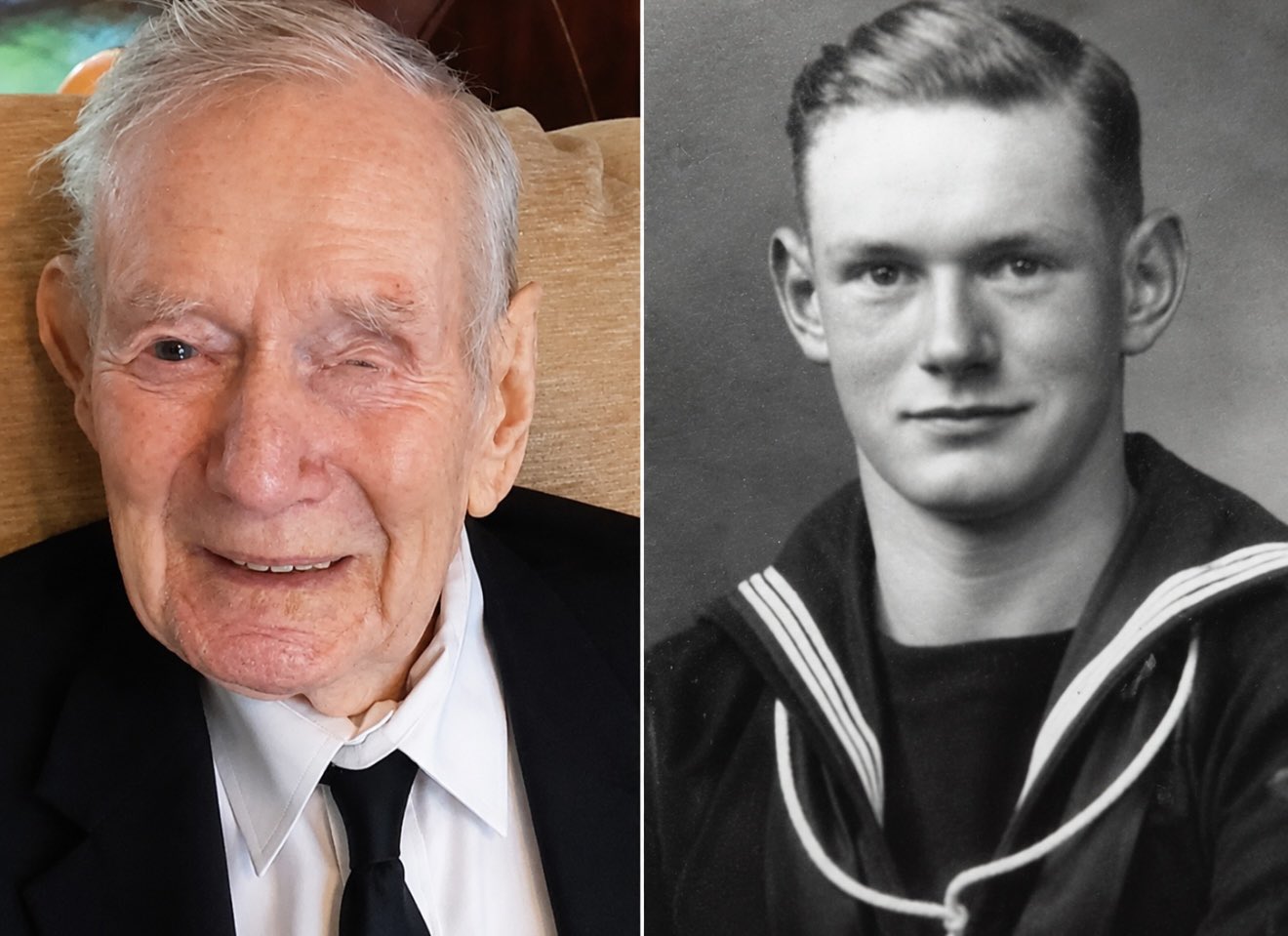
Redston, who died peacefully surrounded by family, was among the young servicemen who helped secure Allied victory in the Second World War. Barely out of school, he joined the Royal Navy and found himself at the centre of one of history’s greatest military enterprises. By the age of 19, he had already been promoted to First Lieutenant aboard Motor Launch 191, a small but vital vessel operating in dangerous waters off occupied France.
His wartime duties extended far beyond conventional naval operations. Before D-Day, Redston and his crew undertook covert night missions to the French coast, extracting British agents whose cover had been compromised and returning them safely across the Channel. Such operations demanded exceptional seamanship, courage and discretion. Capture would likely have meant imprisonment or death.
Then came June 6th, 1944. D-Day remains one of the most remarkable military achievements ever attempted.
More than 156,000 Allied troops crossed the English Channel and landed on five Normandy beaches. Nearly 7,000 vessels participated, supported by thousands of aircraft overhead. The operation represented the culmination of years of planning, deception and logistical preparation on a scale never before witnessed.
The invasion required not merely military strength but extraordinary coordination. Millions of tonnes of equipment had to be assembled in Britain. Artificial harbours were designed and constructed. Elaborate deception plans convinced German commanders that the main assault would come elsewhere, helping to preserve the vital element of surprise.
The political leadership behind this effort was equally important. Sir Winston Churchill had guided Britain through its darkest hours, sustaining national resolve when Nazi Germany appeared unstoppable. While strategic debates continued throughout the war regarding the timing and location of a return to continental Europe, Churchill’s leadership helped maintain the Allied coalition that ultimately made Operation Overlord possible.
Yet even the finest plans depended on the bravery of ordinary men.
Redston’s own experience illustrates how narrow the margin between life and death could be. His vessel had originally been assigned the perilous task of guiding American troops directly towards Utah Beach during the initial assault. At the last moment, however, American commanders requested that a US vessel undertake the mission instead. Motor Launch 191 was reassigned to escort vital supply barges carrying ammunition, fuel and equipment to the beachhead. Later, Redston learned that the American vessel which took over the original assignment had been destroyed within the opening stages of the invasion. A routine change of orders may well have saved his life.
The episode captures the randomness that often determined survival during wartime. Heroism was essential, but fortune frequently played its part.
Redston’s contribution also highlights a frequently overlooked aspect of D-Day. The invasion was not won solely by the soldiers who stormed the beaches. It depended equally on the sailors who maintained the flow of supplies across the Channel. Every bullet, ration pack, vehicle and gallon of fuel had to be delivered. Without that logistical achievement, the Allied armies would have been unable to break out of Normandy and begin the liberation of Western Europe.
After Germany’s defeat, Redston’s service continued in the Far East. On VJ Day he was stationed in Burma, where news of Japan’s surrender finally brought an end to six years of global conflict. Like millions of others, he then returned home and built a civilian life that reflected the values of his generation: duty, resilience and quiet determination. He spent decades working as a civil engineer, helping to rebuild and improve the country for which he had fought.
Such stories are becoming increasingly rare. Historians estimate that only a small number of British D-Day veterans remain alive today, all now well into their nineties or older.
The passing of Bill Redston therefore resonates beyond his family and friends. It marks the loss of another direct witness to the struggle against tyranny and to the extraordinary events of June 1944. Future generations will study D-Day through books, archives and documentaries. They will learn about the vast fleets, the complex planning and the geopolitical consequences that shaped the modern world.
But they should also remember the individuals.
Young officers navigating small vessels through hostile waters. Sailors escorting supply ships towards a continent at war. Men who carried immense responsibility before they were old enough to vote.
Bill Redston was one of them.
He leaves behind three children, two grandchildren and seven great-grandchildren. He also leaves a legacy shared by an entire generation whose sacrifices secured the freedoms that millions enjoy today.
As the last members of the Greatest Generation pass into history, the obligation falls to the rest of us to ensure their stories endure. The debt owed to them cannot be repaid.
It can only be remembered.