

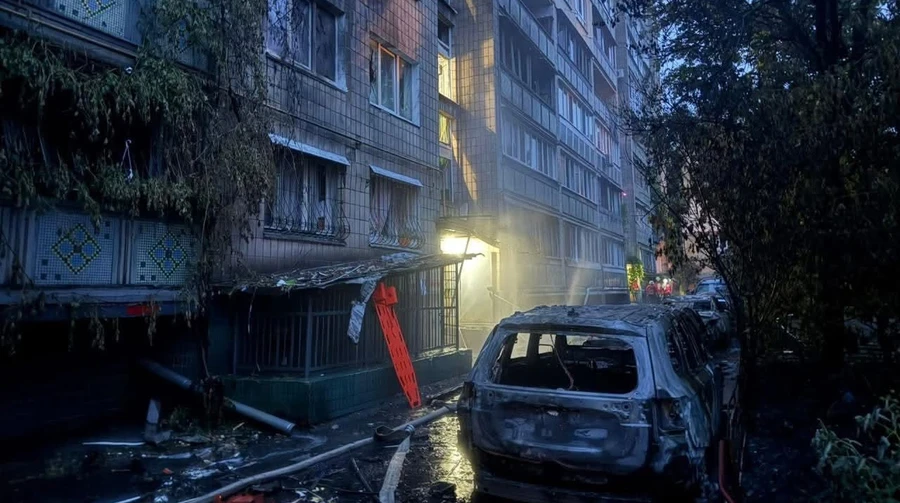
According to Ukraine’s Air Force command, Russia launched 611 drones and 70 missiles during the night of 14–15 June. Ukrainian air defences reported the interception or suppression of 582 drones and 50 missiles, including five of six Zircon missiles, all 30 Kh-101 and Iskander-K cruise missiles, and 15 of 34 Iskander-M or S-400 ballistic missiles.
The figures require careful reading. The drone interception rate was very high, and the reported shoot-down of five Zircon missiles is politically and militarily important. Russia has promoted the Zircon as a high-speed weapon intended to complicate Western and Ukrainian air-defence planning. If Ukraine’s figures are accurate, the missile is not performing in practice as Russian official claims suggest.
The weaker point remains ballistic missile defence. Fewer than half of the Iskander-M and S-400-type ballistic missiles were intercepted. This is not primarily evidence of Ukrainian incapacity, but of the limited number of systems able to engage such targets. Patriot batteries and comparable Western systems remain essential for Kyiv, Kharkiv, Dnipro and other major cities. The overnight attack therefore strengthens Ukraine’s argument that air-defence support is not a secondary requirement but the central condition for civilian protection and economic resilience.
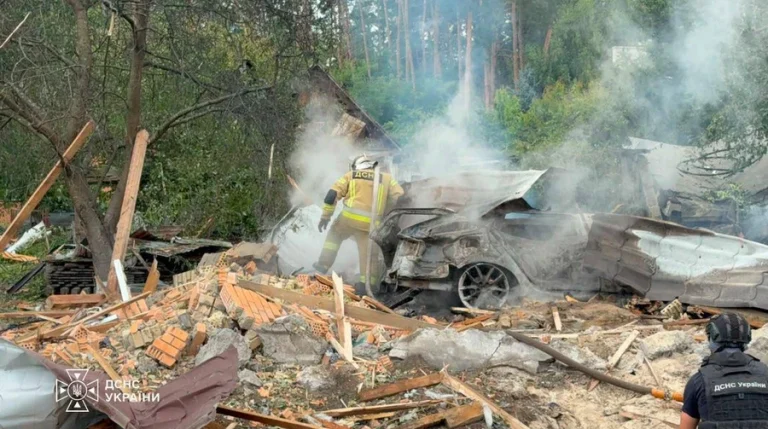
The main targets included Kyiv, Kharkiv and Dnipro. In Kyiv, at least four people were reported killed and dozens injured, including children. Kharkiv also suffered casualties. According to initial casualty reports, at least nine people were killed nationwide, although the figures may still be revised as emergency services continue their work.
The most symbolically charged damage was at the Kyiv-Pechersk Lavra, one of the most important religious and cultural sites in Eastern Europe. The monastery complex is part of a UNESCO World Heritage site, and its Dormition Cathedral caught fire during the attack. At the time of writing, there was no independently established public conclusion on whether the damage was caused by a direct strike, falling debris, a drone, or another element of the attack. Ukrainian officials said a Russian strike had set the cathedral on fire, while Moscow denied responsibility and claimed the site had been hit by a Ukrainian air-defence missile.
The military significance of the Lavra damage is limited; its political significance is not. Russia has repeatedly framed its war in civilisational and religious language, including references to the defence of Orthodox Christianity. Damage to one of Kyiv’s central Orthodox shrines therefore carries a contradiction that is hard for Moscow to dismiss outside its own information space. For Ukraine, the incident will reinforce the argument that Russia’s campaign is directed not only against military infrastructure but also against civilian life, identity and cultural heritage.
The attack also came after several days of warnings that Russia might use the Oreshnik intermediate-range ballistic missile. No confirmed use of that system was reported in the overnight strike. That absence matters only if the prior warnings were accurate. It may indicate a signalling operation, a delay, a technical constraint, or a decision not to escalate in that form. What can be said with more confidence is that Oreshnik warnings serve a political purpose even when the missile is not launched. They are designed to raise the perceived strategic risk of Russia’s campaign and to remind the United States and Europe that Moscow can threaten systems associated with longer-range escalation.
At the same time, the war is no longer one-directional in its long-range strike dynamic. Ukrainian drones also struck targets inside Russia, including the Tula region, where the regional governor reported three deaths and three injuries. Reutov, near Moscow, was also reported among areas affected by drone activity, drawing attention because of its proximity to the Russian capital. The extent of damage and the precise targets remain less clear than in Ukraine, but the pattern is now established: Russia attacks Ukrainian cities and infrastructure at scale, while Ukraine uses long-range drones to impose costs on Russia’s rear areas, logistics, fuel infrastructure and defence-industrial sites.
This does not create symmetry. Russia is the invading power and continues to conduct the far larger strike campaign against Ukrainian civilian and urban infrastructure. But it does mean that Russia’s own rear is increasingly exposed. The Kremlin can still strike Kyiv, Kharkiv and Dnipro, but it can no longer fully insulate Moscow’s industrial and logistical belt from the consequences of the war it launched.
The overnight exchange therefore points to the next phase of the conflict. Russia is likely to continue mass attacks that combine drones, cruise missiles and ballistic missiles in an attempt to exhaust Ukraine’s interceptors and test gaps in its protection. Ukraine’s priority will be to preserve a layered air-defence system while expanding its own ability to strike Russian military production, logistics and fuel networks.
The immediate result was civilian death, damage to historic Kyiv, and renewed pressure on Ukraine’s partners to supply interceptors and air-defence systems. The broader conclusion is that Russia can still inflict heavy damage, but its mass strikes are not producing uncontested military effects. The war is becoming a contest of endurance, production, interception capacity and long-range reach. In that contest, air defence is not defensive in the narrow sense. It is now one of the main determinants of Ukraine’s ability to continue functioning as a state under attack.


Britain’s Consistent Message on Ukraine Carries Growing Weight at the OSCE