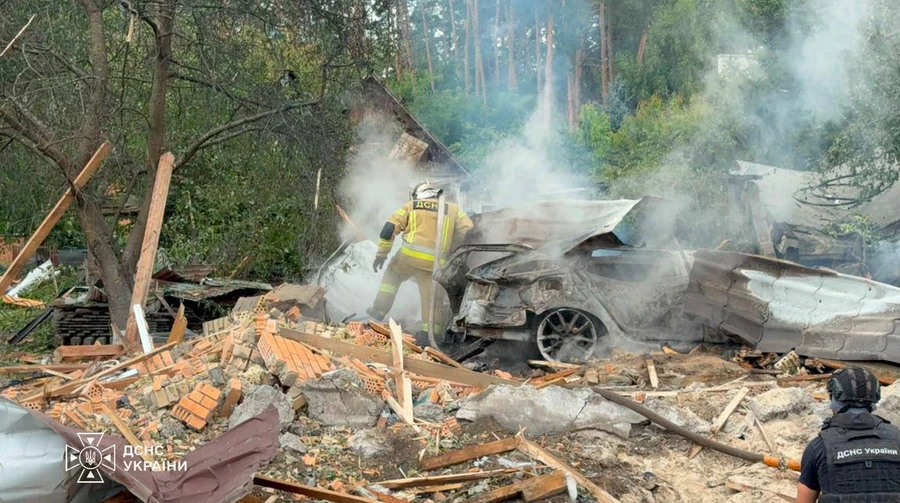
A Kyiv court has detained Armada association head Vasyl Honcharuk after a Russian missile strike on a publicly promoted defence gathering killed 11 people, shifting scrutiny towards wartime event security.
A Kyiv court has ordered the organiser of a defence-industry exhibition to remain in custody while prosecutors investigate alleged negligence surrounding a gathering struck by Russian missiles on 24 July.
Vasyl Honcharuk, head of the Armada Association of Manufacturers of Unmanned Systems and Related Technologies, was remanded for 60 days without bail. The death toll from the strike on the event in the Kyiv region has risen to 11, with nearly 100 people reported wounded.
The criminal proceedings do not diminish Russia’s responsibility for launching the missiles. They address a different question: whether a publicly promoted wartime gathering of defence companies and personnel was organised with adequate security in a country exposed to persistent surveillance and long-range attack.
Suspilne reported the court hearing, while Ukrainska Pravda detailed the remand decision. Honcharuk is suspected under a provision covering official negligence resulting in deaths. He has not been convicted and is entitled to challenge the prosecution’s case.
Russian forces chose to strike the site. Ukrainian investigators must avoid allowing that act to disappear behind an easier domestic target.
At the same time, wartime institutions have a duty to reduce foreseeable risk. Defence exhibitions combine information, technology and people of direct interest to Russian intelligence. Publicity that would be ordinary in peacetime can assist target identification.
The investigation will need to establish what Honcharuk controlled. Was he responsible for the site, invitation process, communications, shelter arrangements and co-ordination with military authorities? Did warnings exist, and did officials approve the event?
An association head should not be made criminally responsible for every consequence of an enemy attack simply because he organised a meeting. Negligence requires more than a bad outcome. Prosecutors must identify a specific duty, a serious failure to perform it and a causal connection to the deaths.
Defence events normally depend on promotion. Companies want customers, investors and partners; organisers want attendance. In wartime Ukraine, each advertisement can create intelligence.
A location need not be published explicitly. Photographs, travel instructions, supplier posts and attendee messages can be combined with satellite imagery and electronic surveillance. Russia has demonstrated the ability to strike time-sensitive targets after detecting concentrations of personnel.
Organisers should therefore separate public promotion from operational detail. Attendance lists, exact schedules and locations should be distributed only to verified participants and as late as practical.
That cannot guarantee secrecy. A compromised attendee or device may still reveal the event. Security should assume that the location may become known and limit the consequences.
The suitability of the venue will be central. A defence gathering should have sufficient protected space for all participants, clear routes, trained staff and procedures for missile alerts.
Large crowds take time to move. If a shelter cannot be reached within the warning period available for ballistic missiles, the site may be inappropriate regardless of its convenience.
Dispersing exhibitors across smaller sessions reduces the number of people exposed to one strike. Hybrid participation and controlled demonstrations can also limit concentration, although sensitive online systems create cyber risks.
The inquiry should examine whether organisers consulted local military and emergency authorities, what threat assessment they received and whether the event continued after any warning.
Defence Matters covered how the original Russian strike on the Kyiv defence gathering exposed wartime security risks. The remand is a material legal development, but it should lead to evidence rather than retrospective assumptions.
Ukraine’s defence companies cannot suspend all conferences, tests and procurement meetings until the war ends. Rapid exchange between soldiers, engineers and manufacturers is one of the country’s advantages.
The answer is not to drive every gathering underground without structure. It is to develop common wartime standards and give organisers access to security advice.
Government agencies can certify suitable sites, provide secure communication channels and issue rules on publicity. Companies should know what is mandatory rather than discovering after an attack that expectations were informal.
International visitors and investors also need guidance. Their presence may increase both the value and visibility of an event.
Focusing solely on Honcharuk may obscure failures by venue operators, public authorities or participating organisations. Each actor controlled different information and safety decisions.
Investigators should reconstruct the approval chain and communication record. If officials knew of the event or attended it, their role deserves the same scrutiny.
The court’s decision to deny bail may reflect the seriousness of the allegation, possible evidential risks or the public impact of the case. Detention should not become a substitute for proving negligence.
Public discussion must also protect victims and witnesses. Publishing additional details of how the event was organised could help Russia target future gatherings.
The most useful outcome would extend beyond punishment. Ukraine needs an incident review that identifies how the location was exposed, what warnings were available and which protections failed.
Some findings will need to remain classified. A practical safety standard can still be issued to organisers across the defence sector.
Russia’s attack was an unlawful use of force against people gathered at the site. Domestic accountability does not transfer that responsibility. It recognises that the enemy’s methods are now foreseeable enough to require precautions.
The prosecution must prove its allegation against Honcharuk individually. The wider defence community should not wait for a verdict before reviewing how it convenes.
In a war shaped by drones, phones and rapid targeting, an event begins creating risk before the first participant arrives. Security must begin at the same moment.