

Russia’s latest missile and drone attack on Ukraine again forced Poland to activate aircraft, underlining the recurring air-defence burden carried by NATO states on the Alliance’s eastern border.
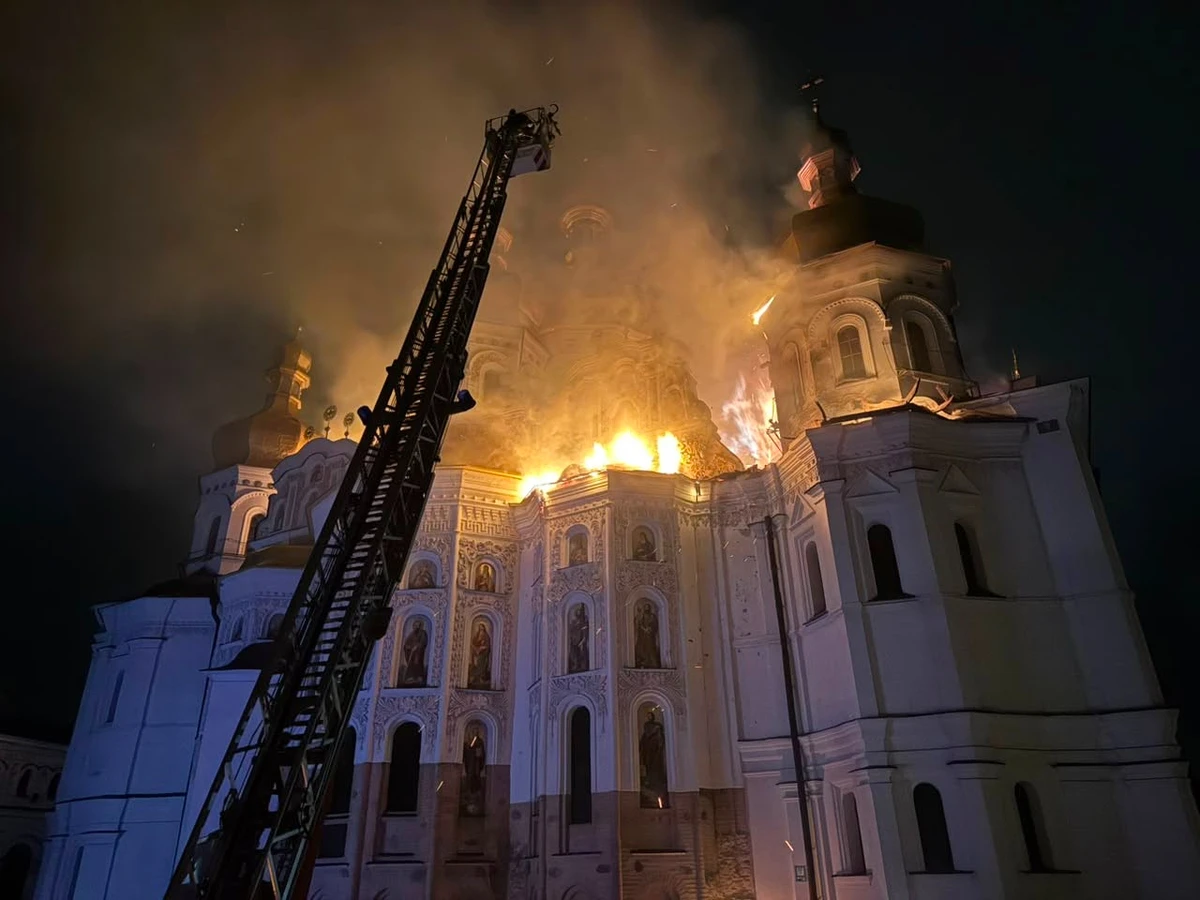
The attack killed at least nine people across Ukraine and caused a fire at the Dormition Cathedral within the Kyiv Pechersk Lavra, one of the country’s most important religious and cultural sites. Ukrainian authorities said Kyiv, Kharkiv and Dnipro were among the areas struck in a large-scale overnight attack involving missiles and drones.
For Ukraine, the immediate consequences were civilian deaths, damaged homes, power disruption and an attack on cultural heritage. For NATO, the operational signal came from Poland. Warsaw again activated aircraft and air-defence procedures as Russian long-range weapons moved through Ukrainian airspace close enough to NATO territory to require a live readiness response.
Poland’s response underlines how Russia’s attacks on Ukrainian cities also create immediate security consequences for NATO’s eastern border. The primary burden falls on Ukraine’s civilians, emergency services and air defenders, who face the missiles and drones directly. But each large strike also forces neighbouring NATO states to raise readiness, with radar operators, pilots, ground crews and air-defence units monitoring the border as a live warning zone rather than a passive line on a map.
Russia’s campaign continues to place Ukrainian civilians under nightly threat, while also forcing Ukraine’s air defenders to make impossible calculations under extreme pressure. Missiles and drones aimed at Ukrainian cities are first and foremost an attack on people, homes, energy systems, rescue workers and cultural sites. Yet the scale and direction of these attacks also create wider security consequences. Missile routes, drone trajectories, air-defence activity and falling debris can all affect neighbouring NATO members, especially Poland and Romania.
Defence Matters warned earlier this month that Russia’s mass strikes on Ukraine were renewing questions over NATO border air defence. The latest Polish scramble reinforces that point without changing the central reality: Ukraine is carrying the direct burden of Russia’s war. For NATO’s eastern flank, the issue is whether repeated large-scale attacks near Alliance territory require a more durable air-defence posture against spillover, miscalculation or technical failure.
Poland’s response reflects its position as one of NATO’s most exposed eastern-flank states and as a major transit route for support to Ukraine. When Russia launches large missile and drone attacks, Polish monitoring is not a procedural formality. It is part of a wider effort to protect national airspace, critical infrastructure, military movement and civilian areas close to the Ukrainian border.
The repeated activation of aircraft also shows how deterrence is maintained in practice. Air policing depends on trained crews, available aircraft, radar coverage, command decisions and clear rules of engagement. These measures are defensive and precautionary, but they still require resources and constant readiness.
For NATO planners, the issue is cumulative rather than dramatic. Russia does not need to target Polish territory directly for its attacks on Ukraine to affect eastern-flank security planning. Sustained strikes near NATO borders create recurring alert conditions and force allies to test whether their air-defence posture is strong enough for a prolonged war next door. The question is not whether Poland can respond once, but whether NATO’s eastern members have the depth, rotation capacity and layered defences required if such alerts become routine.
The reported damage to the Kyiv Pechersk Lavra gives the latest attack an additional dimension. The site is not only religiously significant; it is also part of Ukraine’s cultural identity and international heritage. Strikes that damage such sites raise the political temperature around the war, increasing pressure on European governments to strengthen air-defence assistance to Kyiv.
Kharkiv adds another grim layer. Ukrainian officials said emergency workers were killed after a second wave of attacks struck while rescue operations were under way. Such “double-tap” patterns deepen the argument that Russia’s air campaign is not confined to military targets, whatever Moscow claims about its objectives.
For NATO, the political challenge is to support Ukraine’s air defence while avoiding direct escalation. That balance has defined much of the Alliance’s war policy since 2022. But the more often Russian weapons push NATO border states into alert status, the harder it becomes to separate assistance to Ukraine from the defence of NATO’s own airspace.
The latest attack also strengthens the case for a more integrated eastern-flank air and missile defence posture. NATO already operates collective air-policing and air-surveillance arrangements, but Russia’s war has exposed the need for greater depth: layered ground-based systems, better drone detection, faster data-sharing and clearer procedures for ambiguous cross-border threats.
Ukraine remains the country intercepting Russian missiles and drones under direct attack, often with limited stocks and little margin for error. For NATO, the lesson is different but connected: large Russian strike packages can still create warning, tracking and spillover risks beyond Ukraine’s borders. Poland’s latest scramble shows that air defence on the eastern flank is no longer a distant contingency. It is part of the routine security environment created by Russia’s continuing war against Ukraine.
The strategic question is therefore not only how many missiles Russia fired, or how many Ukraine intercepted. It is how many times NATO border states can be forced into high-readiness air-defence cycles before the Alliance treats this as a sustained operational pressure campaign in its own right.
If Russia’s aim is to exhaust Ukraine, the side effect is to test NATO’s eastern edge. Poland’s response shows that the Alliance is alert. The harder question is whether it is configured for a war in which the border may remain under pressure night after night.


Britain’s Consistent Message on Ukraine Carries Growing Weight at the OSCE