The United Kingdom has unveiled three prototype long-range missiles for Ukraine that are designed without US components, in a move that reflects growing European concern over dependence on American-controlled defence technology.
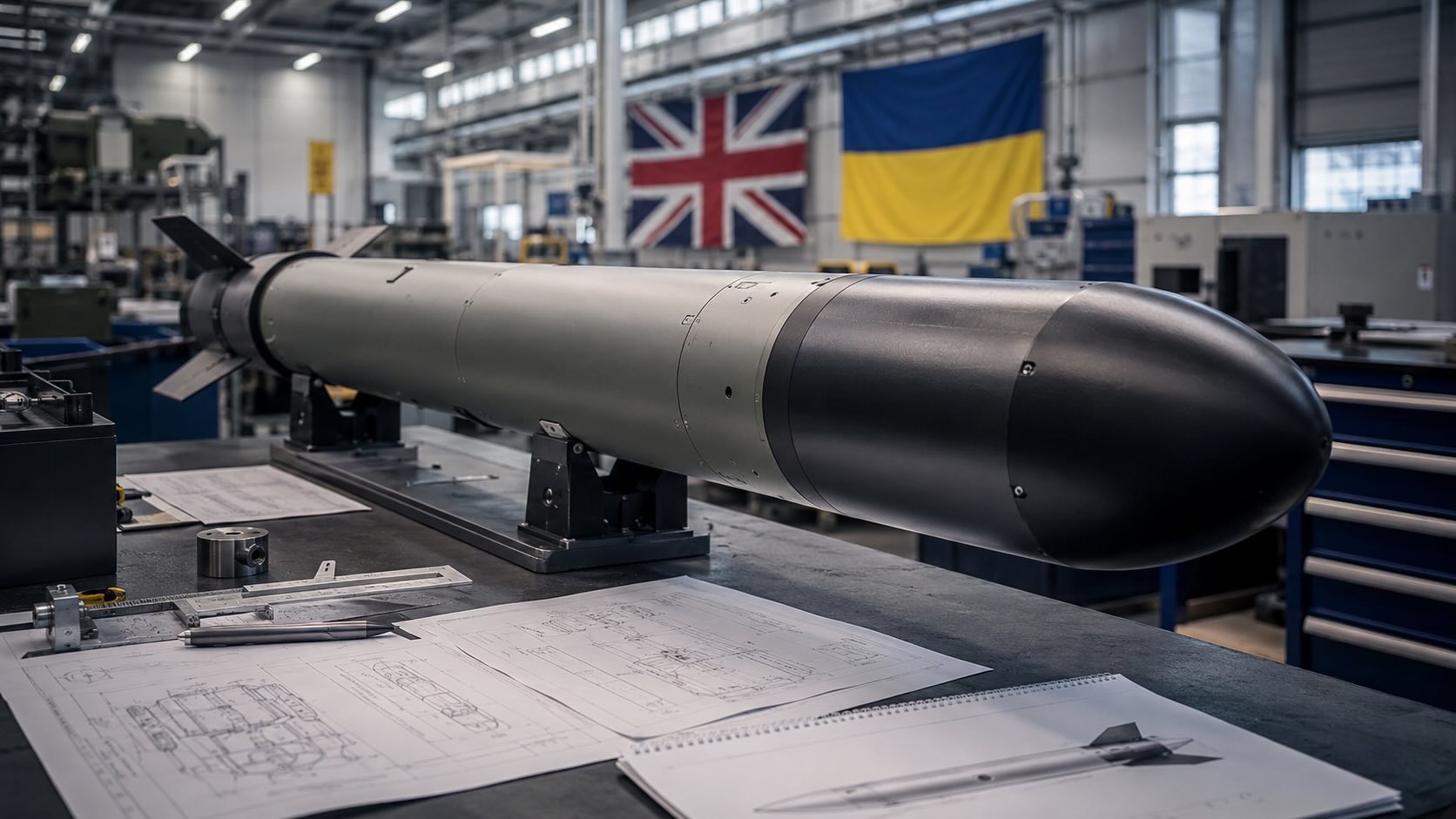
The systems have been developed under Project Brakestop, a British programme intended to produce lower-cost, ground-launched strike missiles for Ukraine at greater speed and in larger numbers than more complex Western weapons currently in service. The project involves MBDA UK, MGI Engineering and Rotron Aerospace, each of which has put forward a prototype.
The central feature of the programme is not only range or price. It is control. By designing missiles without US-origin components, Britain aims to avoid restrictions linked to American export-control rules, including the International Traffic in Arms Regulations, known as ITAR. Those rules can affect whether weapons containing US components may be transferred, modified, re-exported or used in certain ways.
That issue has become more important during the war in Ukraine. Western-supplied long-range systems have been subject not only to technical constraints, but also to political restrictions imposed by donor states. Decisions over the use of such systems against targets inside Russia have repeatedly been shaped by concerns over escalation, alliance management and national approval processes.
Project Brakestop is therefore more than another weapons-development effort. It is a response to a strategic problem: Ukraine needs deep-strike capacity at scale, while European governments want to supply weapons without depending on Washington’s authorisation at every stage.
The prototypes reportedly include MBDA UK’s Crossbow, MGI Engineering’s TigerShark and Rotron Aerospace’s SkyLance. They are designed to strike targets at ranges of more than 300 miles, carry heavy warheads and be produced at a lower unit cost than Storm Shadow, the air-launched cruise missile previously supplied to Ukraine by Britain and France.
The target price has been reported at around £400,000 per missile, far below the cost of high-end cruise missiles, although the new systems are not presented as direct equivalents. They are expected to be less sophisticated than Storm Shadow, but simpler to produce, easier to scale and better suited to a war in which magazine depth has become as important as individual weapon performance.
That distinction matters. Ukraine’s long-range strike campaign has placed increasing pressure on Russian fuel, logistics, air-defence and command infrastructure. But sustaining such operations requires weapons that can be produced in sufficient numbers. A limited stock of expensive precision missiles cannot meet every operational requirement in a prolonged war.
The British programme appears to be aimed at that gap. The Ministry of Defence has reportedly funded competing designs and tested them in the Hebrides, with a decision expected on which missile or missiles to buy. Production targets have been reported at about 20 units per month, with at least one system expected to reach Ukraine by the end of 2026.
For European defence planners, the significance is wider than Ukraine. The war has exposed the shortage of long-range fires, air-defence interceptors, ammunition and strike weapons across NATO’s European members. It has also shown that weapons designed for short campaigns and limited stockpiles are poorly matched to a high-intensity war of attrition.
The absence of US components in the new British missiles is part of a broader European shift towards sovereign or ITAR-free systems. This does not mean Europe can replace US technology across the defence sector in the short term. The United States remains central to NATO capability, from air defence and intelligence to aircraft, missiles and command systems. But the political and regulatory risks attached to dependence on US systems are now being designed into procurement decisions.
The issue has become sharper under President Donald Trump, whose administration has pressed European allies to take more responsibility for their own defence. European governments have also had to consider the possibility that future US decisions could delay or limit weapons transfers to Ukraine or other partners.
For Britain, Project Brakestop offers an opportunity to demonstrate that a faster acquisition model is possible. Rather than waiting years for a conventional procurement cycle, the programme has used a competitive process with several companies working in parallel. That approach may not work for every category of weapons system, but it reflects the pressure created by the war in Ukraine.
There are still unanswered questions. The prototypes must meet performance, reliability, guidance and production requirements. Lower cost may come with trade-offs in accuracy, survivability or warhead options. Ukraine will also need integration, targeting data, logistics support and training. A missile that is politically easier to transfer still has to be operationally useful.
Even so, the direction is clear. European support for Ukraine is moving from the transfer of existing stocks towards the development of weapons designed specifically for wartime production and political control by European states.
The British missile project does not remove Europe’s dependence on the United States. It does show that European governments are beginning to treat that dependence as an operational constraint rather than an abstract policy concern.
For Ukraine, the immediate value would be another source of long-range strike capability. For Europe, the larger lesson is that sovereignty in defence is not measured only by where a weapon is assembled. It is also determined by who controls the components, software, approvals and political decisions that decide whether that weapon can be used.