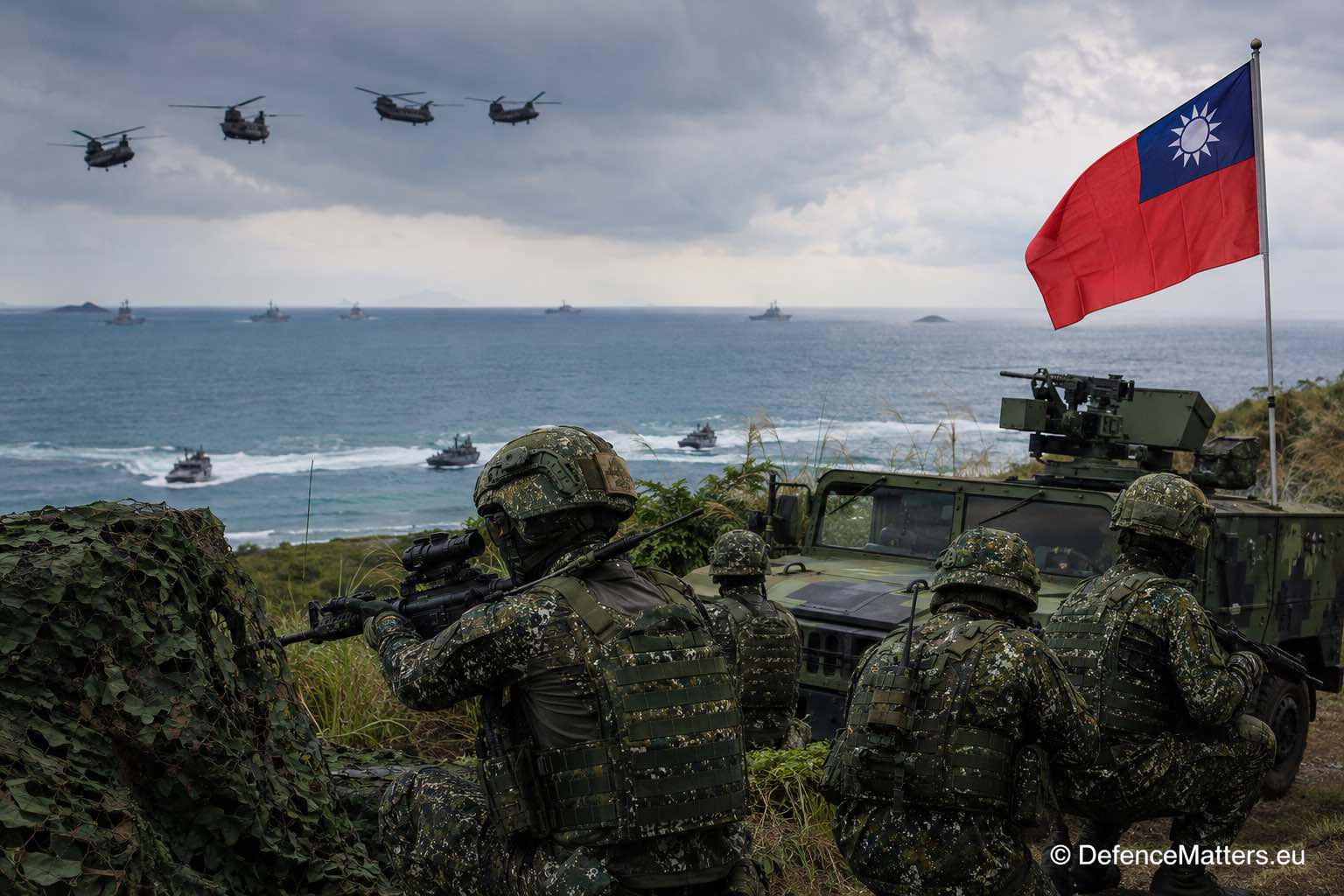
The exercise, described by Taiwan’s defence ministry as an “Immediate Combat Readiness Exercise”, will run from Monday through Friday and forms part of a broader programme aimed at making military training more realistic and operationally relevant. Rather than focusing on heavily scripted demonstrations, the drill is intended to prepare units for the rapid transition from peacetime conditions to active combat operations.
The change reflects growing concern in Taipei that the distinction between military exercises and military action is becoming increasingly blurred. Chinese aircraft and naval vessels now operate around Taiwan on an almost daily basis, creating a security environment in which a routine People’s Liberation Army exercise could, in theory, become something far more serious.
Taiwanese military planners have increasingly built exercises around precisely that scenario: the possibility that Beijing could transform one of its regular drills into an actual military operation with little advance warning. The latest readiness exercise is designed to test how effectively commanders and troops can respond under those circumstances.
According to the defence ministry, participating units will operate with real personnel, on actual terrain and using operational equipment. The emphasis will be on command-and-control procedures, logistics, deployment readiness and battlefield preparation rather than public displays of military hardware.
The announcement came as Taiwan reported another significant wave of Chinese military activity around the island. Officials said 21 Chinese aircraft had been detected, including fighter jets, airborne early-warning platforms and aerial refuelling aircraft. Nineteen of those aircraft reportedly flew into areas south-west of Taiwan before continuing into the western Pacific for long-range training operations.
Such incidents have become increasingly common. Beijing regards Taiwan as part of China and has never ruled out the use of force to achieve unification. Taiwan’s democratically elected government rejects Beijing’s sovereignty claims and maintains that only the island’s people can determine their future.
The evolving nature of Taiwan’s military training also reflects wider changes in regional security. Defence analysts have noted that recent conflicts, particularly in Ukraine, have reinforced the importance of readiness, resilience and rapid mobilisation. Taiwan’s leadership has increasingly sought to emphasise asymmetric capabilities, decentralised command structures and the ability to sustain operations during the early stages of a crisis.
These reforms are taking place against the backdrop of China’s continuing military modernisation programme. Beijing raised defence spending again in 2026 as it pursues long-term plans to transform the People’s Liberation Army into a world-class fighting force by 2035. Regional governments are watching those developments closely, particularly given the steady increase in Chinese naval and air operations across East Asia.
For Taiwan, however, the challenge is less about matching China’s military power than ensuring that any potential aggressor faces a credible and immediate response. The forthcoming readiness drill is therefore not merely another entry on the military calendar. It is part of a broader effort to convince both allies and adversaries that Taiwan can react quickly, maintain operational cohesion and withstand the crucial opening phase of any conflict.
Whether such preparations ultimately strengthen deterrence remains uncertain. What is clear is that Taiwan’s defence establishment increasingly views readiness not as an occasional exercise, but as a permanent requirement in an era when the line between peace and crisis appears ever thinner.
China and Taiwan’s Maritime Stand-off Signals a Dangerous New Phase