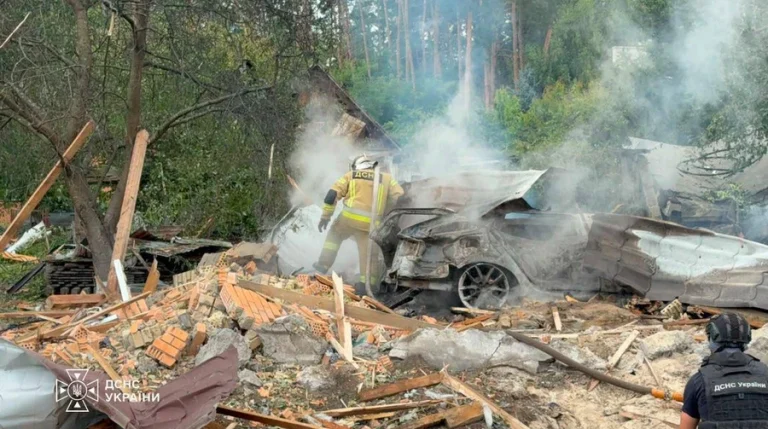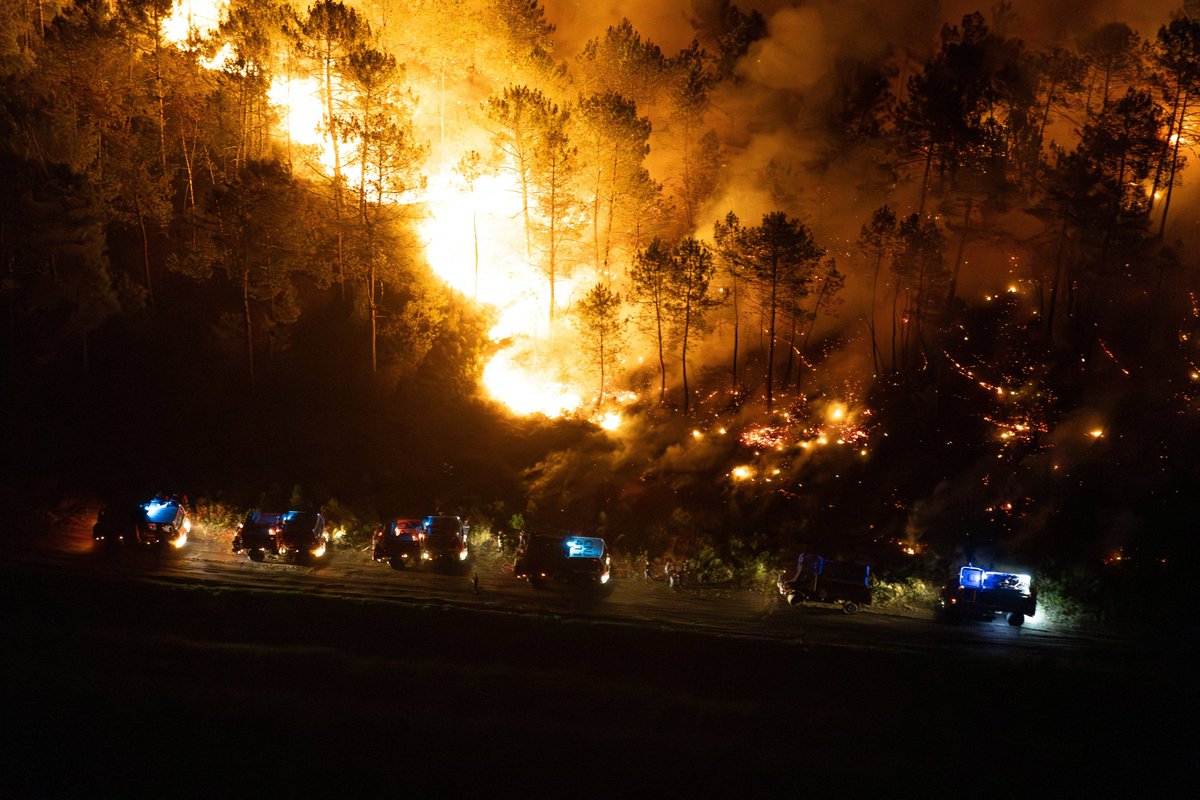
Fires west of Bordeaux have reached a region containing Rafale assembly, strategic-missile propulsion, rocket-motor plants and military test sites, exposing the geographical concentration of French defence production.
Wildfires around Bordeaux have forced precautionary measures at a concentration of industrial and military sites connected to the Rafale fighter, France’s M51 submarine-launched ballistic missile and rocket motors used in European missile programmes.
The immediate priority remains public safety. The fires have threatened communities, transport and emergency personnel across the Gironde department. Yet their proximity to nationally important factories and test facilities gives the disaster a defence-industrial consequence that extends beyond the burned area.
Defense News reported that sites affected by precautionary action include Dassault Aviation’s Rafale final-assembly operation, an ArianeGroup facility involved in propulsion for the M51, Roxel rocket-motor production and French military research or testing infrastructure.
None of that establishes that a major programme has been halted or damaged. Companies and state authorities have not published a common assessment of lost production. The important fact is the exposure: several capabilities of exceptional strategic value depend on facilities located inside the same fire-affected region.
Industrial clusters exist for good reasons. Skilled workers, suppliers, test ranges and specialist infrastructure are difficult to recreate. Locating related activities near one another shortens technical links and supports a labour market with rare expertise.
Bordeaux’s aerospace and defence sector reflects decades of investment. Dassault’s Mérignac operation sits within an ecosystem that supports aircraft assembly and testing. ArianeGroup and Roxel work with solid propulsion and pyrotechnic materials that require controlled sites, safety distances and specialised staff.
These facilities cannot be moved like ordinary office work. A rocket-motor plant depends on buildings designed for hazardous processes, certified equipment and a workforce trained to handle energetic materials.
Concentration therefore improves efficiency in normal conditions while increasing exposure to a regional disaster. A severe fire can affect roads, electricity, air quality and staffing even if flames never cross a factory perimeter.
The M51 is the missile carried by France’s ballistic-missile submarines and forms the sea-based core of the country’s independent nuclear deterrent. Work connected to its propulsion is not simply another aerospace contract.
France maintains deterrence through continuous readiness, planned missile evolutions and an industrial base able to sustain the system over decades. A temporary interruption need not affect deployed submarines, but repeated or prolonged disruption could complicate testing and production schedules.
Defence Matters has examined how France is strengthening its nuclear deterrent. The fires show that strategic independence also depends on the resilience of ordinary physical infrastructure surrounding highly protected programmes.
Security plans traditionally focus on espionage, sabotage and military attack. Climate-related hazards require different preparations: vegetation management, firefighting access, smoke protection, alternative power and safe shutdown procedures for hazardous processes.
Dassault is working through a large Rafale order book from France and export customers. Final assembly is only one stage, but disruption there can affect delivery timing across the chain.
Aircraft manufacturing is tightly sequenced. Fuselage sections, engines, radar, electronic systems and interiors arrive according to a production rhythm. If final assembly pauses, components accumulate upstream and later slots may be compressed.
A short closure may be absorbed through rescheduling. A longer interruption can be harder, particularly when the company is trying to increase output. Customers will want to know whether contractual milestones are affected, but premature estimates would be irresponsible until the fire risk stabilises.
Roxel’s importance is similarly wider than one site. Solid rocket motors feed missile programmes associated with MBDA and allied armed forces. European governments are already pressing industry to raise missile and air-defence production after years of limited peacetime orders.
A temporary loss of a specialist process can propagate through several programmes because alternative qualified sources may not exist.
Facilities handling propellant and explosive material cannot simply continue operating while a wildfire approaches. Shutdowns, evacuations and the movement of sensitive equipment may be necessary even when the probability of direct impact is low.
The safety margin should not be criticised as lost productivity. A fire reaching hazardous stock could endanger workers and firefighters and create a much longer industrial interruption.
The relevant question is whether continuity plans preserve critical data, tooling and work in progress. Companies should have protected backups, alternative storage and agreements with other sites for selected processes.
Complete duplication would be extraordinarily expensive. Resilience does not require a second copy of every plant. It requires identifying the processes whose loss would stop several programmes and creating proportionate alternatives.
European defence procurement increasingly discusses supply-chain resilience in terms of foreign components and geopolitical dependence. Extreme weather belongs in the same assessment.
Wildfire, flood and heat can close transport corridors, limit outdoor work and strain power systems. Suppliers may be affected even when prime contractors remain untouched.
EU Today has covered the Bordeaux and Spanish wildfire emergency and the challenge of shared European firefighting capacity. The defence-industrial angle is distinct but connected: civil-protection resources are also protecting the factories on which national security relies.
Military planners should not assume that defence sites receive unlimited priority. Firefighters must protect lives and communities first. Companies therefore need enough on-site prevention and trained personnel to reduce demands on public services.
Once immediate danger passes, the French government and companies should provide a factual assessment: which sites closed, for how long, whether equipment or stocks were moved and whether delivery schedules changed.
Sensitive details need not be published. Customers and parliament still require assurance that strategic programmes retain continuity.
The event should also prompt a map of correlated risk. If one fire zone contains aircraft assembly, missile propulsion, testing and military units, national resilience cannot be judged site by site.
The Bordeaux cluster is a strength of French industry. Its accumulated expertise supports exports, European missile production and the nuclear deterrent. The wildfires do not negate that advantage.
They reveal its physical condition. Strategic autonomy exists in factories surrounded by roads, power lines and forests. Protecting it requires treating natural hazards with the same seriousness as the hostile threats those factories were built to answer.