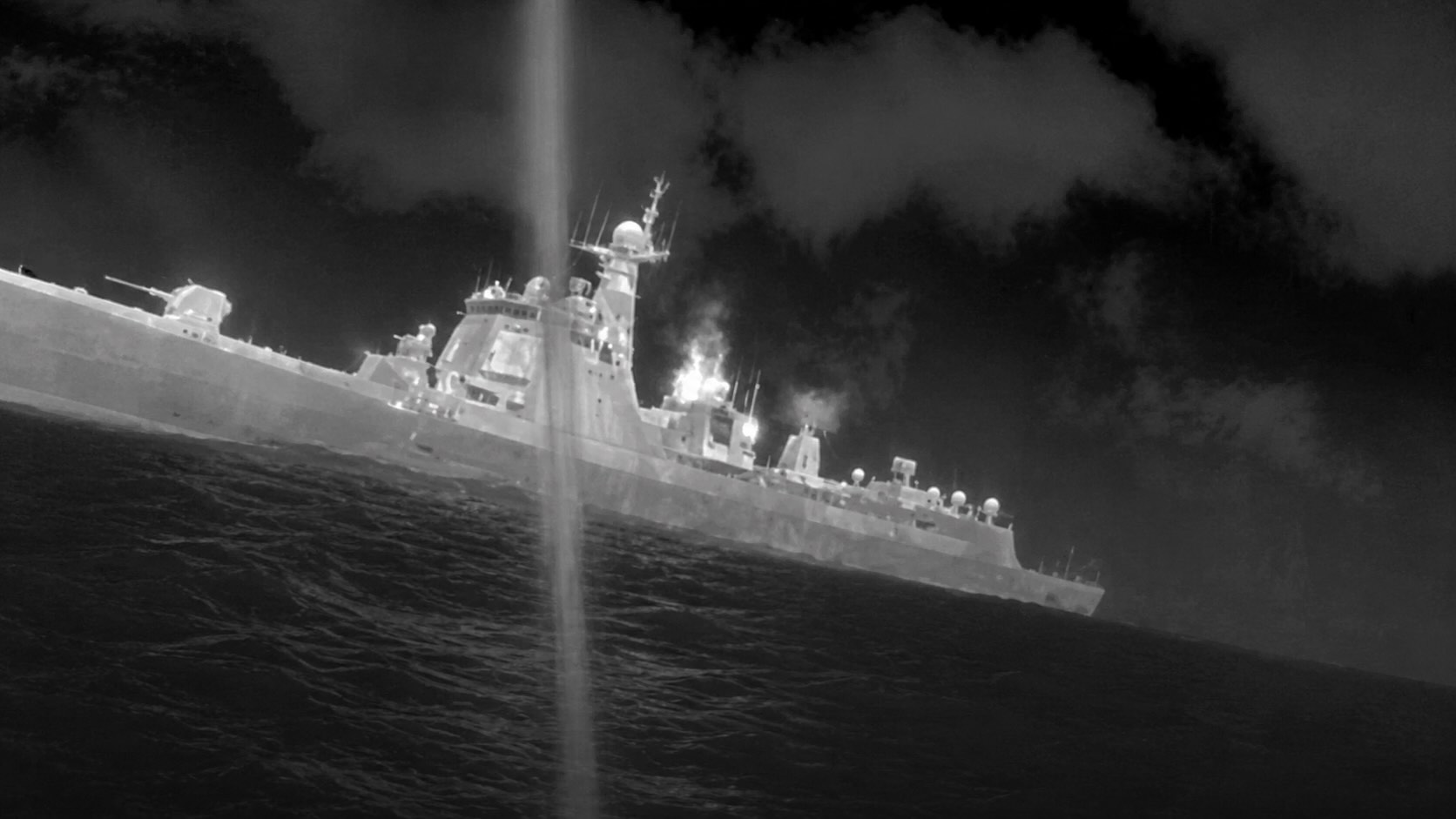
Verified footage of a commercial autonomous vessel near a Type 052D destroyer illustrates the identification problem created by cheap uncrewed craft.
A commercially available autonomous surface vessel recorded close-range images of a Chinese Type 052D destroyer in Philippine waters, demonstrating how an inexpensive uncrewed platform can approach a modern warship and collect useful information without resembling a conventional military threat.
The encounter occurred on 16 June, while the footage was publicly disclosed and independently verified on 29 July, according to Reuters. There is no evidence in the published account that the craft carried a weapon or that its operator intended an attack.
That caution does not reduce the operational significance. Naval crews increasingly encounter small autonomous or remotely controlled vessels that may be conducting legitimate survey work, collecting intelligence, testing reactions or carrying an explosive charge. The same external appearance can support very different missions.
The destroyer’s problem was therefore not simply detection. It was deciding what the vessel was, who controlled it and when its behaviour would justify intervention.
A Type 052D is a sophisticated air-defence destroyer equipped with phased-array radar and vertical-launch cells. Its systems are designed principally to detect and defeat aircraft, missiles, ships and submarines.
A small surface craft presents a different target. It sits close to sea level, may have little radar or thermal signature and can blend with fishing, research and recreational traffic. In crowded waters, treating every uncrewed vessel as hostile would be operationally and politically unsustainable.
Close imagery can still provide useful information. It may reveal weapons fitted, sensor condition, deck activity, course, formation and crew response. Repeated observations can help analysts identify operating patterns.
The platform does not need to survive long or carry an expensive sensor suite to create value. A commercial camera, navigation system and communications link may be sufficient for reconnaissance. If lost, the financial cost is small compared with deploying an aircraft or crewed ship.
The event therefore illustrates an asymmetry: a low-cost observer can oblige a high-value warship to reveal attention, manoeuvres or defensive procedures.
Navies traditionally rely on layers of awareness: long-range surveillance, escorts, helicopters, shipboard sensors and visual watchkeepers. Small autonomous vessels can move through gaps between those layers, particularly near coastlines and commercial traffic.
Detection must be followed by classification. Useful indicators include route, speed, communications behaviour, payload, response to warnings and whether the craft is operating inside a declared survey area.
Autonomy complicates the assessment. A vessel may continue on a programmed track when communications are lost, making it appear unresponsive. It may also alter course using onboard software without a human operator issuing each command.
Rules of engagement need to account for uncertainty. Waiting until hostile intent is obvious may leave too little time to respond. Acting early against a civilian craft can cause casualties, legal disputes or escalation.
Naval commanders require graduated options: electronic warnings, interception by a small boat or drone, jamming, entanglement, non-lethal disablement and, when necessary, gunfire. Using a major missile against a cheap surface vehicle would reproduce the unfavourable cost exchange already seen in air defence.
The location gives the incident an additional dimension. The South China Sea is contested, and Chinese naval and coastguard activity near the Philippines is closely watched by Manila and its allies.
Defence Matters has reported on joint US, Japanese and Philippine activity in the South China Sea. A small autonomous vessel operating in the same environment may be commercial, state-directed or somewhere between the two.
The proliferation of dual-use systems makes attribution harder. A government can purchase an off-the-shelf platform through an intermediary. A private operator can collect material later sold or shared with authorities. A vessel may begin a legitimate mission and drift into a sensitive encounter.
The published evidence does not establish who tasked the craft or whether the approach was deliberate. Analysis should not turn uncertainty into an accusation. The military lesson exists regardless of the operator: naval forces must assume that civilian technology can produce surveillance effects once reserved for states.
The fact that a craft obtained footage does not prove the destroyer failed to detect it. The crew may have tracked the vessel and judged that it posed no immediate danger. Its weapons and manoeuvres may not be visible in the recording.
The “gap” is more accurately understood as the space between awareness and proportionate action. A warship can know that a small object is present without having enough information or legal basis to destroy it.
Closing that gap requires better short-range sensing and command tools rather than indiscriminate exclusion zones. Electro-optical systems, compact radars, acoustic sensors and machine-learning aids can help compare behaviour against known patterns. Data from helicopters and friendly uncrewed systems can extend observation away from the hull.
Technology is only part of the answer. Crews need repeated training against ambiguous craft, including swarms and decoys. Bridge, operations-room and weapons teams must share a common picture and understand the escalation rules.
The vulnerability is not confined to a destroyer at sea. Naval bases, merchant anchorages and amphibious forces contain high-value targets in predictable locations.
Protective booms and patrol boats may stop a direct approach but do not prevent surveillance from outside the barrier. Jamming can interrupt remote control while leaving an autonomous craft unaffected. Broad electronic interference may also disrupt friendly and civilian systems.
Future task groups will probably use their own small drones to inspect other drones. An inexpensive interceptor can approach, identify and shadow a questionable vessel without immediately placing sailors in danger.
Standards for digital identity may help legitimate operators prove who they are, but hostile systems can spoof them. Behaviour will remain important.
The 16 June encounter should not be exaggerated into evidence that a Chinese destroyer was nearly attacked. The available information supports a narrower and more durable conclusion.
Commercial autonomous vessels can now travel far enough, navigate accurately enough and carry sensors good enough to create a military identification problem. They are accessible to governments, companies and individuals.
Modern warships were designed around threats whose military character was comparatively clear. The next force-protection challenge may arrive as ordinary marine equipment and disclose its purpose only at close range.
Navies need affordable ways to detect, classify and stop such craft without firing expensive weapons or treating every civilian system as an enemy. The footage matters because it records that problem in the real world: a low-cost platform reached observation range of a high-value combatant, and the line between harmless presence and hostile reconnaissance remained difficult to draw.