A five-day allied exercise has been followed by a Chinese naval and air patrol, linking coastguard confrontations to military signalling and increasing the need for both credible deterrence and reliable crisis control.
China has sent naval and air forces on a South China Sea patrol after the United States, Japan and the Philippines completed five days of combined maritime exercises, turning two military announcements into a connected sequence of operational signalling.
The exercise was the 17th Multilateral Maritime Cooperative Activity and ran from 21 to 25 July in Philippine waters. Reuters reported the allied deployment before a second Reuters account detailed China’s response. Beijing called its action a routine patrol, but its own military statement explicitly accused the Philippines of bringing outside countries into the dispute.
According to the Armed Forces of the Philippines’ account published by the Philippine News Agency, the allied serials included replenishment at sea, division tactics, officer-of-the-watch manoeuvres, deck-landing qualifications, vertical replenishment, cross-deck operations and coordinated fly-bys.
The inventory was more revealing than the choreography. The Philippines deployed the frigate BRP Antonio Luna, coastguard vessels, FA-50 fighters, A-29B light-attack aircraft, a TC-90 patrol aircraft, a C-208B surveillance platform and military helicopters. The United States contributed the littoral combat ship USS Santa Barbara, an MH-60S helicopter and a P-8A maritime patrol aircraft. Japan sent the destroyer JS Yuudachi.
This was not a force assembled for a single set-piece battle. It was a network for locating, identifying, communicating and sustaining operations across a disputed maritime space. That makes the exercise directly relevant to the confrontations that preceded it.
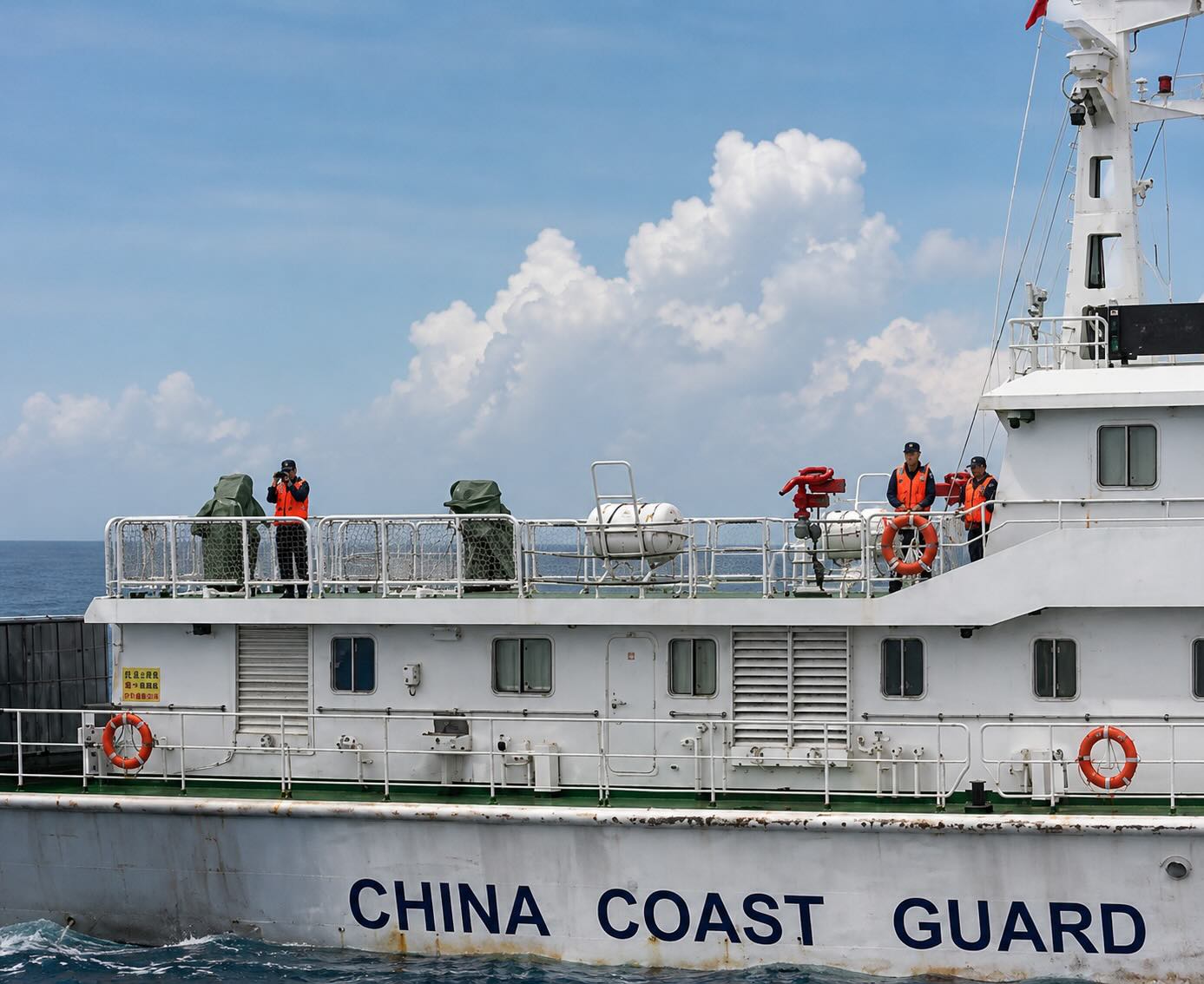
Chinese coastguard ships have repeatedly used water cannon, blocking manoeuvres and close approaches against Philippine vessels. In one July confrontation, Associated Press reporting described Chinese personnel using water cannon during a Philippine mission, part of a pattern in which dangerous coercion is applied below the threshold of conventional armed attack.
That threshold management is central to Beijing’s method. A grey-hulled naval attack on a Philippine warship would create an obvious alliance crisis. Pressure applied by coastguard, maritime militia or unarmed blocking vessels is harder to classify and therefore harder to answer proportionately.
The Philippine-US Mutual Defense Treaty still matters in this environment. Washington and Manila have publicly clarified that an armed attack on either side’s armed forces, public vessels or aircraft — including coastguard vessels — in the Pacific, including the South China Sea, would engage their treaty commitments. A 2025 Philippine government account of the alliance restated that scope.
Water cannon and ramming do not automatically produce a military response, however. The more useful deterrent is a ladder of options between diplomatic protest and war. The latest exercise helped construct that ladder.
A P-8A can provide a wide-area maritime picture. Philippine surveillance aircraft can maintain national custody of information. Warships can exchange tracks and manoeuvre as a group. Helicopters can move personnel or supplies when a surface route is obstructed. Coastguard vessels can remain the visible law-enforcement presence while naval units operate at supporting distance.
The exercise therefore rehearsed the architecture of a response without pretending every incident should be answered by force.
The People’s Liberation Army Southern Theater Command did not disclose the ships, aircraft, route or duration of its patrol. The absence of those details prevents a precise comparison with the allied force. It also gives Beijing flexibility: China can signal that it has answered the exercise without committing itself to a particular level of escalation.
The Chinese Ministry of National Defense published the Southern Theater Command’s statement, in which spokesperson Zhai Shichen said naval and air forces had conducted a “routine patrol”. He accused the Philippines of co-opting countries from outside the region and disrupting peace and stability.
The two descriptions are not mutually exclusive. The PLA conducts regular operations in the South China Sea, but the decision to announce this patrol on the day after the allied activity and to name the Philippines makes it a response. Routine presence is itself part of the competition: each side seeks to establish its operations as normal while describing the other’s as provocative.
This matters more than the number of ships immediately involved. An allied exercise can be scheduled, bounded and separated from an active confrontation. A responsive patrol narrows that separation. Naval and air forces are now being used to reinforce positions established by coastguards and diplomatic statements.
The operational risk depends on proximity. If the formations remain well apart, the principal effect is political. If maritime patrol aircraft, fighters or surface ships begin to monitor one another closely, misidentification and unsafe manoeuvring become more likely. The parties have not published enough positional information to establish which occurred in this instance.
China’s response also exposes a contest over audience. Beijing wants Manila to believe that outside support will produce counter-pressure rather than immunity. Manila wants China to understand that coercion against a Philippine public vessel will be observed and may involve several treaty partners. Washington and Tokyo want to demonstrate commitment without allowing every coastguard dispute to dictate military escalation.
The patrol therefore did not cancel the allied signal. It answered it with a warning that the PLA can shadow the developing network and place its own forces in the same strategic frame.
Japan’s participation also reflects a significant change in regional defence policy. Tokyo depends on sea lanes that pass through the South China Sea and has its own sustained dispute with China in the East China Sea. It has transferred coastal-surveillance radars and other equipment to the Philippines, negotiated a reciprocal access agreement and expanded defence cooperation with Manila.
The JS Yuudachi’s presence makes that cooperation tangible. A Japanese destroyer operating with a US ship and Philippine frigate demonstrates that the bilateral US alliance system is becoming more interconnected. It does not amount to an Asian NATO, nor does it create an automatic Japanese obligation to fight over every Philippine encounter. It does complicate an adversary’s calculation about which forces may be present and how information may be shared.
This networked approach was examined in EU Global’s analysis of Philippine maritime security, which argued that smaller states gain leverage when surveillance, law enforcement and defence partnerships reinforce one another. The July activity moves that logic from policy into practice.
Public attention tends to focus on ships sailing in formation. Replenishment, deck qualifications and cross-deck flying are less photogenic but more important. They determine whether a multinational group can remain on station, share facilities and recover from disruption.
Vertical replenishment tests the ability to move supplies without entering port. Cross-deck operations establish whether an aircraft and crew can safely use another country’s ship. Communications exercises reveal whether classifications, data links and command procedures can be reconciled under pressure. These are the details that distinguish a political appearance from a usable coalition.
There are still substantial limitations. The Philippine Navy and Coast Guard must cover a vast area with a relatively small fleet. Littoral combat ships bring speed and aviation facilities but have limited endurance and survivability in a high-intensity contest. Japan’s rules on the use of force remain politically and legally constrained. Information sharing may also be slowed by incompatible systems and national restrictions.
Most importantly, exercises cannot remove the strategic dilemma created by calibrated coercion. If allied forces accompany every Philippine resupply mission, China can accuse Manila of militarising the dispute. If they remain too distant, their treaty commitments may appear abstract. The answer is unlikely to be permanent escort by foreign warships. It is persistent awareness, rapid consultation and a graduated set of national and allied responses.
The three governments must now turn the exercise into standing procedures. They need agreed channels for verifying an incident, preserving sensor evidence, attributing responsibility and deciding which authority — coastguard, navy or political leadership — responds first. They also need contingency plans for casualties or a disabled vessel, when the time available for deliberation will be short.
Regular activity brings its own risks. More aircraft and ships operating in proximity create more opportunities for collision or misreading. Professional seamanship and direct crisis communications with China are therefore not concessions; they are part of deterrence.
The July drills sent a firm signal, and China’s patrol confirmed that the signal was received. The value of the allied activity lies beneath the formation photographs: it showed how a Philippine encounter could be observed by several countries, supported by several services and sustained without immediately escalating to combat.
In the South China Sea, credibility depends on demonstrating both capability and control. The exercise advanced the first; the Chinese response made the second more urgent. The harder task is ensuring that, in the next confrontation, all sides can distinguish a controlled signal from the opening movement of a fight.